
Winter Break Revision Plan for UAE Students: How to Rest, Reset and Be Ready for the New Term
UAE winter break runs 14 December to 3 January. Here is a realistic three-week revision plan for IGCSE and A-Level students, with rest built in, so the new term starts well.

It is the last day of term in Dubai. A Year 11 student walks in with a bag of revision packs and a mock timetable for the new year. The family flies out on the 22nd and returns on the 2nd.
Her mother has a plan: three hours every morning. Her daughter has a different one: “It's a holiday. I'm doing nothing.”
Both are partly right. Three weeks off is a real break, and she has earned it. But the weeks after it are short, mocks are coming, and a student who does nothing at all for 21 days returns to topics that have faded.
This guide offers a middle path: a realistic three-week plan, built around the UAE calendar, that fits around travel and takes the argument out of the break.
The dates: this winter break is shorter
Under the UAE Ministry of Education's three-year calendar, the 2026-27 winter break runs from Monday 14 December 2026 to Sunday 3 January 2027, with students returning on Monday 4 January 2027. That is 21 days, a week shorter than last year's four-week break (8 December 2025 to 4 January 2026). The spring break has also been trimmed to one week, from 5 to 11 April 2027, and the school year ends on 2 July 2027.
Most private schools follow this calendar, but some differ, so check your own school's dates.
| When | What happens | Why it matters |
|---|---|---|
| 14 Dec to 3 Jan | Winter break (21 days) | The longest window for focused catch-up in the school year |
| From 4 Jan | Term resumes. Mocks at many schools fall in January or February, but dates vary | Results can feed predicted grades and tier decisions (see our guide to UAE mock exams) |
| Around 8 Feb to early Mar | Ramadan is expected, subject to moon sighting | Routines shift, sessions get shorter |
| 5 to 11 Apr | Spring break (one week) | Too short for a big catch-up |
| May to June | Main IGCSE and A-Level exam series | The break is the last long stretch before the run-in |
Rest is part of the plan
Many families treat revision and rest as opposites. They work together.
A rested brain remembers better. Sleep is when recently learned material is reactivated and stabilised, as we explain in Sleep and Memory. A student who spends the break exhausted, or who treats it as a sprint, undermines the very thing they are trying to build.
Doing nothing for three weeks has a cost too. Memory fades without use. Research on distributed practice, including a large review by Cepeda and colleagues, finds that revisiting material in spaced sessions supports long-term retention better than one block of study. For a three-week break, that means little and often is more effective than nothing, and far more effective than one marathon day.
The aim is the smallest amount of work that makes a difference, placed where it counts, with the rest left alone.
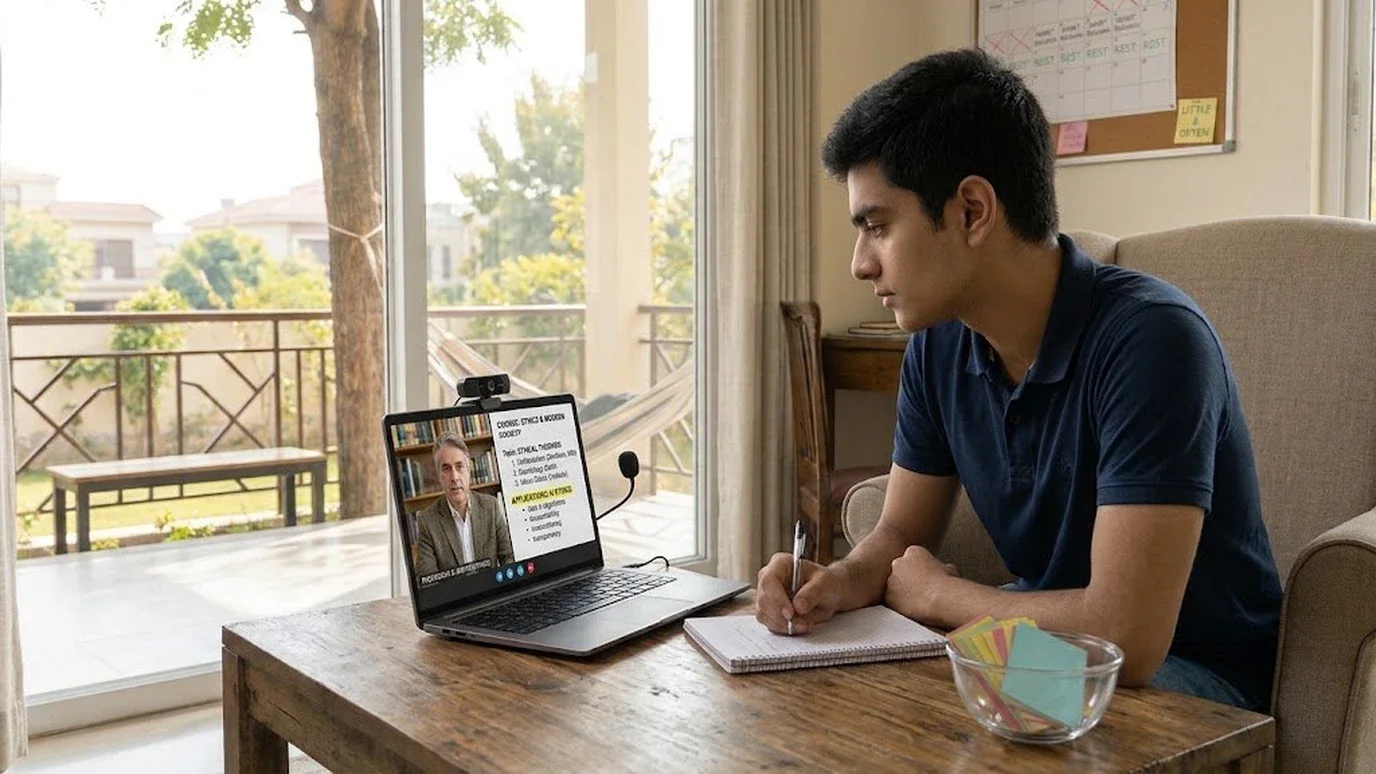
The Reset, Repair, Rehearse plan
Think of the break as three weeks, each with a different job.
| Week | Job | What to do | Time |
|---|---|---|---|
| Week 1 (Mon 14 to Sun 20 Dec) | Reset | A few days of proper rest and normal sleep. Gather marked papers and the mock topic list. Sort topics into red, amber and green (section 04). Two or three gentle recall sessions. | 3 sessions, 20 to 30 min |
| Week 2 (Mon 21 to Sun 27 Dec) | Repair | Work on the red topics: close the book, write what you remember, check against notes, fix the gaps, and record mistakes. Keep at least one full day of no revision. | 4 sessions, 45 to 60 min |
| Week 3 (Mon 28 Dec to Sun 3 Jan) | Rehearse | Mixed recall across topics, then one timed section or paper in exam conditions (correct board and tier), marked honestly. Move to school-day sleep times from about 1 January. | 3 sessions, about 60 min, one of them timed |
For a Year 11 or Year 13 student, that comes to roughly 8 to 10 hours across three weeks, far less than most families fear, but spread so that it works.
How much, by year group. These are starting points, not rules. If your school has set holiday work, do that first.
| Year group | Suggested total across the break | Focus |
|---|---|---|
| Years 7 and 8 | Light: reading and a few short tasks | Keep curiosity alive. No formal revision needed |
| Years 9 and 10 | About 3 to 4 hours | Fill gaps from term 1 and build the habit (see GCSE & IGCSE revision tips) |
| Year 11 | About 8 to 10 hours | Mock topics, weak areas, one timed section |
| Year 12 | About 6 to 8 hours | Consolidate term 1 content and any set coursework |
| Year 13 and IB Diploma | About 10 to 12 hours, plus coursework or IA deadlines | Mock preparation alongside applications and coursework |
Reset, Repair, Rehearse (14 Dec to 3 Jan)
Reset
Proper rest and normal sleep. Gather marked papers and sort topics into red, amber and green.
Repair
Active recall on red topics with the book closed, check against notes, fix gaps and log mistakes.
Rehearse
Mixed recall across topics, one timed section in exam conditions, and shift to school sleep times.
Choosing what to revise
Revising “everything” is how a break turns into nothing. Pick based on evidence, not mood.
Gather the evidence:
- The last marked papers and mock results
- The most recent report and teacher comments (our guide to reading a UAE report card helps)
- The mock topic list, if the school has issued one
- The exam board, specification and tier for each subject
Sort each topic into three colours:
Red, Amber and Green Topic Sort
Cannot do it without notes, or loses marks here repeatedly
Can do it slowly, or with errors
Confident, accurate, quick
| Colour | Meaning | What to do |
|---|---|---|
| Red | Cannot do it without notes, or loses marks here repeatedly | Revise first, and revisit at least twice during the break |
| Amber | Can do it slowly, or with errors | One session each, then mark and log mistakes |
| Green | Confident, accurate, quick | A quick recall check only |
Put the highest-mark red topics first. Students naturally start with the topics they enjoy. A break plan works best when the first sessions go to the topics that are both weak and heavily marked.
If you are not sure which topics those are, a conversation with the subject teacher is the quickest route. Our guide to parent-teacher meeting questions shows what to ask.
Methods that work in a holiday
Time is short, so choose methods that give the most for the least.
Recall before re-reading. Close the book and write everything remembered about a topic, then check what was missed. Testing yourself improves long-term retention more than rereading, as Roediger and Karpicke showed, and the evidence reviewed by Dunlosky and colleagues rates it as a high-utility technique. Our guide to The Illusion of Competence explains why highlighting and rereading feel productive but do little.
Space it. Return to each red topic at least twice across the three weeks, rather than doing it once and moving on.
Mark honestly, and log mistakes. Use the mark scheme, and note the first incorrect step in each error. Our guide to silly mistakes in maths exams shows a simple error log.
Save the timed paper for week 3. Past papers work best once the weak topics are repaired, which is why past papers are the final step, not the first. Use the correct board and tier.

If you are travelling
Most UAE families travel at least part of the break. Plan around it, rather than pretending it will not happen.
| Your situation | Plan |
|---|---|
| Staying in the UAE | Use mornings for revision, before the day's activities. Two or three blocks a week is enough. Do the full three-week plan |
| Away for about a week | Do Week 1 before you leave and part of Week 2 or 3 when you return. While away, one 20-minute recall session a day on a notebook or phone flashcards, with no heavy books |
| Away for most of the break | Minimum plan: three 20 to 25-minute recall sessions a week, plus one 45-minute session in the last three days. Return to school-day sleep times before you fly back, if you can |
| Anywhere with a stable connection | Online 1-to-1 sessions can continue from wherever you are. Check your tutor's availability and time zones |
Do not pack every textbook. A single folder holding the priority topics and a few marked papers is enough, and it avoids the guilt of a bag full of unopened books.
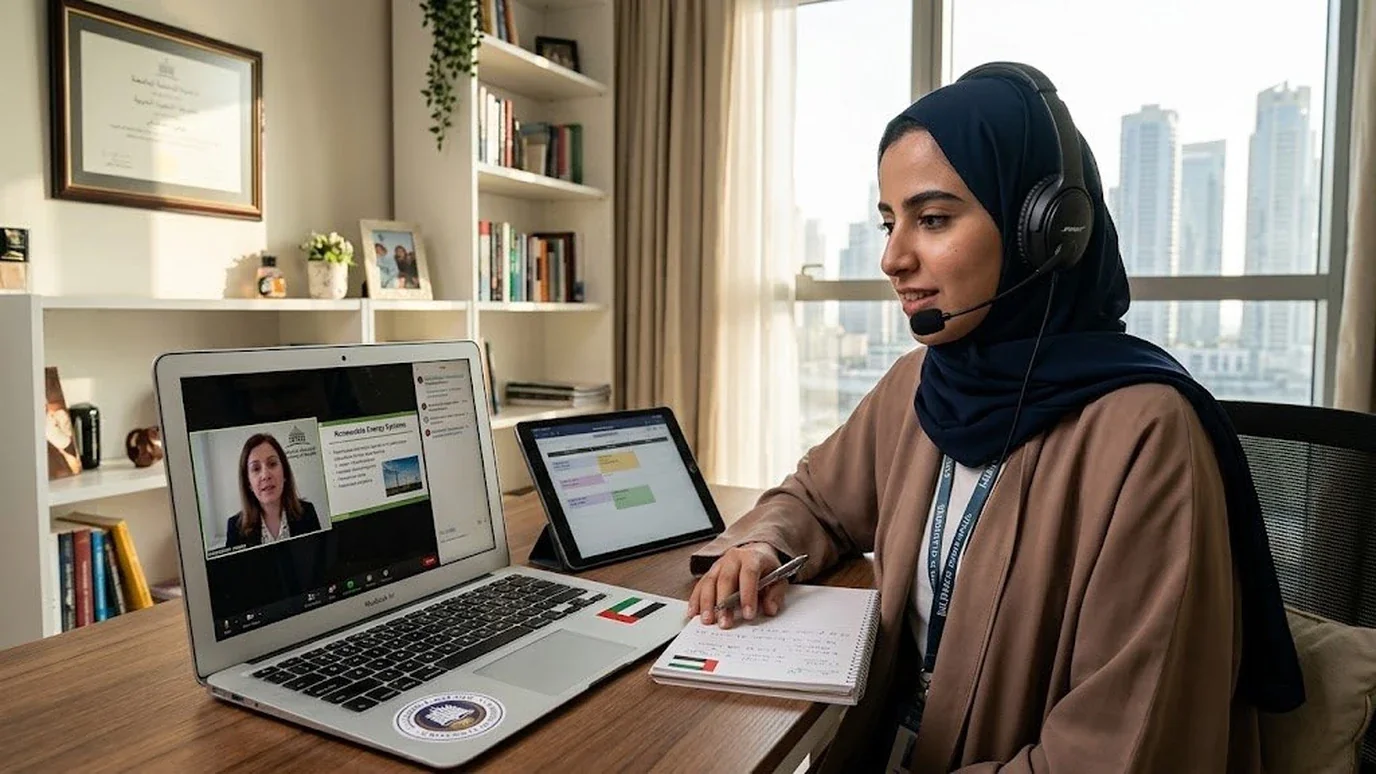
Keeping it a holiday: the family agreement
The best break plans are agreed together, not imposed. A five-minute conversation before the break saves a fortnight of arguments.
| Agree on... | For example |
|---|---|
| The revision window | “10:00 to 11:00 on Tuesday, Wednesday, Thursday and Sunday” |
| The minimum | “Three 25-minute recall sessions in week 1” |
| Protected rest | “Fridays and any day we are out all day” |
| The phone | “In the hallway basket during sessions” |
| The check-in | “Sunday evening, ten minutes: what did you do and what's next?” |
Fixing the window in advance helps. Research by Gollwitzer and Sheeran shows that specific if-then plans, such as “If it is 10:00 and breakfast is done, I sit down at the desk”, make follow-through far more likely than good intentions. If starting is the hard part, our guide to why teenagers procrastinate on revision explains how to make the first step small.
What to say:
| Instead of... | Try... |
|---|---|
| “You'll revise every day, no exceptions.” | “Let's agree three or four short sessions and protect the rest.” |
| “You've done nothing all week!” | “What's one 25-minute thing you could do before lunch?” |
| “Your friends are all revising.” | “What would make this break feel balanced for you?” |

Getting ready for the first day back
The break ends on Sunday 3 January, and school restarts on Monday 4 January. A rough first week can undo some of the break's value, so plan the landing.
- Shift sleep gradually. Move wake-up times earlier by 15 to 30 minutes a day over the last three or four days, so Monday is not a shock.
- Pack the bag the night before, with the timetable, charged devices and any holiday work.
- Ask about the mock timetable and the topics to be covered, if you have not already.
- Plan the first week lightly. One short recall session a day, and an early night.
Think ahead to Ramadan. It is expected to begin around 8 February, subject to moon sighting. The weeks between early January and then are the best time to build a steady routine before sessions shorten. Our guide to Sleep and Memory has practical advice for revising around Ramadan.
When the break shows a bigger problem
A holiday sometimes makes a problem visible. Signs worth acting on:
- A student cannot do the “red” topics even with notes open
- They avoid starting for days despite a small, agreed plan
- Panic or tears around a particular subject
- The same errors keep appearing in marked work
Acting early helps. A few weeks before mocks is a good time to ask for help, not the week after the result. Speak to the subject teacher, and if the gap is specific, a short, targeted block with a tutor can help. Our private tutoring guide explains how to decide, and 10 honest questions to ask before hiring a tutor shows how to choose.
Frequently asked questions
Sources and further reading
UAE Ministry of Education: Academic calendar for public and private schools, 2026-27 to 2028-29 (winter break 14 December 2026 to 3 January 2027, spring break 5 to 11 April 2027).
Gulf News: UAE approves school dates for 2026-2029 across public and private sectors, and UAE school calendar 2026-2029: holidays and key exceptions explained.
Cepeda, N. J., Pashler, H., Vul, E., Wixted, J. T., & Rohrer, D. (2006). Distributed practice in verbal recall tasks: A review and quantitative synthesis. Psychological Bulletin.
Roediger, H. L., & Karpicke, J. D. (2006). Test-enhanced learning: Taking memory tests improves long-term retention. Psychological Science.
Dunlosky, J., Rawson, K. A., Marsh, E. J., Nathan, M. J., & Willingham, D. T. (2013). Improving students' learning with effective learning techniques. Psychological Science in the Public Interest.
Diekelmann, S., & Born, J. (2010). The memory function of sleep. Nature Reviews Neuroscience.
Gollwitzer, P. M., & Sheeran, P. (2006). Implementation intentions and goal achievement: A meta-analysis of effects and processes. Advances in Experimental Social Psychology.
Want a break plan built around your child's mock topics?
Every first Ustaad lesson starts with 15 free minutes to pinpoint the gaps and agree where to focus next. Sessions are online and 1-to-1, for families in every emirate, so they can continue from wherever you spend the break. No commitment. Cancel anytime.
Nimra Shahzada writes about the study problems UAE parents see at home: children who revise for hours but still lose marks, homework that never gets finished, and exam stress that builds before mocks.
Ustaad Editorial Team. Every guide is checked for accuracy and parent clarity before it is published.