


Ask a student why they feel ready after 15 hours of revision, and they will show you their colour-coded notes. Ask an examiner why that same student dropped 25 marks, and they will point to retrieval failure.
Every exam season in Dubai, Abu Dhabi and Sharjah, the same story repeats. A conscientious student spends the weekend highlighting chapters, rewriting summaries and producing beautiful flashcards. They walk into the exam hall feeling prepared. Then question 4 arrives, and the page in their head is blank.
This is not laziness, and it is not a lack of intelligence. It is one of the best-documented traps in the psychology of learning: the illusion of competence. This article explains why it happens, how to spot it early, and what UAE students can do instead.
Recognition is not recall
Your brain does two very different things with information:
Recognition
What happens when you look at a page and think, "Yes, I know this." The information is in front of you, and your brain matches it to something familiar.
Recall
What the exam demands. There is no page. You must generate the concept from scratch, under time pressure, in response to an unfamiliar question format.
Perceptual Recognition vs Independent Neural Recall
Figure 1: Recognition relies on external cues, while recall builds self-contained neural pathways.
Re-reading trains recognition. Exams test recall. A student can be excellent at the first and still fail at the second, and they will not find out until it is too late to fix.
The neuroscience of "fluency" vs "mastery"
When you re-read a chapter for the third time, it feels easy. The words flow, the diagrams look familiar, and nothing surprises you. Psychologists call this fluency, and the brain treats it as a signal: this feels easy, therefore I must know it.
That signal is unreliable. Ease of processing tells you the material is familiar. It does not tell you that you can retrieve it, apply it, or explain it. The student is mistaking visual familiarity for understanding.
| Stage / Dimension | The Passive Reader | The Active Retriever |
|---|---|---|
| Method | Highlights, re-reads, admires the notes | Closes the book and writes from memory |
| At Home | Feels around 90% prepared | Feels uncomfortable, stumbles, spots gaps |
| In the Exam Hall | Blanks on question 4 | Recalls under pressure and scores well |
| What They Trained | Recognition (Passive) | Retrieval (Active) |
The uncomfortable feeling is the point. Struggling to remember is not a sign that revision is failing. It is the exact biological mechanism by which memory is built.
Why highlighting and summarising often backfire
Many UAE students invest serious effort in their notes: coloured pens, neat headings, consistent layouts. The effort is real, but the return is poor, because the work is largely copying and organising rather than remembering.
The most cited evidence here is Dunlosky and colleagues' 2013 comprehensive review of ten common learning techniques. It rated highlighting, re-reading and summarising as low-utility strategies, while practice testing and spaced practice came out as high-utility. In other words, the methods students prefer are often not the methods that work.
The reason connects to psychologist Robert Bjork's idea of desirable difficulty. Learning that feels effortful in the moment tends to last longer than learning that feels smooth. Low-effort habits produce a pleasant feeling of progress and very little durable memory. Higher-effort habits feel slower and more frustrating, and they are the ones that survive the exam.
This is also why past papers are best used at the right point in the cycle, not as a first step. We cover that in our guide on IGCSE Preparation: Why Past Papers Are the Final Step.
The 3 warning signs of false revision competence
Parents and students can catch the illusion early if they know what to look for:

Sign 01: "I know it when I look at the answer."
If a student says they understood everything once they saw the mark scheme, that is hindsight at work. Once the answer is visible, it feels as though they always knew it. The real test is whether they could have produced it beforehand on a blank page.
Sign 02: Revision without friction.
If revision feels smooth, calm and pleasant throughout, memory is probably not consolidating. Some struggle, hesitation and error should be part of every good session.
Sign 03: Chapter-order dependence.
Some students can only solve problems when they are guided by textbook headings or when questions arrive in the order they were taught. Real exams mix topics freely. If a student cannot identify which topic a question belongs to, they have learned the content but not the retrieval.
The working memory breakdown in STEM and humanities
The illusion of competence rarely announces itself at home. It shows up in the exam hall, in different ways depending on the subject:
In Maths and Physics: Students often recognise the formula on a formula sheet but cannot tell when to apply it in an unfamiliar word problem. They know the tool but not the situation it fits. This is explored in more depth in our article on Why IGCSE Physics Formulas Stop Working in Exams.
In Biology, Chemistry and Humanities: Students memorise keywords and definitions but cannot organise them into a logical, structured argument. A 6-mark question does not reward a list of terms; it rewards an uninterrupted chain of reasoning, which only forms through practice retrieving and connecting ideas. See our guide on Why IGCSE Biology Students Lose Marks on 6-Mark Questions for a closer look.
In both cases, working memory is overloaded because the knowledge has not been practised enough to become automatic. Under exam pressure, a student who has only recognised material has nothing reliable to draw on.
Why Passive Review Fails Under Exam Conditions
Passive Recognition Path
External visual cues (highlighter, textbook page, open mark scheme) simulate understanding. Without cues in the exam hall, the pathway breaks down.
Active Recall Path
Internal retrieval cues are forged through closed-book testing, self-explanation, and practice drills. The memory schema is self-sufficient.
The 3-Step "Blurting" Gap Analysis Method
Learn & Close
Review topic for 10 mins. Then close all notes, screens, and textbooks completely.
5-Min Brain Dump
On a blank paper, write every formula, definition, and mechanism recalled in black ink.
Red-Pen Audit
Reopen book. Add missing parts in red ink. The red points become your true revision target.
Figure 2: Active retrieval practice under low-stakes conditions transforms fragile recognition into automatic recall.
The "retrieval practice" antidote: a 4-step home protocol
The fix does not require more hours. It requires changing what those hours contain:
The 4-Stage Memory Consolidation Cycle
How effortful retrieval converts short-term recognition into resilient exam recall
Initial reading & concept structuring
Forgetting curve creates necessary friction
Blank-page testing & mental reconstruction
Neural pathway reinforced for exam pressure
Brain Dumps (Blurting)
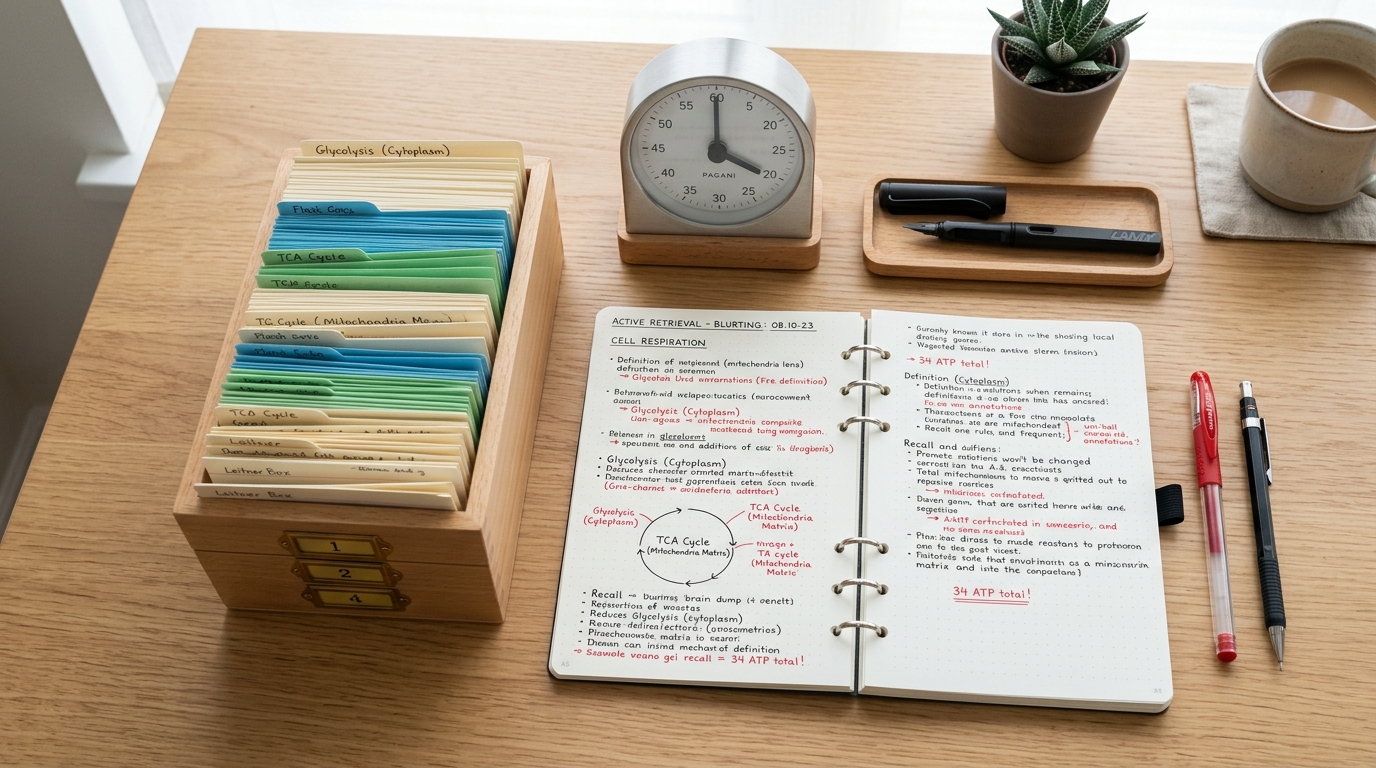
After reading a topic, close the book. On a blank page, write down everything you can remember. Then open the notes and mark what you missed in a different colour. The gaps you find are your real revision list.
The Feynman Technique
Pick a tricky concept and explain it out loud, in plain English, as if teaching a younger student. Wherever you stumble or reach for jargon, you have found a weak spot.
Interleaving
Instead of doing an hour of one topic, mix several topics in a session. It feels harder and less tidy, but it trains the skill exams actually test: deciding which method a question needs.
Leitner Box Flashcards
Sort cards into boxes by how well you know them. Correct answers move to a box reviewed less often; wrong answers return to box 1. Time goes to weak cards, not the comfortable ones.
The Leitner Spaced-Box Protocol
New & missed cards requiring daily recall
Partially retained cards under consolidation
Mastered concepts checked weekly for decay
Permanent recall items verified before test
Spacing these sessions over days and weeks, rather than cramming, strengthens all four steps.
How parents can spot the illusion early
"Did you finish revising?" is the wrong question. A student can answer yes and still be caught in the illusion. Better questions test retrieval directly:
- "Can you teach me question 3 without looking at the textbook?"
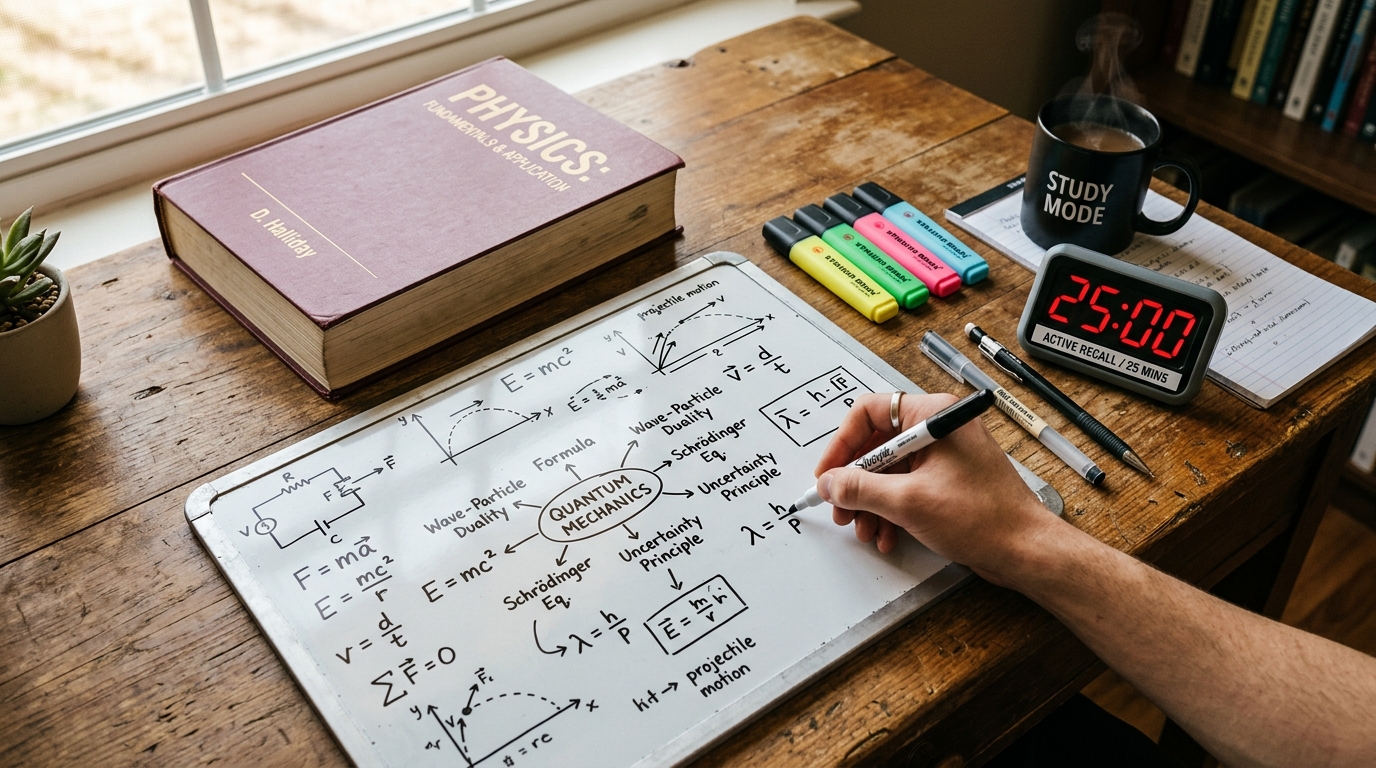
- "Can you do this problem on a blank whiteboard with a 5-minute timer?"

Kitchen-Table Revision Diagnostic: What to Ask
Measures time and task completion rather than recall strength. Encourages passive checklist ticking.
Forces Feynman-style verbal retrieval. Reveals hesitations and conceptual gaps within 90 seconds.
Simulates true exam hall constraints without cues, building resilience and authentic exam stamina.
Figure 3: Kitchen-table check-ins work best when parents ask for blank-page explanations rather than checking hours spent.
If the answer is hesitant, that is useful information, and it arrives while there is still time to act.
Do not measure revision by hours or by how neat the notes are. Measure it by what your child can produce from a blank page. A student who struggles at the kitchen table in February is far better placed than one who feels confident and has never been tested.
Frequently asked questions
Sources and further reading
- Dunlosky, J., Rawson, K. A., Marsh, E. J., Nathan, M. J., & Willingham, D. T. (2013): Improving Students' Learning With Effective Learning Techniques: Promising Directions From Cognitive and Educational Psychology. Psychological Science in the Public Interest.
- Bjork, R. A. & Bjork, E. L.: Desirable Difficulties in Learning and Memory Consolidation. University of California, Los Angeles (UCLA).
- Exam Stamina: Why Your Child Can't Sit the Full Paper: How to build cognitive endurance for long exam sessions.
- IGCSE Preparation: Why Past Papers Are the Final Step, Not the First: Sequencing concept mastery before practice testing.
Related Guides on Learning & Exam Performance
IGCSE Preparation: Why Past Papers Are the Final Step, Not the First
How to sequence concept mastery, topic drills, and timed endurance so practice papers build real exam technique.
Psychology of LearningExam Stamina: Why Your Child Can't Sit the Full Paper
Why unbroken focus breaks down halfway through a paper and how to build cognitive endurance before exam season.
Academic & Exam SkillsWhy Students Forget Chemistry So Quickly
Why chemistry fades from memory, and the visual, spaced habits that make formulas and bonding stick.
Psychology of LearningYour Child Understands Physics. So Why Are the Marks Still Low?
The gap between understanding and exam performance: retrieval, working memory overload, and nerves.
Study Skills & Learning Specialist
Nimra writes on study technique, memory consolidation, and exam preparation for British and IB curriculum students across the UAE.
MPhil in Education Leadership and Management
Nida checks each guide for accuracy, educational validity, and parent clarity before it is published. See how our editorial review works.
Pinpoint where your child's revision is leaking marks
Our curriculum tutors run short diagnostic sessions that show exactly where recognition is standing in for recall, and how to fix it before the exam.