
Silly Mistakes in Maths Exams: (Why They Happen and a 3-Minute Checking Routine)
Silly mistakes in maths exams cost marks on questions you know how to do. A maths tutor explains how to find the first wrong step and check your answer.


Solve 3(x − 2) = 15.
A student writes:
The answer is wrong. Before reading on, can you find the first incorrect step?
It is the last line. Dividing both sides by 3 to reach x − 2 = 5 was correct. But to get x on its own, the student needed to add 2 to both sides, and subtracted 2 instead. The correct answer is x = 7.

Notice what a wrong answer does and does not tell you. It tells you that something went wrong. It does not tell you where. Only the working can do that, and finding the first incorrect line is a skill worth practising, whether you sit IGCSE or GCSE maths.
As a maths tutor, I would rather a student learn to locate the error than simply be told to "check harder". This article shows you how.
01Three types of maths mistakes that can cost marks
Common equation mistakes are not all the same, and the right check depends on the type. Here are three worth knowing.
Copying or transcription errors
The working is fine, but the starting point is not. Typical examples are copying 36 instead of 63, dropping a negative sign, or taking the wrong value from the question.
Suppose the question says 3x − 7 = −10 and the student writes 3x − 7 = 10. Every later line may be neat and correct, but it solves a different equation.
Errors in mathematical operations
The method is right, but a rule is misapplied. These algebra mistakes often happen when expanding brackets.
The 2 multiplies everything inside the bracket, not just the first term.
Calculation and final-answer errors
The method is sound, but the end goes wrong. Maths calculation errors include an arithmetic slip (writing 12 ÷ 2 as 10), a missing unit, or an incomplete response, such as solving for x when the question asks for a perimeter. A mostly correct solution can still lose marks here.
02Why repeating the calculation may not catch the mistake
When a student redoes a calculation the same way, they often reproduce the same error. If you believe "subtract 2" is the right move, doing it again will agree with you.
Independent verification works differently. It checks the answer by a route that does not depend on the working being right. For equations, that route is substitution, and it is one of the simplest ways of verifying algebraic solutions.
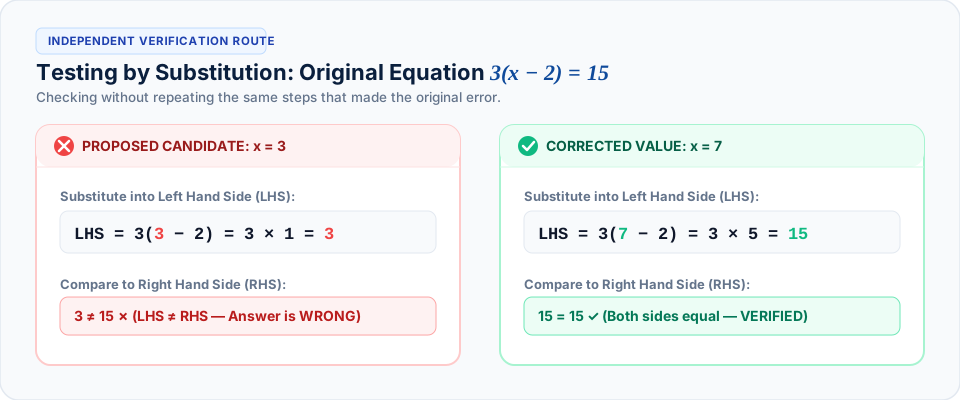
Take 3(x − 2) = 15 and the proposed answer x = 3. Substitute it into the original equation:
Since 3 ≠ 15, the answer is incorrect. Now try x = 7:
Both sides are equal, so x = 7 is correct.
Substitution suits equations best. For other questions, other independent checks help, such as estimating whether an answer is sensible or reversing an operation.
03Fahad's 3-minute checking routine: Trace, Test, Verify
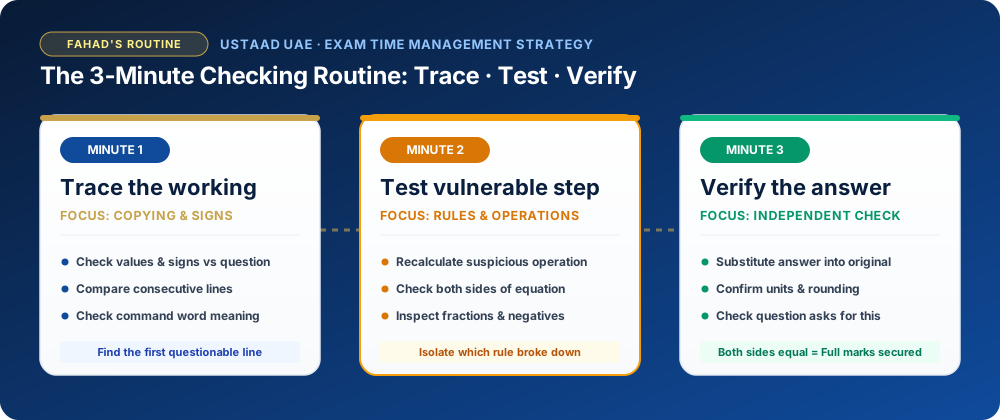
Use this as a practice routine for checking maths answers, not as a guarantee that every question can be checked in exactly three minutes. On a short question it may take thirty seconds. On a long one, choose the steps most likely to hide an error.
Minute 1: Trace the working
- Check copied values, signs and brackets against the question.
- Compare consecutive lines to find the first questionable step.
- Make sure you have interpreted the question correctly. Our guide to command words explains how to read what a question is asking.
Minute 2: Test the vulnerable step
- Recalculate the suspicious operation.
- Check that each operation has been applied to both sides of an equation.
- Inspect arithmetic, fractions and algebraic signs.
Minute 3: Verify the final answer
- Substitute the result into the original equation.
- Check units where relevant.
- Confirm that your answer addresses what the question actually asks.
04Can you spot the first incorrect step?
Try these before reading the answers.
Why is the second line wrong?
05One mistake is a slip. A repeated mistake is a clue.
A single arithmetic slip is one thing. The same kind of error appearing again and again is different. It may mean a rule, such as working with negative numbers, is not yet secure.
An error log helps you tell the two apart. For each mistake, record:
- the original question
- the first incorrect step
- why that step was incorrect
- the check that would have caught it
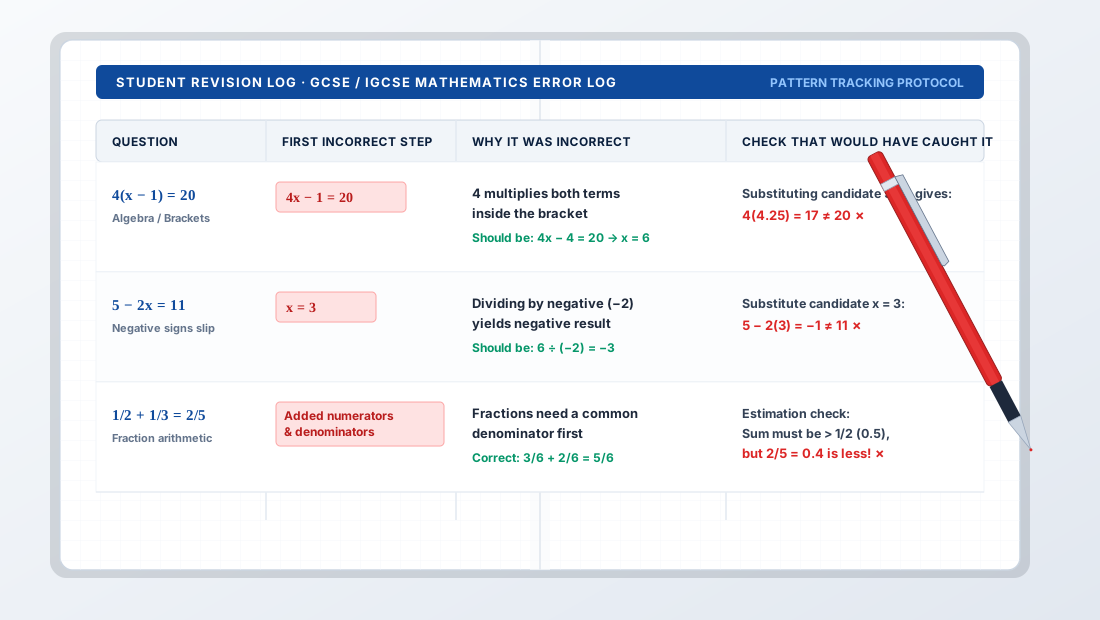
| Question | First incorrect step | Why it was incorrect | Check that would have caught it |
|---|---|---|---|
| 4(x − 1) = 20 | 4x − 1 = 20 | 4 multiplies both terms in the bracket | Substituting 5.25 gives 4(4.25) = 17, not 20 |
| 5 − 2x = 11 | x = 3 | Dividing by a negative number gives a negative result | 5 − 2(3) = −1, not 11 |
| 1/2 + 1/3 = 2/5 | Added numerators & denominators | Fractions need a common denominator first (correct answer 5/6) | Estimation: sum must be > 1/2, but 2/5 is less |
If three rows show negative signs, that is a pattern worth working on directly. Not every repeated error is carelessness. Sometimes a rule or an earlier skill needs more practice.
Review your log before attempting similar questions, and aim to fix the pattern, not just memorise the right answer. If you are already working through past papers, the log is where those mistakes become useful.
Find the error, not just the correct answer
Go back to the opening: x = 3 was wrong because of one line, and the line was easy to find once it was traced. Trace your working, test the vulnerable step and verify the final answer. Over time, your error log shows which skills deserve more attention.
If your child keeps running into trouble with particular skills, such as negative signs, fractions or brackets, 1-to-1 maths tutoring can help pinpoint the first incorrect step and build the habit of checking.
06Frequently asked questions
Can your child find the first wrong step?
In a free 30-minute trial, Fahad Khan works through worked equations with your child, shows where the first incorrect step tends to occur, and explains which checks would catch it. Lessons are online and 1-to-1, for families in every emirate.
Fahad Khan, Maths Tutor, IGCSE, GCSE & A-Level. 10+ years of teaching experience, BS Mathematics & B.Ed, working with Cambridge and Edexcel Maths.
Ustaad Editorial Team. Every guide is checked for accuracy, educational validity and parent clarity before it is published.