
Private Tutoring in the UAE: A Complete Parent Guide
What does the research say about one-to-one tutoring, and how are tutors regulated in the UAE? A complete, evidence-based guide for UAE parents on legal permits, delivery formats, vetting criteria, and curriculum alignment.
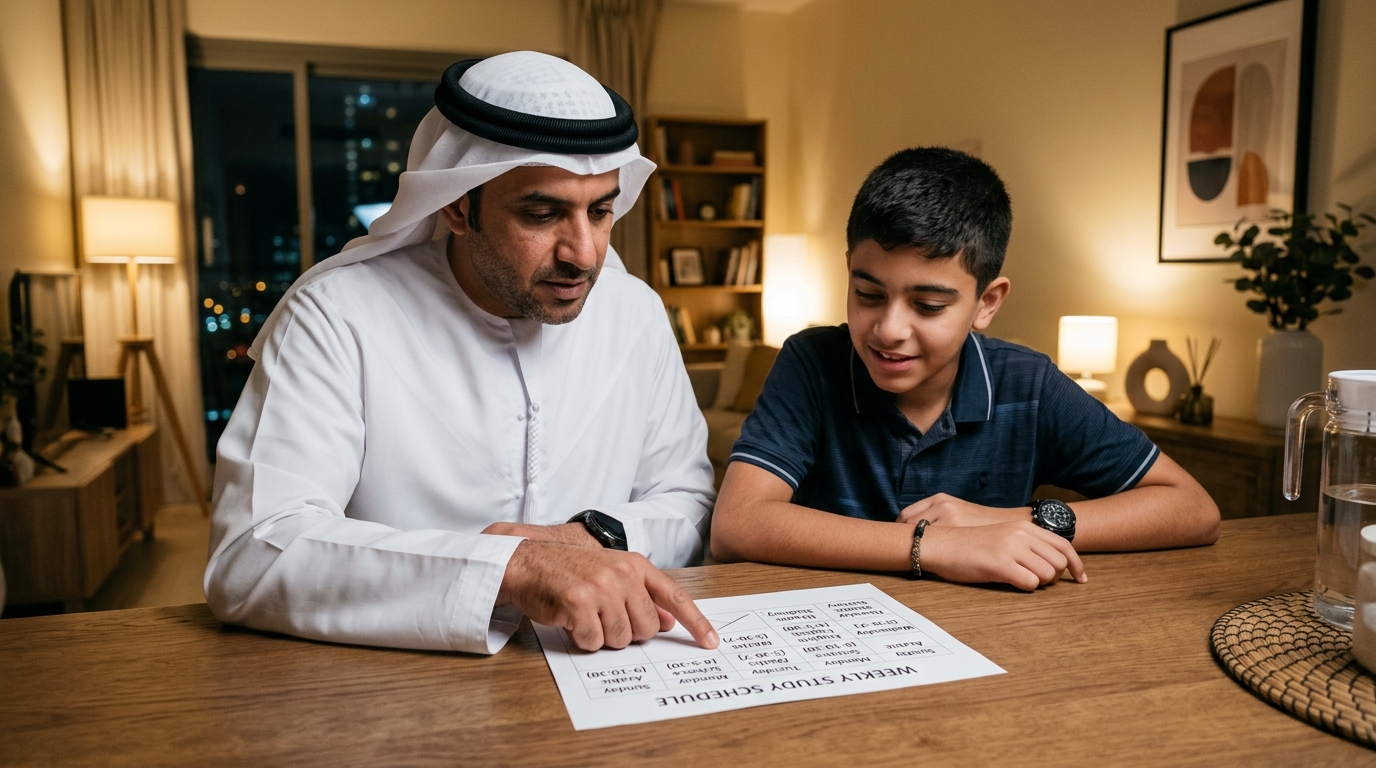
It is a Sunday evening, and the parents' WhatsApp group for your child's school is lighting up again. Someone has asked for a tutor recommendation for Grade 10 chemistry, and within twenty minutes there are a dozen replies: a centre in the next community, a home tutor who "worked wonders" for someone's cousin, an online platform with glowing reviews. Everyone has an opinion. Almost nobody mentions whether the tutor is properly permitted, how their pedagogical methodology works, or whether the format suits your particular child.
That WhatsApp thread is the real starting point for most UAE families shopping for a tutor, and it usually works out fine. Sometimes it does not, and by the time a family notices the instructional fit was mismatched, several critical weeks of exam preparation are already lost.
This guide walks through what the educational evidence actually demonstrates before you commit to an arrangement: what peer-reviewed research shows about 1-to-1 learning gains, how private tutoring is regulated across the UAE, which format suits your child, and the handful of diagnostic questions that reveal more than any group chat recommendation ever will.
Why UAE Parents End Up Looking for a Tutor
The UAE is one of the few places globally where a single school year group can be preparing for four or five distinct national curriculum systems simultaneously. British curriculum families are tracking IGCSE and A-Level. American curriculum families are tracking the SAT and AP exams. IB Diploma families are tracking Diploma point totals and Internal Assessments (IAs). CBSE and ICSE families run to their own board calendar entirely. A classroom teacher, however dedicated, is pacing a room of twenty-five to thirty students against one syllabus at a time, and it is not always the pace or the conceptual depth your child needs most this term.
That is the precise gap private tutoring in the UAE is designed to address: not a second school, but a short, targeted diagnostic intervention aimed at a specific subject, cognitive skill, or exam window. Families who treat it as a disciplined diagnostic tool, rather than an indefinite habit, consistently achieve the highest learning outcomes. If you have recently received term feedback, you may also find our guide on how to read a UAE school report card like a counsellor helpful in pinpointing root issues.

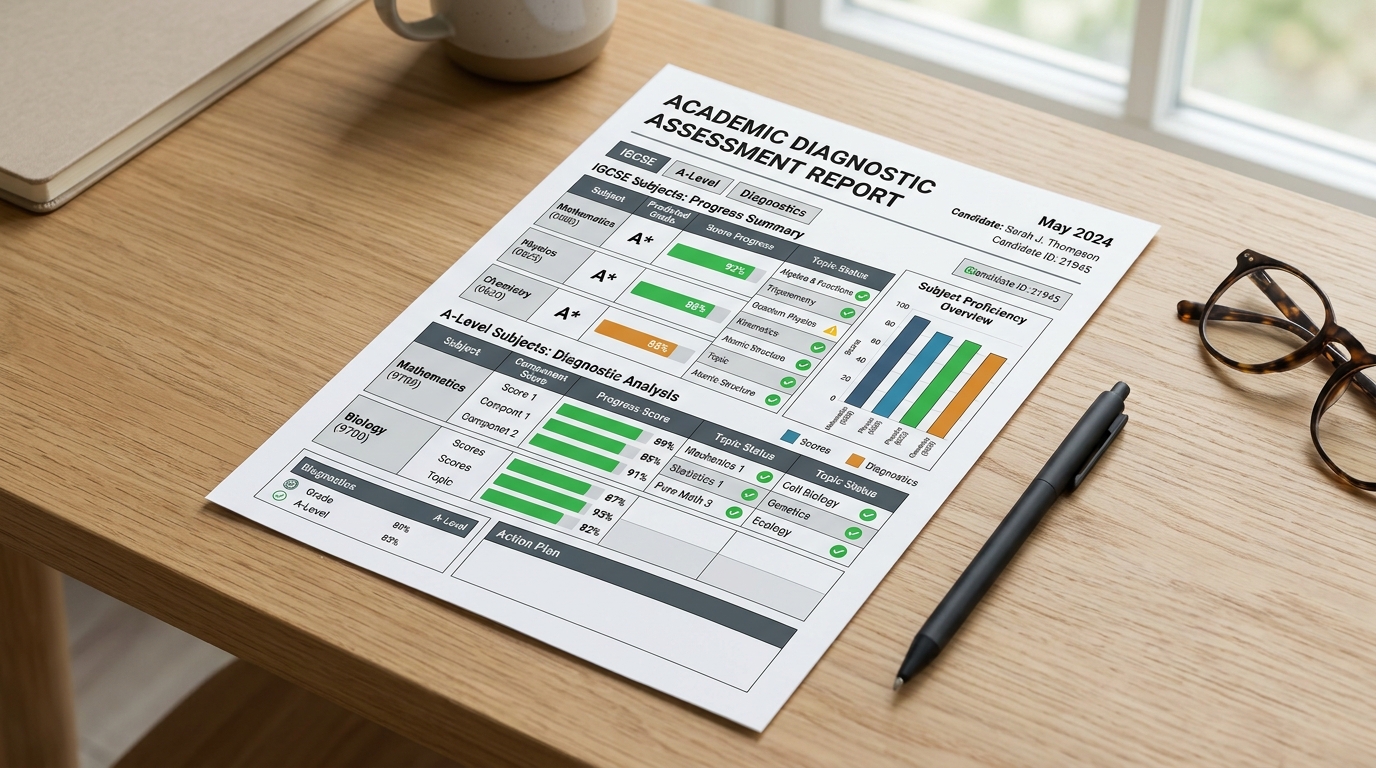
Visual progress tracking allows parents and tutors to pinpoint specific topic gaps and measure conceptual recovery objectively.
Is Private Tutoring Actually Legal in the UAE?
This is the foundational question every parent should confirm before entering into a tutoring engagement.
Individual freelance tutors teaching your child one-on-one, whether in your home or online, are regulated under the Private Teacher Work Permit framework overseen by the Ministry of Human Resources and Emiratisation (MOHRE) in conjunction with the Ministry of Education (MoE). This permit verifies that a freelance educator is registered, identity-verified, and authorised to provide educational mentorship outside of regular school hours.
Tutoring centres and learning institutes (organisations operating physical premises with structured staff) fall under regional educational authorities. In Dubai, private educational providers are licensed and inspected by the Knowledge and Human Development Authority (KHDA); in Abu Dhabi, they operate under the regulatory framework of the Department of Education and Knowledge (ADEK).
Online tutoring platforms operate across both jurisdictions. Reputable educational services maintain registered business credentials in the UAE while verifying that their faculty hold relevant degree qualifications, pedagogical experience, and official teaching permits.
Asking "Do you hold an active MOHRE private teacher permit, or is your center approved by KHDA / ADEK?" is a standard, responsible enquiry. Professional educators and established academic organisations provide their verification credentials willingly and transparently.
What the Evidence Says: The Measured Impact of 1-to-1 Tutoring
Educational economists and cognitive scientists have studied private tutoring extensively over the past four decades. Across thousands of clinical trials and school interventions, one conclusion stands out consistently: high-dosage, diagnostic one-to-one tutoring is among the most effective instructional interventions documented in modern educational research.
To understand why personalised instruction produces such profound learning acceleration, consider the four foundational pillars of global empirical research:
Comprehensive meta-analyses conducted by the Education Endowment Foundation (EEF) demonstrate that targeted one-to-one tuition delivers an average of +5 additional months of academic progress within a single academic year compared to standard classroom pacing alone. The effect is particularly pronounced when sessions are short (30 to 60 minutes), structured around specific diagnostic gaps, and linked directly to curriculum objectives.
In a landmark systematic review of 96 randomised controlled trials published by the National Bureau of Economic Research (NBER Working Paper 27476), researchers found that tutoring yielded a pooled effect size of 0.37 standard deviations. This places one-to-one tutoring in the 99th percentile of all studied primary and secondary educational interventions.
Educational psychologist Benjamin Bloom demonstrated that an average student tutored one-on-one using mastery learning techniques performed two standard deviations (2 sigma) above students in conventional classrooms. In practical terms, 98% of tutored students outperformed the classroom average because immediate formative feedback prevents small misconceptions from compounding into entrenched knowledge deficits.
Data from the OECD Programme for International Student Assessment (PISA) indicates that UAE students facing complex, multi-tiered syllabi benefit dramatically from diagnostic inquiry-based support. Students with access to structured individual feedback show higher problem-solving resilience and significantly stronger command of mathematical and scientific reasoning under timed exam conditions.
The research reveals an important nuance for parents: tutoring is most effective when it is diagnostic and time-limited rather than passive homework monitoring. When a tutor actively diagnoses missing foundations, scaffolds multi-step problem solving, and teaches the student how to learn independently, the gains persist long after the tutoring sessions conclude.

Diagnostic learning reviews and clear milestone tracking help families assess academic progress objectively.
Home Tutor, Tutoring Center, or Online Platform?
There is no single right answer here, only a right answer for a specific child, subject, and stage of preparation.
- In-home tutoring offers full attention, a familiar environment, and flexible scheduling, but usually costs the most per hour and depends heavily on the individual tutor, since there is no institution standing behind the lesson plan.
- Tutoring centers bring structure: a curriculum, a track record, cover if a tutor is unavailable, and, where they hold KHDA or ADEK approval, a layer of institutional accountability. The trade-off is less flexibility and often a commute.
- Online platforms remove geography from the equation, which matters in a country as spread out as the UAE, and open access to specialists who may not live nearby. What they ask of the student in return is more self-discipline, since there is no adult physically present to keep a distracted child on task.
Many UAE families end up mixing formats: an online specialist for a niche subject like IB Higher Level Economics or A-Level Physics, and an in-person tutor for a younger child who needs hands-on engagement close by. Matching the format to the child, rather than picking one format for every subject, is usually the more effective approach. For additional strategies on preparing effectively, explore our advice on GCSE and IGCSE revision tips for parents.
Five Questions to Ask Before You Hire
Treat the first conversation with any tutor or center as a short interview, because that is exactly what it is. For an expanded checklist, see our guide on 10 honest questions before hiring a private tutor in Abu Dhabi.
1. "Which exam board and paper do you specifically teach?"
A tutor who says "all boards" without naming the specific syllabus code (0580, 4BI1, IB Diploma SL/HL, CBSE Class 12, and so on) may be generalizing more than your child's exam needs.
2. "Can I see a sample session plan, or hear how you structure a lesson?"
A credible tutor can describe their structure, not just list what they will "cover."
3. "Are you MOHRE-permitted, or is your center KHDA- or ADEK-approved?"
Section 02 covers why this legal authorization matters across the UAE.
4. "What does progress look like in the first four to six weeks, and how will I know?"
Vague reassurance is weaker than a concrete plan to re-check a specific topic or skill.
5. "What are the cancellation, rescheduling, and payment terms, in writing?"
Get this before the first paid session, not after a dispute.
Getting the Curriculum and Exam Board Right
A tutor's general subject knowledge is not the same as fluency in your child's specific exam board. Cambridge IGCSE Chemistry (0620), Pearson Edexcel International GCSE Biology (4BI1), the IB Diploma's internal assessment criteria, and the AP or SAT format each reward different things and penalize different mistakes. A tutor who is excellent under one system can still misjudge what another system's mark scheme is looking for. For instance, see our subject breakdown on why IGCSE Biology students lose marks on 6-mark questions.
Before the first session, share the exact syllabus code, the specific paper (not just "Maths," but which tier and paper number), and, if you have one, a recent graded paper. This single step does more to match your child with the right tutor than any amount of general reputation checking. If your child is approaching exam season, remember that past papers are the final step of exam preparation, not the starting point.

A tutor's general subject knowledge is not enough: their practice must align with your child's specific syllabus code (e.g. Cambridge 0620 or Edexcel 4MA1).
Red Flags That Should End the Conversation
Some signals are worth treating as a hard stop rather than a discussion point:
How to Tell If the Tutoring Is Actually Working
Progress should be visible in something more concrete than a general sense that "things feel better." Ask to see the corrections made after each practice question or past paper, not only the score. A student who can point to a specific topic they went back and rebuilt after a session is progressing; a student who can only report a mark is being tested, not taught.
Most well-matched tutoring relationships show a measurable shift in a specific topic, skill, or paper within four to eight weeks. If nothing has moved by then, that is useful information too: it is a prompt to re-diagnose the gap, not necessarily to add more hours. When stress becomes a factor before assessments, our guide on what parents miss about exam panic right before exams provides practical ways to protect your child's working memory.
Tangible evidence of progress: active correction notes and diagnostic mark scheme sheets show real learning.
A Simple Way to Approach the Decision
You do not need to become an expert in Cambridge command words or IB assessment objectives to make a good decision here. Confirm the permit or approval question in Section 02, ask the five questions in Section 05, and match the format in Section 04 to your specific child rather than to what a friend's family chose. The parents who get the most out of tutoring are rarely the ones who spend the most. They are the ones who diagnosed the actual gap before they started paying to close it. Explore our broader parent guidance library for ongoing academic insights.
Decision Flowchart & Vetting Checklist
Download or view the free Parent Decision Flowchart & Vetting Checklist, a one-page printable that walks through Sections 01, 04, and 05 of this guide, ready to bring to a trial session:
Private Tutoring in the UAE: Decision Flowchart & Vetting Checklist
Interactive companion for UAE parents: diagnose your child's need, choose the right format, and vet tutors.
Step 1: Diagnose the Learning Gap
Trigger Event: "My child is struggling or plateauing in their schoolwork"
Select the situation that best matches your child right now:
Step 2: Choose the Right Tutoring Format
Click each format to see its specific pedagogical benefits, delivery model, and suitability:
Step 3: The 5-Question Vetting Checklist
Check off each question before committing to paid sessions:
1. Which exam board AND specific syllabus code do you teach?
Verify they know the exact paper (e.g. Cambridge 0580, Edexcel 4MA1, IB DP HL, AP).
2. Are you MOHRE-permitted, or is your center KHDA / ADEK approved?
Confirms authorized legal standing in Dubai, Abu Dhabi, and Northern Emirates.
3. Can you show a sample session plan and past-paper drill structure?
Checks active teaching methodology vs passive homework supervising.
4. What does measurable progress look like in the first 4 to 6 weeks?
Establishes clear diagnostic milestones instead of vague reassurances.
5. What are the cancellation, rescheduling, and refund terms in writing?
Prevents misunderstandings before money changes hands.
A guaranteed grade jump in days • No written agreement • Dodges the MOHRE/KHDA permit question • High-pressure prepaid packages before a trial.
Ustaad UAE · Premium private tutoring across the UAE since 2015 · ustaad.ae · 800 9005 (USTAAD)
Frequently Asked Questions
Sources and Further Reading
This guide synthesises public regulatory frameworks and peer-reviewed educational research, checked at the time of publication:
- Ministry of Human Resources and Emiratisation (MOHRE): Private Teacher Work Permit Regulatory Framework, UAE Cabinet Resolution No. 1 of 2022 and joint Ministry of Education (MoE) licensing updates.
- Knowledge and Human Development Authority (KHDA): Dubai Private Education Quality Assurance & Institutional Permit Standards, Government of Dubai.
- Department of Education and Knowledge (ADEK): Abu Dhabi Private School Policy and Regulatory Framework & Irtiqaa Inspection Standards.
- Education Endowment Foundation (EEF): One-to-One Tuition Evidence Review & Teaching and Learning Toolkit (2023), finding an average acceleration of +5 months of additional academic progress.
- Nickow, A., Oreopoulos, P., & Quan, V. (2020): The Impressive Effects of Tutoring on PreK-12 Learning: A Systematic Review and Meta-Analysis of the Experimental Evidence, National Bureau of Economic Research (NBER Working Paper 27476).
- Bloom, B. S. (1984): The 2 Sigma Problem: The Search for Methods of Group Instruction as Effective as One-to-One Tutoring, Educational Researcher, 13(6), 4-16.
- OECD (2023): PISA 2022 Results: The State of Learning and Equity in Education (United Arab Emirates Country Note), OECD Publishing, Paris.
- Cambridge Assessment International Education (2024): Developing Active Learning and Metacognition in High-Stakes Assessments, Cambridge University Press & Assessment.
- Ustaad UAE Academic Research & Mentorship Team: Curriculum-matched private tutoring in the UAE and examination board preparation.
Editorial note: Regulatory and permit frameworks are updated periodically. Please verify current requirements directly with MOHRE, KHDA, or ADEK, or ask your provider for their official approval reference, prior to commencing an instructional engagement.
Related Articles for UAE Parents
10 Honest Questions to Ask Before You Hire a Private Tutor in Abu Dhabi
Ten practical questions UAE parents should ask before hiring a tutor, plus a free interview worksheet.
Parent GuidanceGCSE & IGCSE Revision Tips UAE: Skills That Raise Grades
Practical GCSE and IGCSE revision tips for UAE parents: the study skills that actually raise grades, and how to support your child without taking over.
AcademicIGCSE Preparation: Why Past Papers Are the Final Step, Not the First
Past papers are the roof of IGCSE preparation, essential, but only after the foundation is set.
Subject & Exam SkillsWhy IGCSE Biology Students Lose Marks on 6-Mark Questions
A board-specific guide explaining what Cambridge and Pearson mark schemes actually reward.
Parent GuidanceWhat UAE Parents Miss About Exam Panic Right Before Exams
Why exam anxiety peaks in the final days before papers, and how parents can help protect working memory.
Education Counsellor & Student Support Specialist | Ustaad UAE
Nimra Shahzada holds a Bachelor's degree in Psychology and works as an Education Counsellor with children across different school settings and age groups. Her work focuses on student wellbeing, academic confidence, and emotional support during high-pressure learning periods. She helps families build calmer, more consistent routines before pressure starts affecting their child's performance and wellbeing.
MPhil in Education Leadership and Management · Ustaad Editorial
Nida Iqbal holds an MPhil in Education Leadership and Management. She reviewed this article for educational accuracy and parent relevance, ensuring the guidance reflects sound practice for UAE families weighing up private tutoring.
Ustaad supports students and families across the UAE through structured academic mentorship, exam preparation guidance, and personalised learning support.
No commitment. Cancel anytime.
 Ask on WhatsApp