
Why Teenagers Procrastinate on Revision (And Why It Isn't Laziness)
Your teenager keeps putting off revision, and it is easy to call it laziness. The psychology says otherwise. Here is what is really going on, and how UAE families can help.


It is Sunday afternoon in Abu Dhabi, and a Year 10 student has a mock in three weeks.
At 2:00 p.m. she sits down to revise. By 2:15 she has sharpened four pencils. By 3:00 she has rewritten her timetable in three colours, tidied her desk and made tea. At 3:40 she watches "just one video" about study tips. At 8:00 p.m. the chemistry textbook is exactly where it was at lunchtime, still closed, and she feels terrible.
Her mother has watched the afternoon pass and says what any worried parent might: "You're not even trying."
But look closely at that afternoon. It was full of effort. The tidying, the timetable and the tea were all work, of a kind. What she was doing, with real energy, was avoiding a feeling. This guide explains what that feeling is, why teenagers are especially vulnerable to it, and what actually helps.
01Procrastination is a feelings problem, not a time problem
Most of us picture procrastination as poor time management. The research points somewhere else.
Fuschia Sirois and Timothy Pychyl, who have studied procrastination for years, describe it as a way of managing mood in the short term. The task in front of us triggers an unpleasant feeling (boredom, anxiety, doubt, overwhelm), and putting the task off brings instant relief. We give in to feeling better now at the expense of our future selves.
That relief is the trap. It feels like a solution, so the brain learns it. The next time the same task appears, avoiding it feels even more appealing.
Large reviews of the research, including Piers Steel's meta-analysis, point the same way. Procrastination is linked to how unpleasant a task feels, how confident the person is that they can do it, and how easily they are distracted. It is not simply a time-management skill that some people lack.
The practical consequence is important. If avoidance is about managing a feeling, then lectures about deadlines address the wrong problem, and often make the feeling worse.

A teenager who will not start is rarely short of information. They already know the exam is coming. What they are short of is a way to start that does not feel bad.
02Five reasons teenagers avoid starting
"I'll do it later" can hide very different problems. Working out which one is in play changes what helps.
| What you see | What is often underneath | What helps |
|---|---|---|
| Endless tidying, planning and re-planning, but no actual work | The task feels too big. "Revise chemistry" has no obvious first step | Shrink the first step until it is almost trivial (strategy 1) |
| Dodging past papers or marked scripts | Fear of finding out. A low mark would feel like a verdict on them | Start with low-stakes recall; treat marks as information, not judgement |
| "What's the point?" and heavy sighing | Low sense of value. The topic feels pointless or dull | Connect the task to something they care about; mix topics to keep it fresh |
| "I'm too far behind, there's no point starting now" | Shame about the gap. Falling behind makes starting feel hopeless | Restart small and without punishment (section 07) |
| Phone in hand, "just five minutes" that becomes an hour | Instant rewards beat delayed ones. The phone wins every contest on the spot | Change the environment, not the willpower (strategy 4) |

Most students have a mix, but one reason usually dominates. A useful question for a calm moment is not "why won't you start?" but "which part of starting feels worst?"
03The motivation formula (and why "just try harder" fails)
Piers Steel and Cornelius König proposed a model of motivation known as temporal motivation theory. Stripped to its essentials, it shows where the true motivational levers lie:
The Motivation Formula
Why "just try harder" fails to move any of the four real levers.
Four levers, not one. Pressure alone moves none of them.
This is a model, not a measurement, but it is a useful one, because it shows where the levers are.
"Just try harder" does not move any of them. It only adds pressure, which can lower confidence and raise dread. More helpful is to work on the four parts directly:
- Raise confidence with small, winnable first tasks.
- Raise value by linking a task to a real goal or by making it more interesting.
- Lower distraction by changing the setting.
- Shorten the delay by giving the effort a visible, near-term payoff, such as a finished set of questions, a tick on the list or a proper break.
The exam in May is a very long way away. A closed notebook and a phone in the hand are right here. The formula explains why the second often wins, and how to even the contest.
04Why the teenage brain makes it harder
Adolescence adds another layer. Laurence Steinberg's work on adolescent development describes how the brain's reward-seeking systems become highly active in the early teens, while the systems that support planning, impulse control and long-term thinking are still maturing, and continue to develop into the early twenties.
In everyday terms: a teenager's brain is especially sensitive to what feels good right now, and the machinery for choosing the slower payoff is still being built. A student can understand perfectly well that revising now helps in May, and still find the phone far more compelling at 4:30 p.m. That gap is not a character flaw. It is a stage of development, and it is a reason to build external structure rather than rely on willpower alone.
None of this makes procrastination harmless. Reviews of the research, such as the meta-analysis by Kim and Seo, find that habitual procrastination is associated with lower academic performance on average. But a single lost evening does not decide anything, and the habit is changeable, especially when families focus on the right target.
05The UAE factor: why the pile feels bigger here
The psychology is universal, but some features of life for many UAE students make starting harder:
- A heavy subject load: IGCSE students often study eight to ten subjects. "Revise" is not one task but a dozen, and choosing where to begin can be paralysing.
- Several systems at once: Families are often navigating Cambridge, Edexcel, IB or American requirements, each with its own papers and deadlines.
- A packed evening: Early starts, long commutes, sport, music and tutoring can leave a short window, which makes the pressure to "use it well" even heavier. Pressure to perform in a short window can increase the urge to avoid.
- Broken rhythm: Long breaks and travel make restarting a routine feel like a fresh hill each time.
- More adults managing the plan: When parents, school and tutors all hold the timetable, the student can feel it as something done to them rather than something they own, and ownership matters for motivation. Our guide on GCSE & IGCSE revision tips for UAE parents describes a split that tends to work: parents own the environment and routines, the student owns the studying.
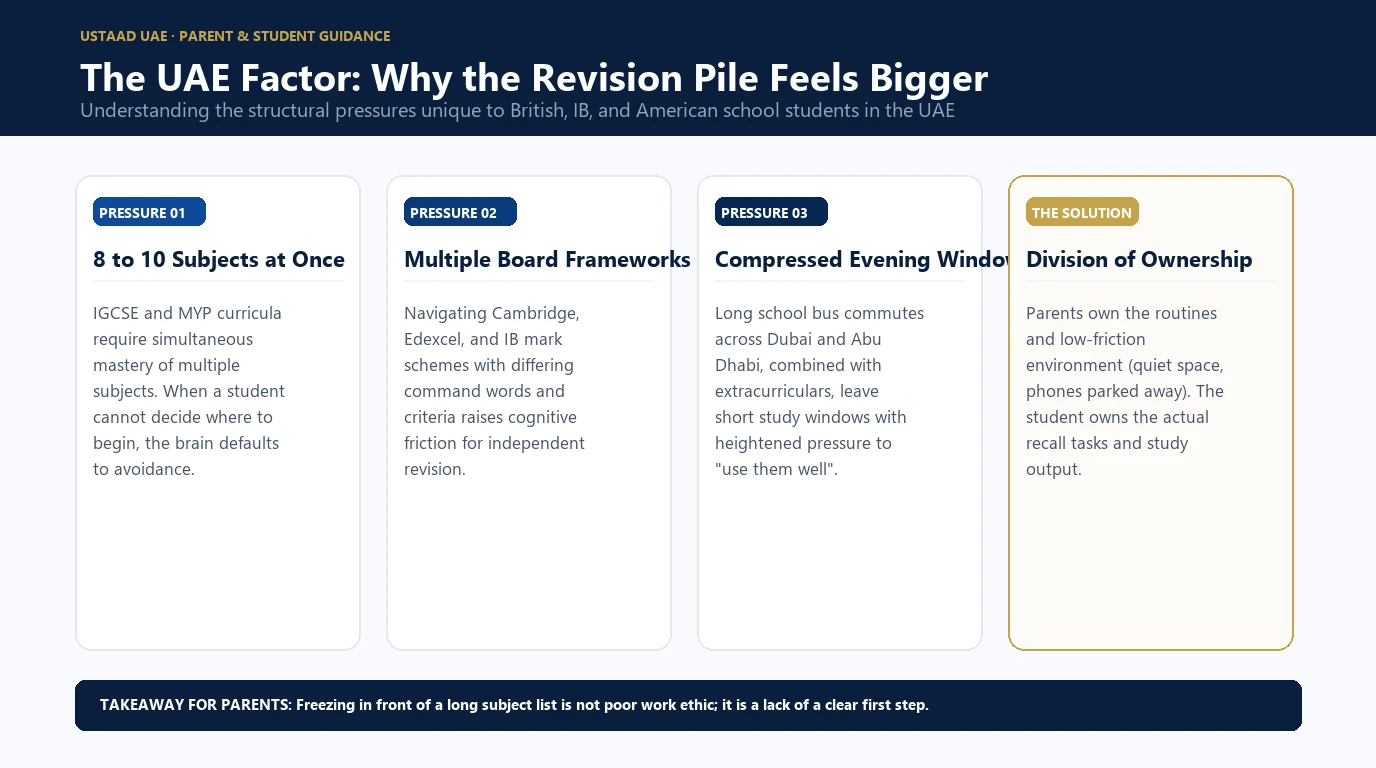
If your child freezes in front of a long list of subjects, the problem is rarely their work ethic. It is that the list has no obvious first step.
06Seven strategies that actually help
1. Make the first step almost embarrassingly small
"Revise chemistry" is a mountain. "Close the book and write down three things you remember about ionic bonding" is a two-minute task. Because the hardest part of procrastination is starting, the goal is to make starting so easy that it barely registers. Once a student is underway, the resistance usually drops. A good first step also doubles as retrieval practice, which is exactly what builds memory, as we explain in The Illusion of Competence.
2. Replace "I'll start soon" with an if-then plan
Peter Gollwitzer's research on implementation intentions shows that deciding in advance exactly when, where and how to act makes follow-through considerably more likely. A meta-analysis by Gollwitzer and Sheeran found a medium-to-large effect across many studies.
| Vague intention | If-then plan |
|---|---|
| "I'll revise this evening." | "If it is 4:30 p.m. and I've had a snack, then I'll sit at the desk and do the first ten-minute recall task." |
| "I'll do past papers this weekend." | "If it is Saturday at 10:00 a.m., then I'll do one timed section at the dining table." |
| "I'll stop using my phone." | "If I sit down to revise, then my phone goes in the hallway basket first." |
3. Name the feeling
Research on affect labelling, including work by Matthew Lieberman and colleagues, suggests that putting a feeling into words can reduce its intensity. Before starting, a student can say or write one sentence: "I'm avoiding this because I'm worried it'll show I don't understand it." Naming the fear takes some of its power, and it gives a parent something concrete to respond to.
4. Change the environment, not the willpower
Willpower is a poor plan against a phone. Make the right thing the easy thing:
- The same desk, at the same time, most days
- Phone out of the room, not on silent beside the book (see the research in our Exam Stamina guide)
- Books and materials laid out the night before, so starting needs no setup
- Browser tabs closed except the one needed

5. Use a short time-box with a visible end
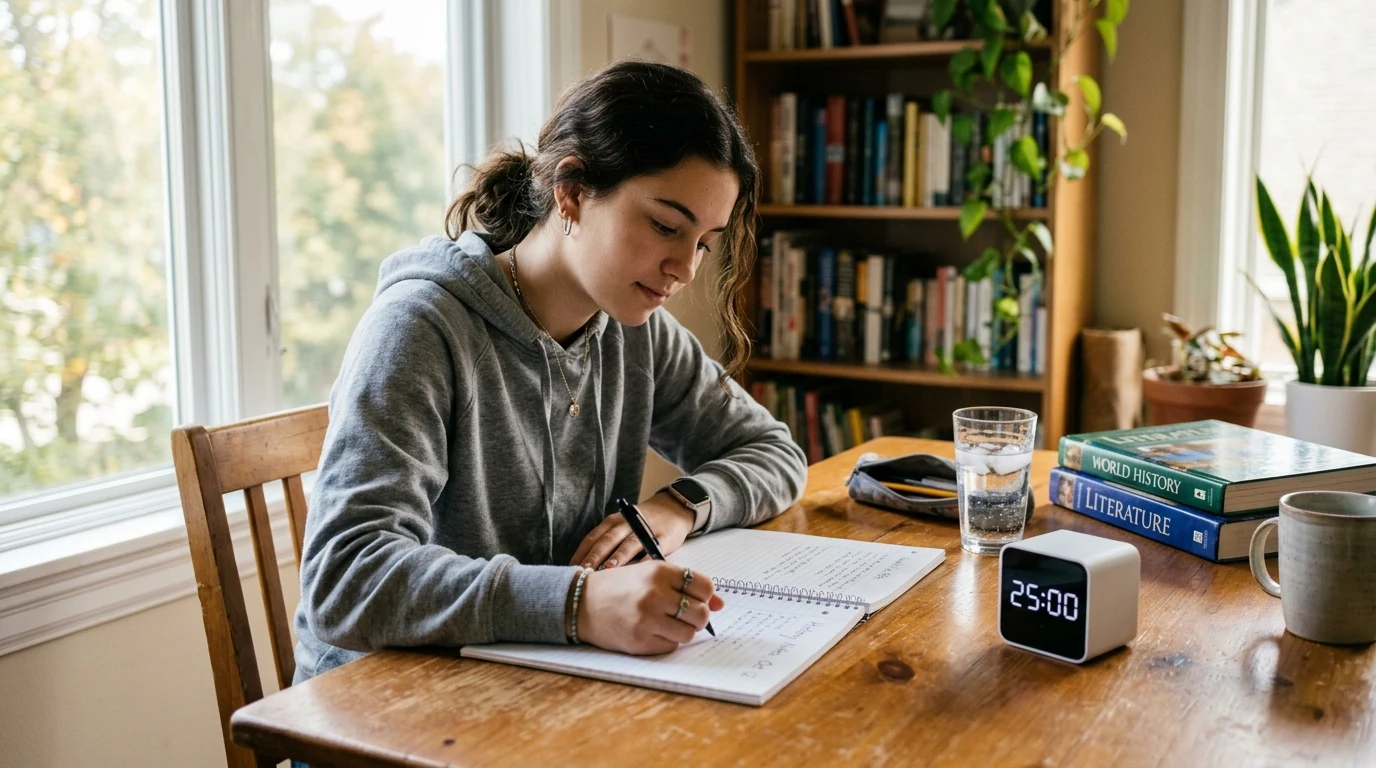
"Revise until you've done enough" has no finish line. "Work for 25 minutes, then a proper five-minute break" does. Many students find a defined end makes starting less threatening. As concentration grows, the blocks can lengthen over a few weeks.
6. Plan by what gets produced, not by hours
"Study for two hours" is easy to fill with drifting. "Do eight questions and mark them against the mark scheme" is concrete, and finishing it brings a real, near-term sense of progress. This also fits the advice to measure revision by what a student can produce from a blank page, not by time spent.
7. Build in self-forgiveness
This one surprises parents. In a study by Michael Wohl, Timothy Pychyl and Shannon Bennett, students who forgave themselves for procrastinating before their first exam procrastinated less before the next one. Guilt feels like motivation but tends to feed the avoid-and-feel-bad cycle. A student who can say "that afternoon was lost, and I'm starting now" is far more likely to start than one who spends the evening in self-criticism.
The Procrastination Avoidance Cycle
Relief now feeds guilt later, making the next start even harder.
07The 10-minute restart after a lost week
Sometimes a week disappears, and the pile feels impossible. A short, repeatable restart works better than a dramatic new plan.
- Choose one overdue thing, not the whole backlog: Pick the smallest meaningful task.
- Set a 15-minute timer and give yourself permission to do it badly: A rough first attempt beats a perfect plan that never begins.
- Write two lines afterwards: what I did, and what I found hard. The hard part is the useful information, not a failure.
- Decide tomorrow's first task now: and attach an if-then trigger to it (strategy 2).
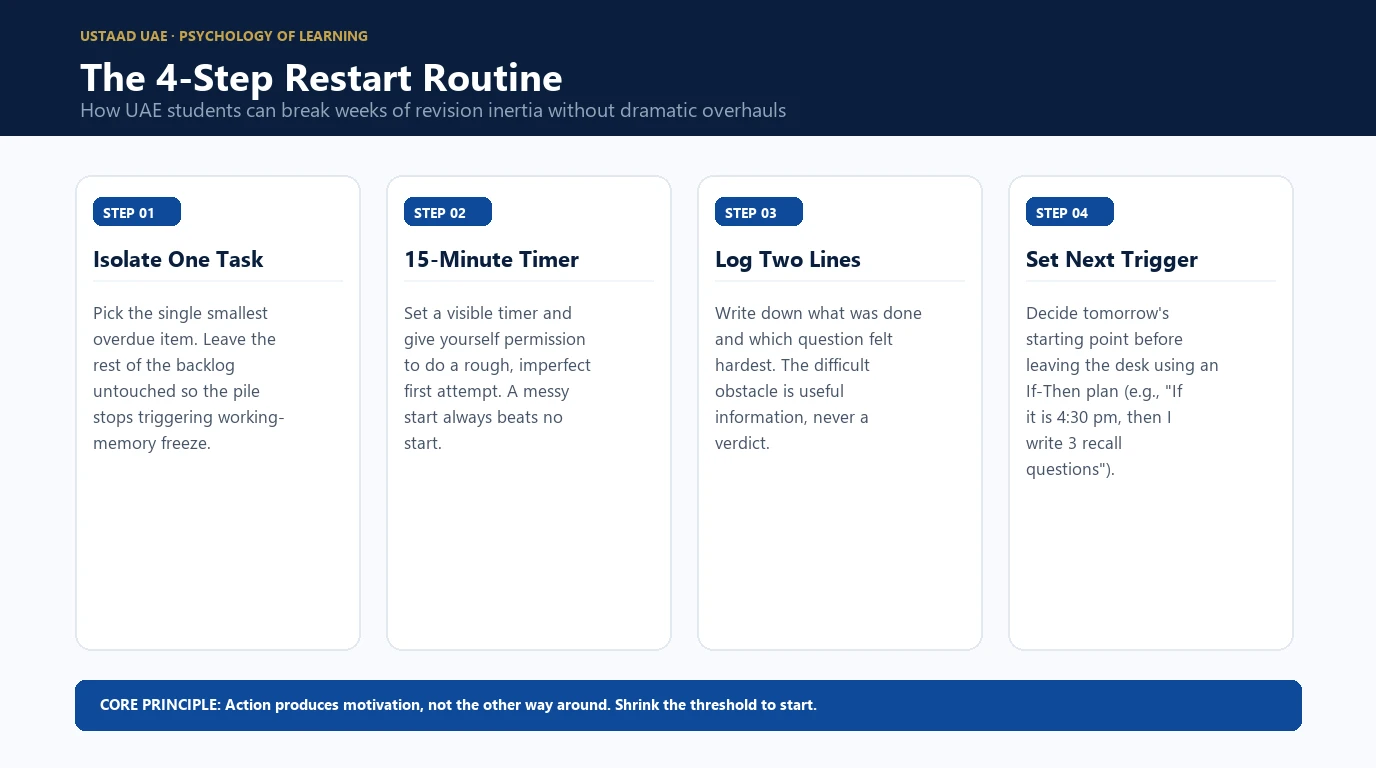
That is the whole routine. It deliberately avoids resolutions about "catching up on everything", because those usually collapse by Wednesday. Small restarts rebuild confidence, the first lever in the motivation formula.
If the backlog is large and the exam is close, the next move is to ask the subject teacher or an exam preparation tutor to help prioritise which topics matter most, so the student faces a short list instead of a mountain. If last-minute panic is also part of the pattern, our guide on why some children only panic right before exams explains what often sits underneath it.
08What parents can say (and avoid saying)
Nagging usually deepens avoidance, because it adds guilt without removing the obstacle. The aim is to lower the threat of starting while keeping expectations clear.
| Instead of… | Try… |
|---|---|
| "You're just being lazy." | "Which part of starting feels hardest right now?" |
| "You've had all weekend!" | "What's one small thing you could do before dinner?" |
| "Put your phone away and study." | "Where should the phone live while you work so it isn't tempting?" |
| "Everyone else is revising." | "What would make today feel like a win?" |
| "If you don't do this, you'll fail." | "I'll sit nearby for the first ten minutes if that helps you begin." |
Some small things that help at home:
- Sit nearby for the start: Many students find it easier to begin when someone is quietly present, such as a parent reading at the same table. Staying for ten minutes is different from supervising the whole session.
- Praise the start, not just the result: "You sat down when you didn't feel like it" reinforces exactly the skill you want.
- Keep the plan collaborative: A timetable the student helped design is one they are far more likely to follow.
- Look at the pattern, not the day: One lost evening is normal. Several weeks of avoidance is worth a calm conversation.
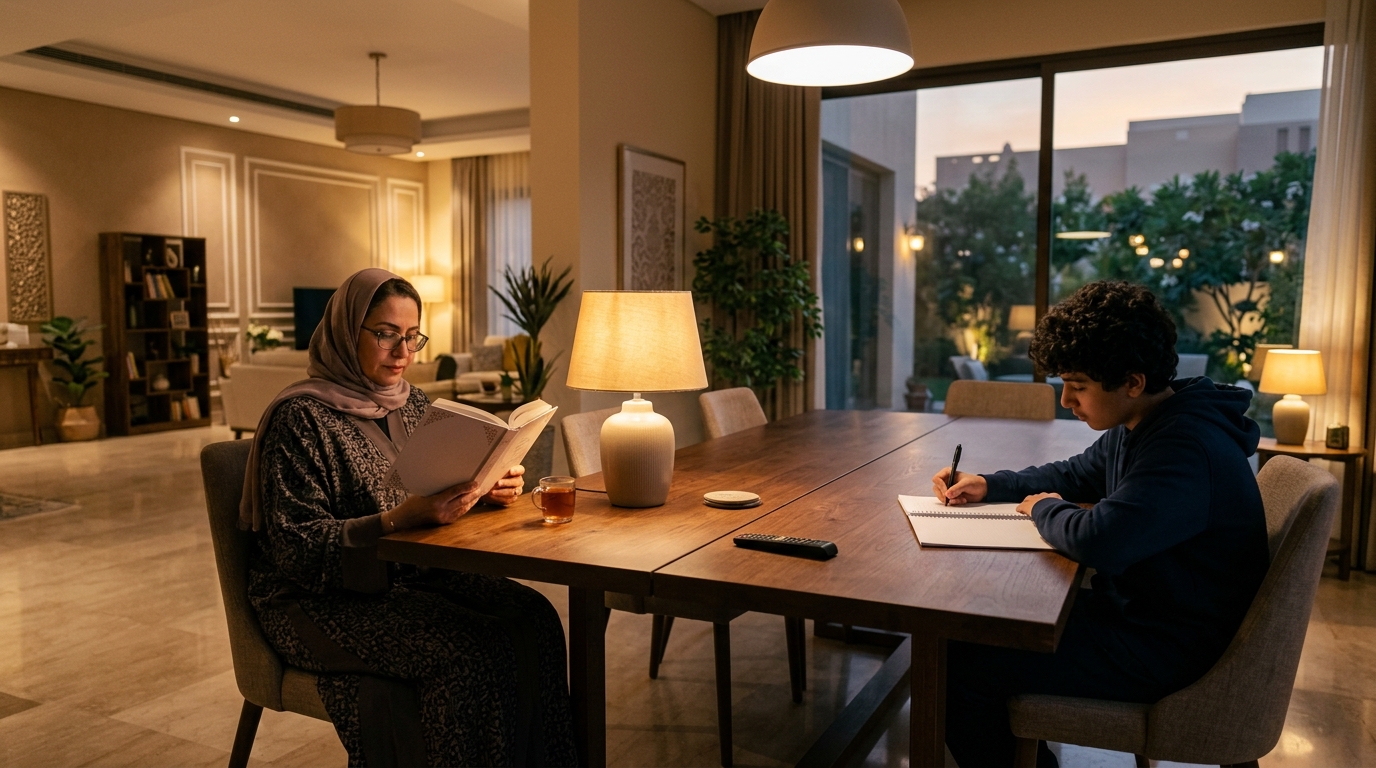
You cannot make a teenager want to start. You can make starting smaller, clearer and less frightening, and that is usually enough to change what happens next.
09When it is more than procrastination
Most procrastination is ordinary and responds well to the strategies above. Some signs suggest that a student needs more than study skills:
- Difficulty focusing, organising or starting tasks across all areas of life, not only revision, lasting for months
- Persistent low mood, loss of interest in things they used to enjoy, or withdrawal from friends
- Anxiety so strong that sitting down to work brings tears, panic or physical symptoms
- Significant changes in sleep or appetite
- A strong belief that they are "stupid" or "hopeless" that does not shift
If several of these persist, speak to the school's counsellor or pastoral team, and consider your family doctor or paediatrician. They can look at the full picture, including whether an assessment would help. This article is educational guidance and does not replace professional advice.
10Frequently asked questions
11Sources and further reading
• Steel, P. (2007). The nature of procrastination: A meta-analytic and theoretical review of quintessential self-regulatory failure. Psychological Bulletin.
• Steel, P., & König, C. J. (2006). Integrating theories of motivation. Academy of Management Review.
• Sirois, F., & Pychyl, T. (2013). Procrastination and the priority of short-term mood regulation: Consequences for future self. Social and Personality Psychology Compass.
• Wohl, M. J. A., Pychyl, T. A., & Bennett, S. H. (2010). I forgive myself, now I can study: How self-forgiveness for procrastinating can reduce future procrastination. Personality and Individual Differences.
• Gollwitzer, P. M., & Sheeran, P. (2006). Implementation intentions and goal achievement: A meta-analysis of effects and processes. Advances in Experimental Social Psychology.
• Lieberman, M. D., Eisenberger, N. I., Crockett, M. J., Tom, S. M., Pfeifer, J. H., & Way, B. M. (2007). Putting feelings into words: Affect labeling disrupts amygdala activity in response to affective stimuli. Psychological Science.
• Steinberg, L. (2005). Cognitive and affective development in adolescence. Trends in Cognitive Sciences.
• Kim, K. R., & Seo, E. H. (2015). The relationship between procrastination and academic performance: A meta-analysis. Personality and Individual Differences.
Related Guides on Psychology of Learning
Writer on learning and the psychology of studying. Nimra writes guides for parents on study technique, memory and exam preparation for British and IB curriculum students across the UAE.
Every guide is checked for accuracy, educational validity and parent clarity by curriculum specialists before publication.
Is it avoidance, or a gap your child doesn't want to face?
An Ustaad tutor can work through a short, board-specific task with your child, notice where starting feels hardest, and help you build a small, realistic plan that gets revision moving again. Sessions are online and 1-to-1, for families in every emirate.