

Choosing a private tutor is one of the least visible decisions a parent makes, and often one of the biggest. There is no ceremony to it. You send a few messages, compare a few profiles, and someone new steps into your child's week. Yet that person will shape how your child feels about a subject, and sometimes about themselves.
Degrees and years of teaching matter. But they only tell you the surface of what you are choosing. What you are really deciding is who sits beside your child on a hard evening, and whether that hour leaves them calmer or more discouraged. After years of arranging private tutoring in Abu Dhabi for families across the emirate, we have found that the same handful of questions separate a strong match from an expensive mismatch. The ten below help you look past the CV. Some are for the tutor, and some are for you.
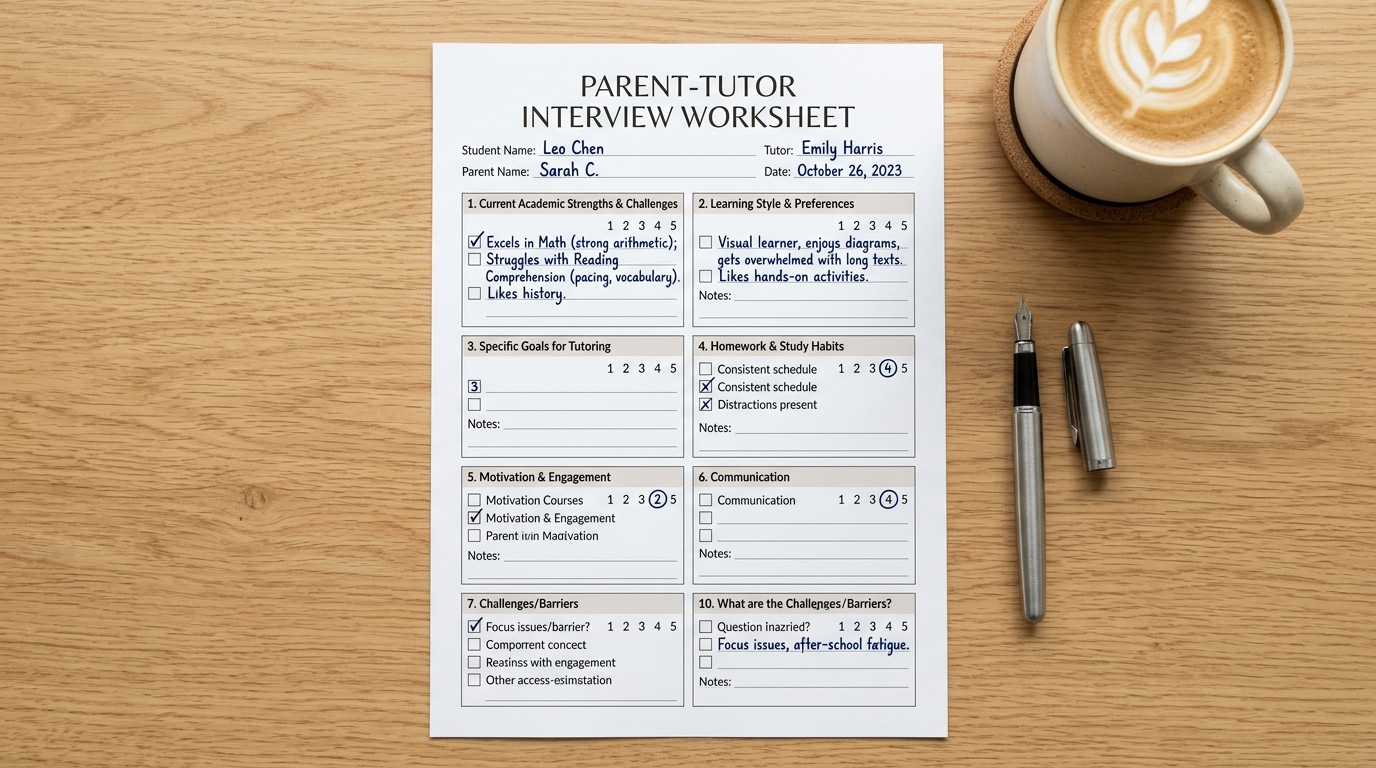
Print it and take it with you
Download the free Parent Tutor Interview Worksheet (PDF) so you can write down each tutor's answers during a trial session and compare them side by side.
Download the worksheet (PDF)Follow this structured sequence to select a tutor who matches your child's curriculum, learning style, and academic goals.
Define Real Goal
Identify whether your child needs gap repair, exam technique, or stretching.
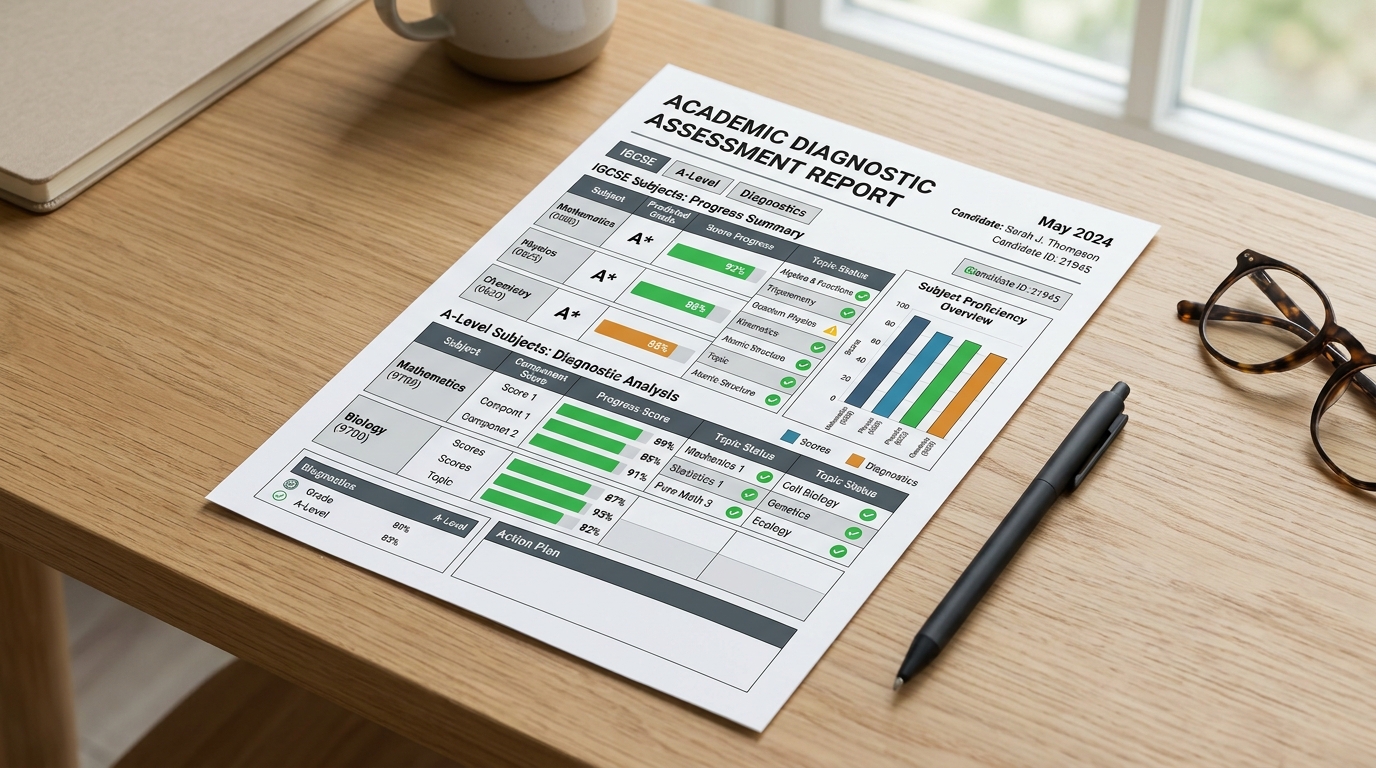
Diagnostic Check
Audit specific topic gaps and past test errors before teaching begins.
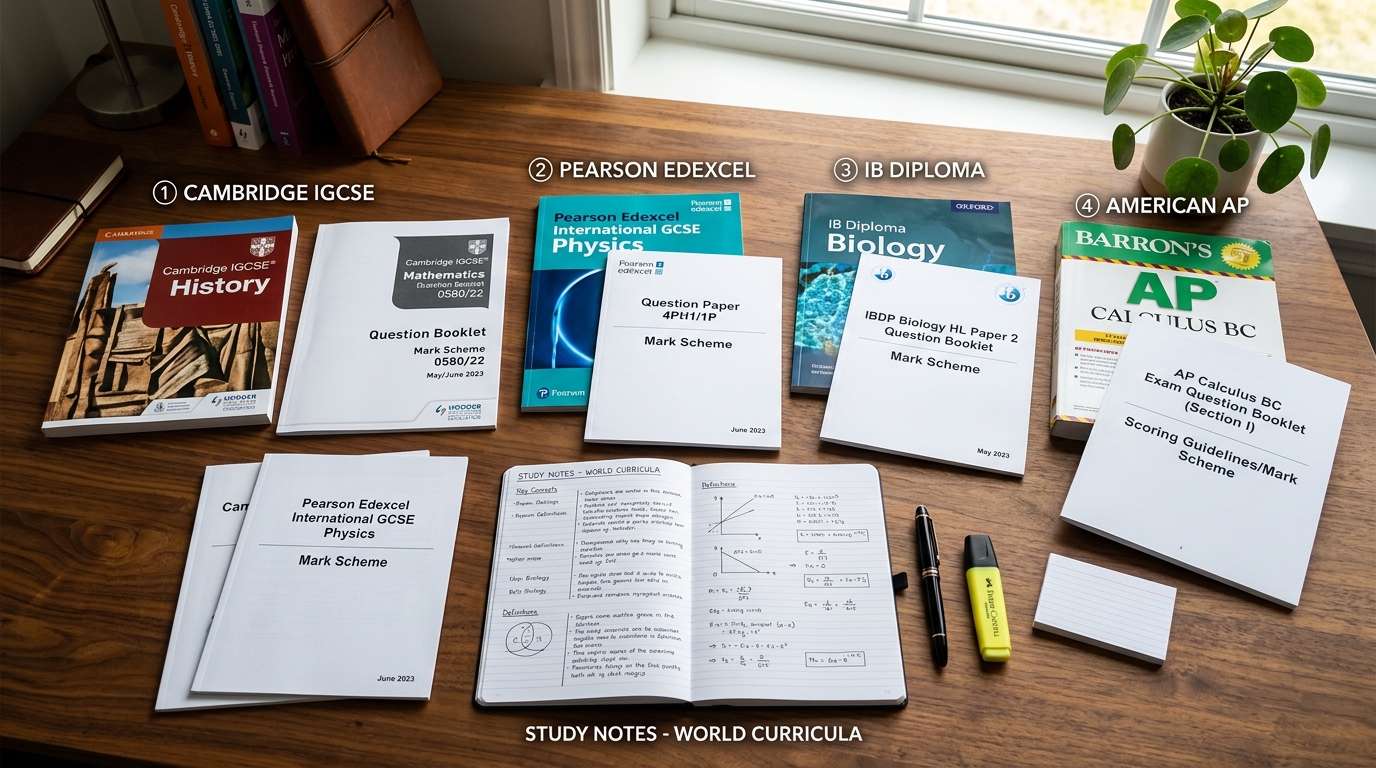
Board Alignment
Verify exact mark scheme mastery (Cambridge, Pearson Edexcel, IB, AP).
Track & Hand Off
Require visible progress notes and build independent study habits.
Quick answers before you read
Short on time? Here are the ten questions with a one-line answer for each. Tap any question to jump to the full section.
Why do I want a tutor at all?
Before you judge anyone else, get honest about what you want to change. "Better grades" is rarely the full answer.
Common reasons parents reach out:
- catching up after a tough term
- getting ready for IGCSE or A-Level exams
- fixing shaky basics and restoring confidence
- stretching a bright child who is coasting
- forming stronger study habits
Each reason needs a different kind of tutor and a different pace. When you name the real goal, you also give yourself a fair way to measure success later. A tutor hired to restore confidence should not be judged only on a mock score three weeks in.
Has anyone checked what my child actually needs?
A good tutor does not start teaching on day one. They start by finding out where the gaps really are.
Ask how they will check your child's level before lessons begin. Good signs:
- a short first chat or quiz to spot weak areas
- a look at recent tests or exam papers
- curiosity about why a topic feels hard, not just what is on the syllabus
A child who "hates maths" often has two or three exact gaps, not a general weakness, and naming them changes everything. The warning sign is the opposite: a tutor who launches straight into teaching with no check often spends the first month on things your child already knew.
If low marks keep coming back even after revision, the real problem is usually an unfixed gap, something we cover in our post on why IGCSE maths revision sometimes fails to lift marks.
- • Starts teaching Chapter 1 without auditing prior knowledge
- • Explains topics already understood by the student
- • Misses underlying foundational gaps from previous years
- • Result: Slow progress and repeated exam mistakes
- • Audits exam papers and specific weak topic clusters first
- • Targets exact conceptual gaps with surgical precision
- • Verifies understanding through active recall questions
- • Result: Fast confidence recovery and grade jumps
Am I hiring qualifications, or good teaching?
Strong credentials and clear teaching are not the same thing. Some of the most qualified people struggle to explain one idea to a nervous fourteen-year-old.
In your first talk, listen for how they explain a hard topic:
- Do they reach for a simple, everyday example?
- Do they slow down or change tack when you look lost?
- Do they talk about lesson structure and pace, not just the subject?
A first-class degree tells you what someone knows. It does not tell you whether your child will follow them. So try this: ask them to explain a tricky topic from your child's course in plain words. Their answer tells you more than any certificate.
A high mark and real understanding are not the same thing either, a gap we unpack in why some students understand physics but still lose marks.
The Pedagogy Matrix: Degrees vs. Teaching Delivery
Mastery of Subject Content
Knows every formula, equation, and academic term in the syllabus. Necessary foundation, but insufficient on its own.
Explanatory Skill & Adaptability
Simplifies complex concepts, adjusts pacing live, listens to student cues, and builds confidence under pressure.
How will I know the tutoring is working?
Good tutoring gives you proof you can see, not just reassurance you have to trust.
Ask how progress will be tracked and shared. Reasonable answers include:
- short notes after each session
- regular check-ins against the goals you agreed
- marked past papers
- a simple record of topics covered and how confident your child feels
"He's doing well" is nice to hear and hard to act on, so ask for something you can actually look at. Agree at the start what a good month looks like, so you and the tutor are measuring the same thing.
It also helps to read the signals your child's school already gives you. Our guide to making sense of your child's report card shows what to look for between tutoring updates.

What happens if my child still does not get it?
Every child hits a wall at some point. What matters is what the tutor does next.
Look for flexibility, not force:
- changes the method instead of repeating the same one louder or slower
- goes back to check for an earlier gap
- tries a picture, a story, or a real-life example
- stays patient and never blames the child
Steady patience under pressure is one of the truest signs of a good teacher, and it almost never shows up on a profile.
Does this tutor really know my child's curriculum?
Knowing a subject and knowing an exam board are two different things, and the gap between them costs marks.
The same topic is tested very differently across IGCSE, IB, GCSE, and the American curriculum. So ask plainly:
- Have you taught my child's exact board, whether Cambridge, Pearson Edexcel, IB, or AP?
- How recently?
- Do you know its mark scheme, command words, and paper layout?
This fluency matters whether you are looking for a maths tutor, a science tutor, an IB tutor, or an A-Level tutor in Abu Dhabi, and it counts as much for GCSE and IGCSE students as it does for those sitting their final A-Level papers. A good sign is a tutor who asks which board and tier your child is on before you even mention it.
Will this build independence or dependence?
The goal of good tutoring is, in a way, to make itself unnecessary.
Ask how the tutor plans to hand work back to your child over time:
- teaches a method, then lets the child try it alone
- corrects gently instead of rescuing instantly
- aims for your child to need them less, not more
Watch for the opposite. If your child cannot start homework without the tutor beside them, that looks like progress but quietly weakens it. Real learning has to survive on its own once the session ends, which is why we wrote about why chemistry so often fades from memory and how to make it stick.

What is my job as a parent?
Tutoring works best as a partnership, and your part is smaller and steadier than many parents expect.
You do not need to sit in on every lesson or become a second teacher. What helps most:
- protect a calm, regular time and place to study
- keep expectations realistic
- share what you notice at home
Ask a tutor how and how often they like to update parents. Their answer tells you whether they see you as a partner or an interruption. Hovering rarely helps; a set time, a quiet space, and honest feedback help far more.
Which promises should make me pause?
In a busy market, some offers are built to calm your worry rather than help your child.
Be careful with:
- guaranteed grades
- promises of instant improvement
- the claim that one method fits every student
Learning does not move in a straight line, and any honest tutor will say so. Confidence is welcome; certainty about a future exam result is not something anyone can responsibly sell. The tutors worth trusting tend to promise less and then show you the work.
And if your child is anxious rather than behind, the fix is rarely a bigger promise. Our post on calming exam panic before UAE exams may help more than any guarantee.
Would I trust this person with my child?
After the facts and the logistics, one quieter question remains, and it is often the most reliable.
Picture the tutor sitting with your child on a hard day, and ask yourself:
- Do I sense warmth, respect, and calm?
- Does my child seem at ease with them?
Trust is not a soft extra here. Children learn far more readily from someone they feel safe with, and you usually sense that ease within one conversation. This is exactly what a free trial session is for: it lets you and your child feel the fit before you commit to anything.
A good tutor vs a red flag, at a glance
If you remember nothing else, remember this contrast. It sums up what the ten questions are really looking for.
Finds the learning gaps before teaching
Starts teaching without checking what your child needs
Tracks progress with evidence you can see
Offers vague reassurance that "it's going well"
Knows your child's exact exam board
Knows the subject, but not the board or mark scheme
Builds independence over time
Creates ongoing dependence on the sessions
Makes honest, realistic promises
Guarantees grades or instant results
Bringing the ten questions together
Notice that only a few of these questions are about subject knowledge. Most are about finding the gap, explaining it clearly, being honest, growing independence, and trust. That is not an accident. The tutors who change a child's year are rarely the ones with the longest list of degrees. They are the ones who find the real problem, explain it simply, show you the progress, and then gradually step back.
Take these questions into your next conversation and let the answers do the work. A careful choice, made slowly, tends to outlast a quick one made under pressure. Your child does not need the most impressive tutor available. They need the right one, chosen with care. If you are also supporting revision at home, our GCSE and IGCSE revision tips for UAE parents may help you spot whether tutoring is filling a gap or compensating for weak study habits.
Parent Tutor Interview Worksheet Preview
See the fit for yourself
You do not have to judge a tutor from a profile alone. Ustaad matches your child with an experienced, vetted private tutor in Abu Dhabi who fits their curriculum, their pace, and their personality, whether you are in Khalifa City, Al Reem Island, Saadiyat Island, or Yas Island, or learning online across the UAE. Then we give you a free trial session to test the fit.
Bring these ten questions to that first lesson. If the match is right, you will feel it. If it is not, you have lost nothing but an hour, and learned exactly what to ask next time.
No commitment. Cancel anytime.
 Ask on WhatsApp
Frequently Asked Questions
Related Articles for UAE Parents
Exams Are Back in the UAE. What Changes for Your Child
After portfolio grading, what changes for students who have never sat a real paper, and how parents can help.
Parent GuidanceGCSE & IGCSE Revision Tips for UAE Parents
The study skills that actually raise grades, and how to support your child without taking over.
AcademicIGCSE Preparation: Why Past Papers Are the Final Step
Past papers are the roof of IGCSE preparation, essential, but only after the foundation is set.
Parent GuidanceWhat UAE Parents Miss About Exam Panic Right Before Exams
Why exam anxiety peaks in the final days before papers, and how parents can help protect working memory.
Education Counsellor & Student Support Specialist | Ustaad UAE
Nimra writes our parent-facing guides on learning and the psychology of studying, turning the questions UAE families ask at home into practical steps they can follow.
MPhil in Education Leadership and Management · Ustaad Editorial
Nida reviews Ustaad's academic content for accuracy and parent relevance, ensuring guidance reflects sound classroom practice for UAE families.