

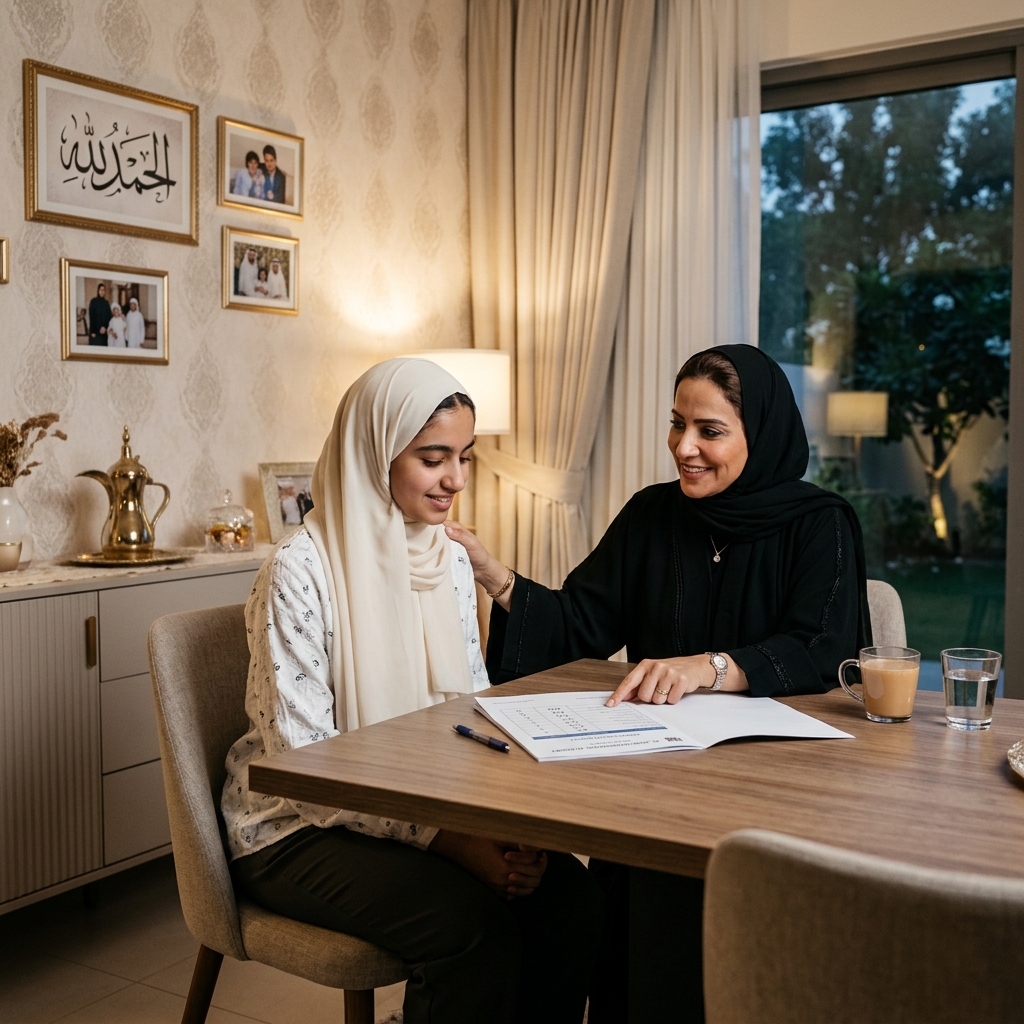
Report card season creates a specific silence in a UAE household. The envelope opens. The grades get read first, then the comments. Most parents give the comments a scan, feel reassured or worried, and move on.
The comments were not written to be scanned. Teachers in KHDA and ADEK-registered schools spend hours on report writing at the end of every term. Every phrase is chosen. What looks like a compliment sometimes carries a small warning. What looks like a warning is sometimes routine language. In my counselling work with UAE families, I often go through reports line by line with parents who thought everything was fine. Nine times out of ten, the same comments read differently once you know the pattern.
Why Report Cards Are Written More Carefully Than Parents Realise
Teachers write comments knowing three audiences will read them:
- The parent: needs enough clarity to respond, but not language that alarms.
- The head of year: needs enough specificity to track progress across terms.
- The student: a Year 10 will read the comment and take it personally.
That triple audience shapes the language. A comment cannot be too direct, because a Year 10 student will read it and take it to heart. It cannot be too vague, because the head of year needs to track progress. It cannot be alarmist, because it goes home to a family the school wants to keep supporting.
The result is a diplomatic style that carries information underneath the surface. Every experienced UAE teacher has a vocabulary for signalling 'this student needs help' without writing those words in a document that stays on the school record. This is not evasive. It is professional. But it means parents have to read the report differently from how they read a text message.
The Three Layers of a School Report
Every comment on a UAE school report carries three layers. Read all three together, or the surface layer alone will mislead.
The sentence the parent reads at first glance.
What the teacher observed in class over the term.
What the teacher recommends, translated into report-card-safe language.
A comment like 'A pleasant member of the class who contributes when prompted' looks positive. The surface says the student is well behaved. The second layer says the student rarely volunteers answers. The third layer, the recommendation, is that the student is coasting and needs pushing. Once parents can see all three layers, most report cards start telling a fuller story.
Decoding the Most Common Phrases
Each phrase below has a surface reading (what parents hear) and a working meaning (what the teacher intended). The working meaning is the one that matters.
"Making steady progress"
Decoded 🔍The student is doing well.
"Would benefit from..."
Decoded 🔍A gentle suggestion the teacher is making.
"Encouraged to..."
Decoded 🔍The teacher is nudging the student.
"Has shown improvement in..."
Decoded 🔍Something has got better.
"Works well when focused"
Decoded 🔍The student can work well.
"A pleasure to teach"
Decoded 🔍The teacher likes the student.
"Silence in the comment box"
Decoded 🔍The teacher was busy.
"The subject-specific tells"
Decoded 🔍Standard subject-specific phrasing.
Effort Grades and Attainment Grades: The Mismatch That Matters
Most UAE reports carry two grades per subject: an effort grade (sometimes called approach or attitude) and an attainment grade. Parents read them together. The gap between the two carries the most information, and it maps neatly onto four quadrants.
Approach is wrong
Student is trying but the study method is off. A good problem to have; effort is harder to build. Fix is in study method or exam technique, not motivation.
Healthy state
Comments here will usually be detailed and specific. A suddenly generic comment feels different.
Fastest response needed
Both metrics dropping in the same term is rarely accidental. Book a meeting.
Coasting on ability
Looks fine until Year 11 or 12 content jumps. Comments usually include 'has capacity for more'.
The follow-up piece why students understand physics but lose marks covers the classic high effort, low attainment pattern.
When the Report Card and Your Child's Words Do Not Match
This is the moment parents notice first: the report shows a drop, and the child says everything is fine. Or the report is glowing, and the child seems worried.
In my experience, the child is usually giving you information the report cannot capture. A Year 12 student who says 'chemistry feels heavier this year' but has an A- on the report is telling you the effort behind that A- has doubled. A Year 10 student who says 'maths is fine' but has a lower grade than last term is often protecting the parent from their own frustration, or protecting themselves from a difficult conversation.
When there is a mismatch, take the child's version seriously. Reports show what has already happened, not what is happening now. What a student feels this week usually shows up on the next report, not the current one. If the child mentions anything about stress, sleep, or exam nerves, the blog what UAE parents miss about exam panic is worth reading before deciding on next steps.
What to Do With the Report Card in the Next 48 Hours
The first 48 hours after a report arrives shape whether the term ahead improves or repeats the same pattern.
Read the comments twice before saying anything. The first read is emotional. The second read is where the pattern shows.
Do not lead with the grade. Ask about a specific comment. 'Your maths teacher wrote that you would benefit from checking your working. What do you think she meant?' This gets a real answer. 'Why did you get a B?' does not.
Compare this term's comments to last term's for the same subject. One report tells you where the student is. Two consecutive reports tell you where they are moving.
Wait until day two before deciding whether extra support is needed. Reports read differently after a night's sleep. Panic-booking tutors on the same evening rarely leads to the right match.
When to Ask the School for a Meeting
A meeting is worth requesting in three situations:
- 1When a comment contains language you do not fully understand and you want the teacher to translate. Schools appreciate parents who ask rather than assume.
- 2When the effort grade and the attainment grade have moved in opposite directions. One of them is telling a story the report format has flattened.
- 3When a subject-specific comment references a topic your child cannot explain at home.
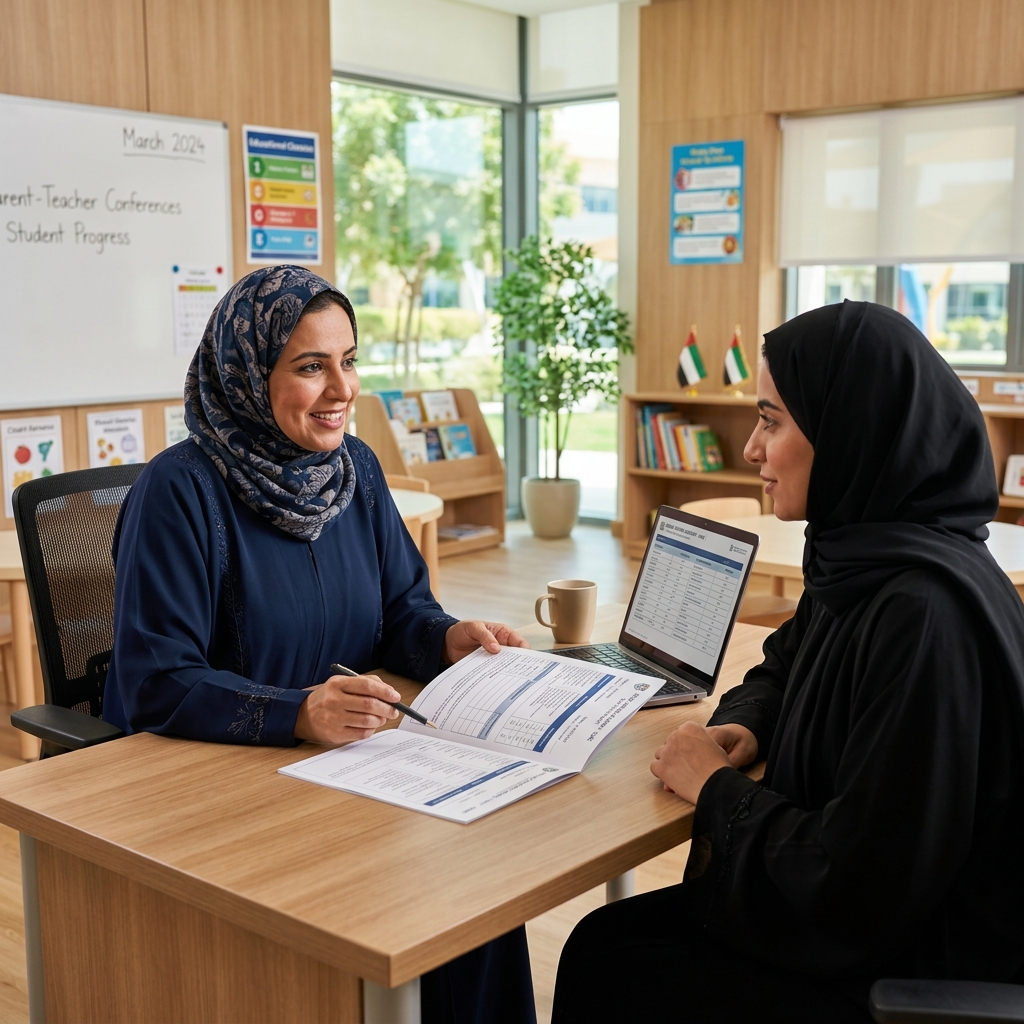
Meetings work best when they are booked around a specific question. 'I want to understand what changed in chemistry between term one and term two' is answerable. 'I am worried about the report' is harder to respond to.
Print, Save, Use Later: Report Card Resources for UAE Parents
Three practical resources to save or print for the next report card cycle. Each takes under one minute to use and works with any UAE curriculum.
The Report Card Decoder
One-page cheat sheet with the eight most common phrases decoded (surface reading versus working meaning). Print and keep with the term's report cards.
Download → ustaad-report-card-decoder.pdf · under 300 KBThe 48-Hour Parent Response Plan
The printable action checklist for the first two days after a report arrives. Hour-by-hour prompts, questions to ask, and what not to do.
Download → ustaad-48-hour-response-plan.pdf · under 300 KBParent-Teacher Meeting Question Template
A short template of specific, answerable questions to bring to a meeting instead of general concerns. One version for high effort or low attainment, one for silence in the comment box, one for a subject-specific concern.
Download → ustaad-parent-teacher-questions.pdf · under 300 KBFrequently Asked Questions
Nimra Shahzada
Education Counsellor at Ustaad UAE
Nimra Shahzada holds a Bachelor's degree in Psychology and works as an Education Counsellor with children across different school settings and age groups. Her work focuses on parent communication, report interpretation, and early-stage learning support. She helps families notice the small routine shifts that appear before performance drops.
Nida Iqbal
MPhil in Education Leadership and Management
Nida Iqbal reviewed this article for educational accuracy and parent relevance, ensuring the guidance reflects sound classroom practice for UAE families navigating report card season.
Need help translating your child's report card into a clear study plan?
Our UAE education counsellors and subject specialist tutors can help decode subject reports, identify core learning gaps, and build a targeted revision roadmap.
No commitment. Cancel anytime.
 Ask on WhatsApp