ChatGPT for Studying: Does AI Hurt Memory? How UAE Students Can Use It the Smart Way
Does ChatGPT hurt students' memory? See what the research shows, plus six rules for using AI to revise without losing what you learn.

It is 9:40 p.m. in Sharjah. A Year 10 student finishes his maths homework in twelve minutes. Every answer is correct, neatly laid out, with working shown. His mother is impressed.
The next morning, he sits a short class test on the same topic and scores far below his homework. Nothing about him changed overnight. The difference was that, the night before, ChatGPT had been open in the next tab.
Families across the UAE are asking the same question: is ChatGPT for studying a shortcut to better grades, or a shortcut around learning? The honest answer is that it can be either, and the difference comes down to one thing: who does the thinking first.
What the research says about AI and learning
The best evidence so far comes from a study by Hamsa Bastani and colleagues, published in the Proceedings of the National Academy of Sciences in 2025. They worked with a high school in Turkey and gave nearly a thousand maths students one of three set-ups during practice sessions:
- GPT Base: a tool that behaved like standard ChatGPT.
- GPT Tutor: the same underlying model, but set up with safeguards: it gave incremental hints and common-mistake warnings rather than full solutions.
- No AI: a control group.
In a later exam, taken with no AI at all, the results split sharply.
| Group | Practice session (AI available) | Exam (AI removed) |
|---|---|---|
| GPT Base | About 48% better than the control group | About 17% worse than the control group |
| GPT Tutor (with hints) | About 127% better than the control group | Roughly the same as the control group |
| No AI | Baseline | Baseline |
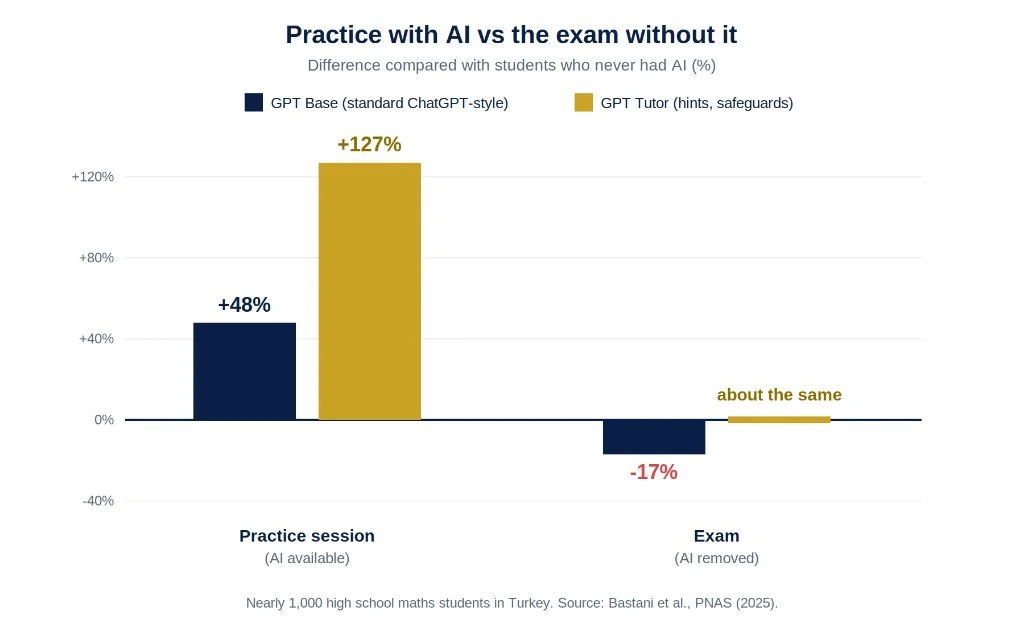
Two lessons stand out:
- Better performance with AI is not the same as learning. Practice scores soared, but the knowledge did not travel with the students.
- Design matters. The harm was largely avoided when AI behaved like a tutor, giving hints and making the student work, rather than an answer machine. The researchers also found that students who used AI tended to overestimate how much they had learned.
A note of caution. This was one school, one subject and one version of the technology, so results may differ elsewhere. But it matches what decades of memory research would predict.
Why AI can weaken memory
Memory is built by effort, and AI is very good at removing effort. Four mechanisms are worth knowing.
It skips retrieval. The act of pulling information out of your head is what strengthens it, a finding known as the testing effect (Roediger and Karpicke). If AI supplies the answer, there is nothing to retrieve. Our guide to The Illusion of Competence explains why recognising an answer feels like knowing it.
It skips generation. Information you produce yourself is remembered better than information you simply read, known as the generation effect (Slamecka and Graf). A neatly written AI answer is read, not generated.
It encourages cognitive offloading. People naturally lean on external tools to reduce mental effort, and research on cognitive offloading (Risko and Gilbert) suggests this can reduce what we remember ourselves. That is fine for a phone number. It is a problem for a chemistry mechanism that will be tested in a silent hall.
It creates a feeling of understanding. A clear, confident explanation feels like learning. Students who read an AI explanation often feel they have understood, but a feeling of fluency is not the same as being able to reproduce the idea. This is the same trap that makes re-reading feel productive.
There is also a practical problem: AI makes mistakes. It can state wrong answers confidently, and a student who has not tried the problem first is poorly placed to notice.
The same mechanism sits behind the pattern in The Scaffolding Trap: Why Students Freeze on Exam Questions. A tool that is always available is the most powerful scaffold a student has ever had, and the exam removes it.
AI in UAE schools and exam rooms
AI is not going away, and the UAE is leaning in. The Ministry of Education introduced AI as a formal subject across public schools from kindergarten to Grade 12 from the 2025–26 academic year, and some private schools have introduced it too. Students are being taught to understand and use AI, which makes careful habits more important, not less.
Meanwhile, the rules for assessments are firm:
- Supervised exams are AI-free. Internet-enabled AI tools are not allowed in written IGCSE and A-Level papers.
- Coursework has strict rules. Cambridge and Pearson allow only limited, acknowledged AI use in some coursework, and treat unacknowledged or inappropriate use as malpractice. Rules differ by board and subject and change over time, and Cambridge notes that centres and teachers hold primary responsibility for spotting inappropriate use.
- Your school's policy comes first. Many schools have their own AI policy that is stricter than the board's.
In other words, in the places where marks are decided, a student's own memory is still the only tool. See our guide on independent thinking in A-Level tutoring for why this matters more at A-Level.
A traffic-light guide: green, amber and red uses
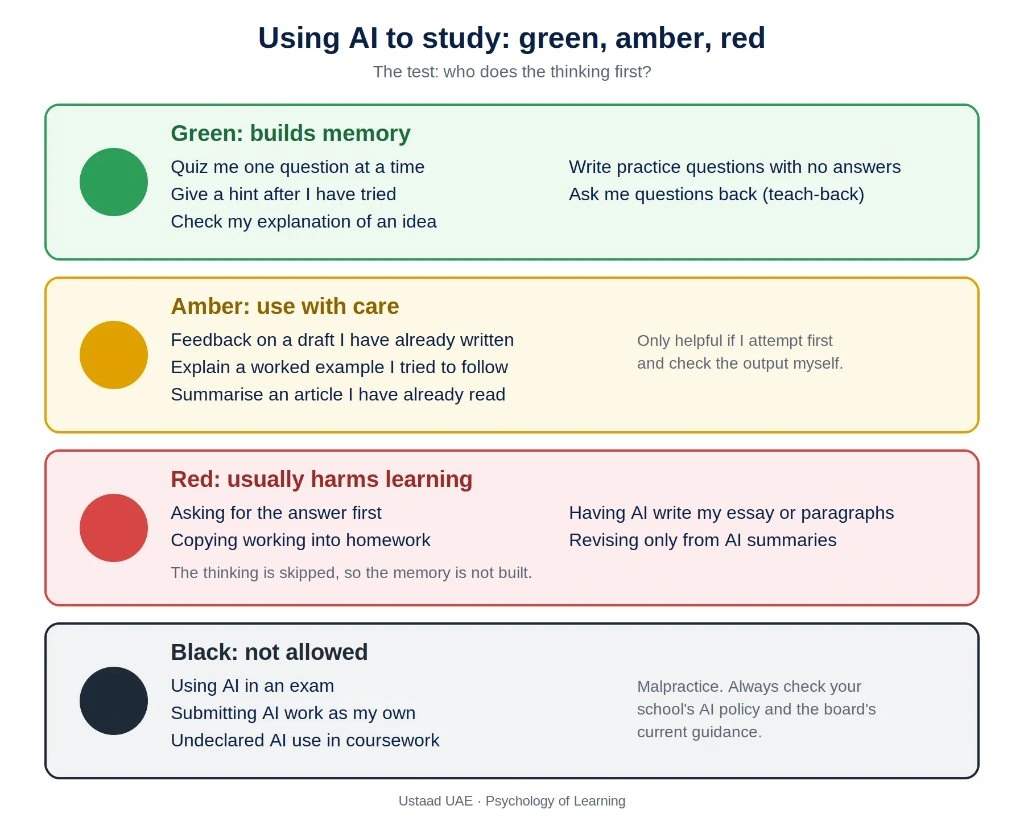
Not all AI use is equal. A simple traffic light helps families sort it.
| Colour | Uses | Why |
|---|---|---|
| Green: builds memory | Quizzing you one question at a time. Giving a hint after you have tried. Marking your explanation and asking questions back. Generating practice questions without answers. | You do the retrieval and the thinking. AI provides the challenge and feedback. |
| Amber: use with care | Feedback on a draft you have already written. Explaining a worked example you have tried to follow. Summarising an article you have already read. | Helpful only if you attempt first and check the output yourself. |
| Red: usually harms learning | Asking for the answer first. Copying working into homework. Having AI write paragraphs or essays. Revising only from AI summaries. | The thinking is skipped, so the memory is not built. |
| Black: not allowed | Using AI in an exam. Submitting AI-generated work as your own in assessed work. Undeclared AI use in coursework. | Malpractice, with serious consequences. |
Six rules for using ChatGPT to study
1. Try first, for at least ten minutes. Before opening AI, attempt the question on paper. Struggling for a few minutes is not wasted time: it is where memory forms. If you get stuck, note exactly where.
2. Ask for hints, not answers. Use a hint ladder: first a nudge, then a hint, then a worked step, and only after another attempt, the full solution. This is the design that protected learning in the research.
3. Let AI quiz you. The best use of AI for revision is retrieval practice: it asks, you answer from memory, then it gives feedback. That is far closer to an exam than reading an AI summary.
4. Teach it back. Explain the idea in your own words, then ask AI what you missed. Saying it aloud or writing it out forces generation, and the feedback fills the gaps.
5. Check what it tells you. Treat AI as a fallible tutor, not an authority. Check facts against your textbook, notes and the official mark scheme. In maths, check answers by substituting them back (see our guide to silly mistakes in maths exams).
6. End with a no-AI test. After a study session, close the laptop and answer five questions cold. If you cannot, the learning has not stuck. This is the closest home version of the exam.

Copy-and-paste prompts that build memory
Students often ask for better “ChatGPT prompts for revision”. These are built to keep the thinking with the student. Replace the brackets with your subject, board and topic.
| Purpose | Prompt |
|---|---|
| Quiz mode | “Act as my [board] [subject] tutor. Ask me one question at a time on [topic]. Do not show the answer until I reply. After I answer, tell me what I got right, what I missed, and the first step where my thinking went wrong.” |
| Hint ladder | “I'm stuck on this question. Do not solve it. Give me one small hint and wait. If I ask for more, give a bigger hint, but do not give the final answer until I have tried again and ask for the full solution.” |
| Teach-back | “I will explain [concept] in my own words. Tell me what is correct, what is missing, and ask me two questions to test my understanding.” |
| Error finder | “Here is my working. Do not rewrite it. Tell me only the first line that contains an error, and why it is wrong.” |
| Practice questions | “Write five questions on [topic] in the style of [board] papers, getting harder, with no answers. I will send my answers before you show any mark points.” |
Always verify against the official mark scheme. AI marking is a useful second opinion, but it is not a substitute for the board's own marking guidance.

What parents can look for (and say)
You do not need to understand the technology. You need to notice the gap between homework and understanding.
Signs AI may be doing too much of the thinking:
- Homework is polished, but the child cannot explain it aloud
- Class-test results are far below homework results
- Your child cannot do a similar question when you change the numbers
- A sudden jump in the quality of writing that does not match their usual voice
- Reluctance to show rough working or the first attempt
What to say:
| Instead of… | Try… |
|---|---|
| “Are you cheating with ChatGPT?” | “Show me how you used it. Where did you get stuck first?” |
| “Don't touch AI.” | “Try it on paper first, then use AI for hints and feedback.” |
| “This looks perfect!” | “Explain this step to me as if I'd never seen it.” |
| “Why did you do worse on the test?” | “Let's try a few without AI and see which parts feel shaky.” |
A simple family agreement helps: try first, ask for hints, quiz yourself, and finish with a no-AI check. Researchers and educators suggest a short reflection after any AI-assisted work: where did I get stuck, what hint did I ask for, what did I use, and can I now solve a similar question alone? Our guide on how much parents should help with homework covers the wider balance.

Coursework, honesty and the rules
Where marks count towards a qualification, honesty matters most.
- Check your school's AI policy and the exam board's current guidance before using AI for any assessed work.
- Declare any permitted use in the format the school or board requires.
- Never submit AI-generated text as your own. Passing off AI work as a student's own is treated as malpractice, with consequences that can include lost marks or disqualification.
- Keep drafts and notes. Schools often check progress at intermediate stages, and your own drafts show the work is yours.
If you are unsure whether a use is allowed, ask the teacher before you do it.
When reliance on AI is a sign of something else
Sometimes heavy AI use is not laziness but a way of managing a feeling. A student may reach for AI immediately because:
- They feel anxious about getting it wrong. See our guide to maths anxiety in teenagers.
- They find it hard to start. See why teenagers procrastinate on revision.
- They are overwhelmed or exhausted. Sleep and workload both matter (see Sleep and Memory).
- They have a genuine gap and no one to ask.
In each case, banning the tool treats the symptom. Addressing the cause usually reduces the reliance. If a gap is the reason, a short diagnostic with a tutor or the subject teacher can rebuild the foundation, so AI becomes a coach rather than a crutch.
Frequently asked questions
Sources and further reading
Bastani, H., Bastani, O., Sungu, A., Ge, H., Kabakcı, Ö., & Mariman, R. (2025). Generative AI without guardrails can harm learning: Evidence from high school mathematics. Proceedings of the National Academy of Sciences, 122(26), e2422633122.
Roediger, H. L., & Karpicke, J. D. (2006). Test-enhanced learning: Taking memory tests improves long-term retention. Psychological Science.
Slamecka, N. J., & Graf, P. (1978). The generation effect: Delineation of a phenomenon. Journal of Experimental Psychology: Human Learning and Memory.
Risko, E. F., & Gilbert, S. J. (2016). Cognitive offloading. Trends in Cognitive Sciences.
Dunlosky, J., Rawson, K. A., Marsh, E. J., Nathan, M. J., & Willingham, D. T. (2013). Improving students' learning with effective learning techniques. Psychological Science in the Public Interest.
UAE Ministry of Education: Announcement of AI as a formal subject in public schools, kindergarten to Grade 12, from 2025–26.
Cambridge International: Guidance on generative AI in coursework.
JCQ: AI Use in Assessments: Protecting the Integrity of Qualifications.
Related: The Scaffolding Trap: Why Students Freeze on Exam Questions
Related: The Illusion of Competence
Is AI doing your child's thinking, or helping it?
Every first Ustaad lesson starts with 15 free minutes to pinpoint the gaps and agree where to focus next. Sessions are online and 1-to-1, for families in every emirate. No commitment. Cancel anytime.
Nimra writes guides for parents on study technique, memory and exam preparation for British and IB curriculum students across the UAE.
Ustaad Editorial Team. Every guide is checked for accuracy, educational validity and parent clarity before it is published.