
Why Students Understand in Class: Breaking the Scaffolding Trap
Does your child follow everything in class but freeze when facing an exam question? Learn why educational scaffolding creates false fluency, how "near transfer" tricks the brain, and how UAE parents can rebuild genuine problem-solving independence.


A Year 11 student in Dubai sits down at her revision desk, completes eight chemistry problems from the end-of-chapter review, and gets seven of them correct. Her notes are beautifully arranged in highlighters, and she feels ready.
Two weeks later, during mock examinations, she opens Paper 4. On question three, she stares at the page for six minutes in total silence. Her mind feels completely blank. She writes down a stray formula, crosses it out, and moves on with a racing heart.
When the graded papers are returned, her parents ask the inevitable question: “You did five of these exact questions on Tuesday evening. Why couldn’t you do this one?”
The student assumes she panicked or is “just bad at exams.” But in cognitive science, the true culprit is almost always something far more specific: the scaffolding trap.
Following a worked solution is a recognition task. But walking into an unprompted exam question and determining what to do first is an unassisted production and retrieval task. When students mistake the comfort of following an explanation for the ability to initiate it from scratch, they fall into the scaffolding trap.
01The classroom paradox: following vs initiating
To understand why students freeze, we must look at what actually happens during classroom instruction. When a teacher or tutor presents a multi-step problem, whether in IGCSE Mathematics, IB Physics, or A-Level Chemistry, they provide three invisible cognitive supports that the student does not notice:
- Topic Framing: The problem is delivered under a specific banner (e.g. “Chapter 4: Conservation of Momentum”). The student never has to ask themselves what formula applies.
- Entry Point Cueing: The teacher states the opening assumption: “First, let us resolve horizontal vectors...” The student is relieved of the single hardest cognitive task: finding the entry step.
- Working Memory Offloading: The interim calculations are displayed visually. The student only evaluates whether step 3 follows step 2.
Because every individual step makes total sense, the student’s brain releases a sensation of comprehension. Educational psychologists call this the illusion of explanatory depth. The student genuinely believes they understand the topic. In reality, they understand the story of the topic when narrated by an expert.
02The anatomy of the scaffolding trap
In educational theory, scaffolding is a positive concept introduced by Lev Vygotsky and Jerome Bruner. It refers to temporary support structures that enable a learner to complete tasks they could not yet manage independently.
A scaffolding trap develops when the supports are never systematically removed before the examination. Instead of building self-reliant cognitive paths, the student becomes dependent on subtle environmental crutches:
| Study Habit | The Invisible Scaffolding | What Happens in the Exam |
|---|---|---|
| Re-reading worked examples | The complete pathway is visible before problem-solving begins. | Freezes because the page is blank and offers no forward cues. |
| Immediate mark scheme checking | Checking after 30 seconds of resistance avoids mental struggle. | Lacks stamina when stuck; gives up after one attempt. |
| Topic-by-topic textbook drills | Every question belongs to the chapter heading above it. | Cannot identify which topic an unlabelled question belongs to. |
| Spoon-feeding revision sessions | A peer, parent or tutor steps in whenever hesitation occurs. | Experiences panic without an adult validating early calculations. |

03Near transfer vs far transfer in UAE exams
Students attending leading British and IB schools across the UAE (such as JESS Arabian Ranches, Dubai College, Cranleigh Abu Dhabi, or GEMS Wellington) face modern assessments designed specifically to defeat rote recall.
Exam boards like Cambridge International (CIE), Pearson Edexcel, and the International Baccalaureate (IBO) deliberately divide questions into two categories:
The question looks identical to classroom demonstrations, with only the numbers changed. E.g., calculating velocity using v = u + at with all three variables provided in the first line.
The concept is disguised inside an unfamiliar context (e.g. calculating orbital deceleration around an irregular satellite using energy conservation first). The student must diagnose the underlying principle with zero explicit cues.
When students spend their term studying with scaffolding, they train purely for near transfer. The moment they open Paper 4 in IGCSE or Paper 2 in IB Diploma, the absence of familiar clues causes cognitive overload.
04Why the brain freezes on unstructured questions
When a student meets a question that does not match their memorised templates, their working memory experiences what John Sweller termed excessive extraneous cognitive load.
Working memory can hold only 4 to 7 items at once. When a student is confident and scaffold-free, the problem schema is retrieved as a single mental chunk: “This is a projectile motion problem where I must resolve initial velocity into components.”
However, when a student is caught in the scaffolding trap, their working memory must simultaneously juggle:
- Scanning the paragraphs for keywords they might recognise.
- Panicking about the ticking clock in the examination hall.
- Wondering which formula on the formula sheet might fit the numbers.
- Remembering what their teacher wrote on the whiteboard last month.
Under this sensory barrage, working memory collapses. The student freezes, stares at the blank answer lines, and assumes they are “just bad at exams.” In reality, their problem-solving muscle simply was not trained to initiate.

05The 4-step "fading support" protocol
Breaking the scaffolding trap does not mean throwing a struggling teenager into deep past papers without help. It requires a disciplined protocol known in cognitive science as fading scaffolding:
Step 1: Worked model with reasoning verbalisation
The student reviews one complete worked example, but with one critical rule: they must explain aloud why the first line was chosen. Not what the calculation is, but what clue in the question forced that exact opening.
Step 2: The “Cover & Re-solve” rule
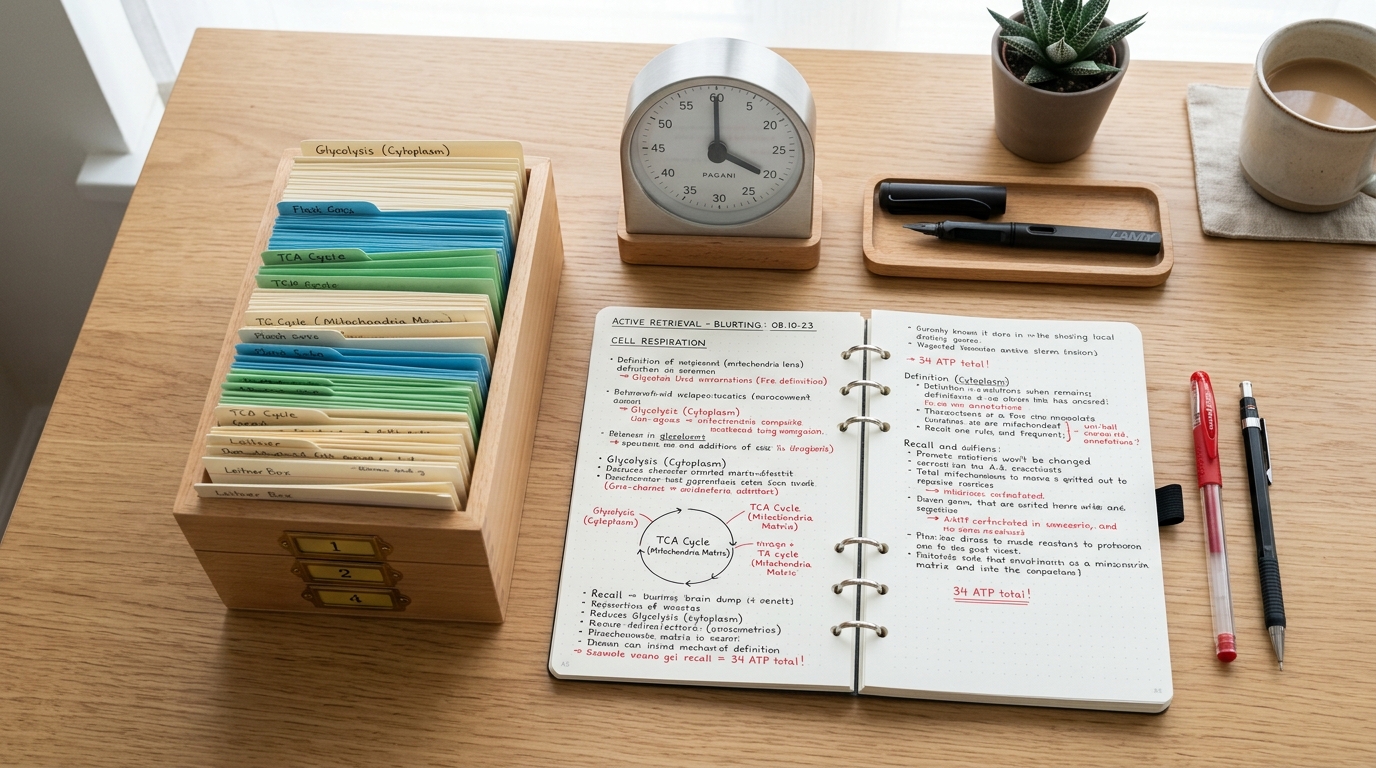
Immediately after reviewing a solution, the student covers it entirely with an index card or blank sheet. They must write out the derivation on clean paper from memory. If they get stuck, they may peek for two seconds, re-cover, and start the line again.
Step 3: Prompt stripping (removing sub-steps)
Textbooks often give parts (a), (b), and (c) to guide students gently to the final conclusion. In Step 3, fold the paper to hide parts (a) and (b), presenting only the initial data and the final goal in part (c). The student must plan their own stepping stones.
Step 4: Interleaved “jumbled papers”
Never revise one topic in a solitary block. Mix questions from three unrelated units (e.g. one circle theorem question, one stoichiometry problem, one kinematics graph). This forces the brain to practise problem identification, which is 50% of exam survival.
06Five question prompts UAE parents can use at home
When parents sit beside a frustrated teenager doing revision at home in Dubai or Abu Dhabi, the natural instinct is to point at the textbook or say: “Look, remember you need to rearrange for x first?”
While well-intentioned, this instantly replaces the student’s mental initiative. Instead, use these five neutral coaching prompts that preserve independent thinking:

07How 1-to-1 mentorship restores exam independence
At Ustaad, our philosophy directly opposes the spoon-feeding culture that traps students in false confidence. A student who has an adult doing the thinking for them during tutoring sessions will always experience an exam-hall shock.
Our vetted subject specialists across Maths, Physics, Chemistry, and Biology are trained specifically in cognitive fading:
- Diagnostic Socratic Questioning: When a student pauses, tutors do not give the next step. They ask the question the student should be asking themselves.
- Deliberate Tolerance of Productive Struggle: Allowing the student two minutes of quiet thinking builds the psychological tolerance required for real exam halls.
- Unstructured Exam Drills: Moving early from topical worksheets to mixed, multi-topic past papers so the student masters topic diagnosis.
08Frequently asked questions
09Sources and further reading
Sweller, J. (1988). Cognitive load during problem solving: Effects on learning. Cognitive Science, 12(2), 257–285.
Roediger, H. L., & Karpicke, J. D. (2006). The power of testing memory: Basic research and implications for educational practice. Perspectives on Psychological Science, 1(3), 181–210.
Vygotsky, L. S. (1978). Mind in society: The development of higher psychological processes. Harvard University Press.
Barnett, S. M., & Ceci, S. J. (2002). When and where do we apply what we learn? A taxonomy for far transfer. Psychological Bulletin, 128(4), 612–637.
Dunlosky, J., Rawson, K. A., Marsh, E. J., Nathan, M. J., & Willingham, D. T. (2013). Improving students' learning with effective learning techniques. Psychological Science in the Public Interest, 14(1), 4–58.
Related Guides on Psychology of Learning
Writer on learning and the psychology of studying. Nimra writes guides for parents on study technique, memory and exam preparation for British and IB curriculum students across the UAE.
Every guide is checked for accuracy, educational validity and parent clarity by curriculum specialists before publication.
Is it exam panic, or the scaffolding trap?
An Ustaad tutor can work through a short, board-specific task with your child, identify where independent problem initiation breaks down, and build a targeted plan for exam independence.