
Maths Anxiety in Teenagers: Why Your Child Says "I'm Just Bad at Maths" (and How to Help)
Does your child say they're bad at maths? Learn the signs of maths anxiety in teenagers, what causes it, and practical ways UAE parents can help.


It is Thursday evening in Dubai, and a Year 9 student has a maths worksheet due in the morning.
In English and history he is quick, funny and confident. With maths, something changes. He suddenly needs a snack. His stomach hurts. He sharpens a pencil, rereads the first question four times, and then says what his parents have heard before: "I'm just not a maths person."
Yet last weekend, with his dad sitting calmly beside him and no clock running, he solved the same kind of question without trouble.
His parents wonder whether he is lazy, unlucky or simply weak at maths. A better question is a different one: what is happening to him in the moment he sees the page?
For many students, the answer is maths anxiety. It is common, it is often missed, and it responds well to the right kind of help. This guide explains what it is, how to tell it apart from a knowledge gap or ordinary exam nerves, and what UAE families can do about it.
01What maths anxiety actually is
Maths anxiety is a feeling of tension, worry or dread around maths, in lessons, homework and tests, that gets in the way of doing it. Researchers have studied it for decades, and three points matter most for parents:
- It is not the same as being bad at maths. Students with strong skills can have it. What it affects is access: the student knows the method but cannot reach it while worried.
- It is different from general anxiety. A student can be relaxed in history and tense in maths. Research by Maloney and Beilock describes maths anxiety as a distinct pattern, related to general anxiety but not identical to it.
- It is a recognised pattern in research, not a diagnosis on its own. It is also found across many countries, and studies using international assessment data link it with lower maths performance (Foley and colleagues).
02What it looks like at home and at school
Maths anxiety rarely announces itself. Students do not usually say "I feel anxious about maths". They show it in ways that can look like laziness, stubbornness or boredom.
One sign is especially telling: a student who can do a question calmly at the kitchen table but not in a lesson or test. That gap suggests the problem lies less in what they know and more in what happens to their thinking under pressure.

Avoidance is a hallmark. If your child puts off maths in particular, our guide to why teenagers procrastinate on revision explains how avoiding an unpleasant feeling can easily be mistaken for laziness.
03Why it happens
There is rarely one single cause. Several usually combine:
Gaps that snowball
Maths is cumulative. A shaky grasp of fractions, negative numbers or basic algebraic rearrangement in Year 7 or 8 can surface as "I'm completely lost" in Year 10, because every single new topic stands on the earlier ones.
Painful moments
Being wrong in front of the class, being made to feel slow, a timed test that went badly, or constant comparison with classmates. One or two such moments can leave a lasting subconscious association between maths and acute embarrassment.
Beliefs about innate ability
"Some people are just maths people" is a profoundly harmful idea. A student who believes it views every struggle not as a problem to solve, but as definitive proof that they simply lack the genetic wiring.
High stakes
Maths is often treated as the subject that counts, with tier decisions, predicted grades and university admission requirements behind it. The bigger the stakes feel, the more threatening a single question becomes.
The attitudes around them
Parents and teachers can pass on maths anxiety without meaning to. In a landmark study of first and second graders in the United States, Maloney and colleagues found that children of highly maths-anxious parents learned less maths over the school year and became more anxious themselves, but only when those parents helped with maths homework frequently. It was a study of young children, and it does not mean parents should stop helping. It suggests that the emotional temperature around the maths matters just as much as the academic help.
The loop
These causes feed each other in a relentless cycle:
Anxiety → Avoidance → Less practice → Gaps → Lower marks → More anxiety
A review by Carey and colleagues concluded that the link between maths anxiety and performance probably runs both ways. Anxiety can lower performance, and poor performance can create anxiety. That is why it is unwise to assume anxiety is always the original cause. Very often, a hidden curriculum gap came first.
The Self Reinforcing Maths Anxiety Loop
04What worry does to the thinking brain
Multi-step maths leans heavily on working memory, the mental workbench that holds a question in mind while the student chooses a method, retrieves formulas, and tracks each arithmetic step.
Research by Ashcraft and Kirk found that maths anxiety actively disrupts working memory, particularly on demanding problems. Worrying thoughts ("I'm going to get this wrong, everyone else is already writing") compete directly for the exact same limited cognitive bandwidth the student needs for the calculation.
- Easy, one-step questions often go fine because they require little working memory.
- Longer, multi-step questions are where the student completely stalls.
- The exact same question is manageable at the kitchen table, where the threat level is lower.
Capable students are not immune. Having high working memory helps, but when anxiety floods the brain, that space gets crowded out just as quickly.
We explore the same cognitive mechanism from a different angle in Your Child Understands Physics. So Why Are the Marks Still Low? and in our guide to Exam Stamina: Why Your Child Can't Sit the Full Paper.
The Mental Workbench: How Anxiety Hijacks Working Memory
Based on Ashcraft & Kirk (2001). Working memory has limited slots (~4 units). Worry competes directly with mathematical reasoning.
05Maths anxiety, a knowledge gap, or exam panic?
The right help depends entirely on which problem you are really facing. Often there is a mix, but one usually leads:
A simple home diagnostic test: Pick three or four easier questions from an earlier year, in a calm weekend moment, with no timer running. If your child manages them comfortably, the issue leans towards pressure and confidence. If they struggle even then, there is almost certainly a foundational gap that needs rebuilding first.
For the exam-panic column, our guide to why some children only panic right before exams explains what usually sits behind general exam nerves.
06Seven ways to help
1Find the first gap and rebuild from there
Doing more of the current topic rarely helps if the foundation is shaky. If algebraic fractions are causing tears, the issue is often Year 7 numerical fractions or Year 8 basic factorising. Work backwards until you find where understanding stops, then rebuild forwards. A maths specialist can do this quickly with a short diagnostic.
2Make success small and frequent
Anxiety shrinks with evidence. Start with questions that are easy, untimed and low stakes, then gradually add difficulty, and only later add time pressure. Each calm success weakens the subconscious "maths equals danger" link.
The Maths Confidence Ladder
Work upwards from Step 1. Never jump to timed past papers until earlier rungs feel calm.
3Write the worry down before a test
Park, Ramirez and Beilock found that students who spent ten minutes writing about their worries before a maths test performed significantly better, particularly those most anxious about the subject. A student writes freely: "What I'm worried about is…" Getting the worry onto paper offloads working memory, leaving more cognitive room for the maths.

4Reframe the body's signals
A racing heart and butterflies are the body preparing to perform, not an omen of failure. In research by Jamieson and colleagues, students taught to see nervous arousal as helpful did better on the maths section of a university entrance test than those who tried to suppress it. "My body is getting ready" is a far more functional thought than "I'm panicking".
5Explain, don't just calculate
Ask your child to say aloud what each step means and why they are doing it. This builds conceptual understanding and reveals exactly where thinking breaks down. It is the same habit Fahad Khan describes in his guide to what the y-intercept actually means, where calculating a number without real meaning leaves a student fragile under pressure.
6Treat mistakes as information
A wrong answer is not proof of inadequacy; it shows where thinking slipped off track. A short error log, recording the first incorrect step and why it happened, turns mistakes into a structured roadmap. Our guide to silly mistakes in maths exams shows how to build this habit into daily practice.
7Watch the language at home
Children pick up adult attitudes with remarkable speed. Subtle shifts in vocabulary transform the emotional atmosphere:
If you feel anxious about maths yourself, you are not alone, and you do not need to hide it. Stay curious ("let's work it out together"), avoid saying you hate the subject, and let the teacher or an experienced tutor lead on method. Our guide to how much parents should help with homework covers finding the right balance.
07Extra pressure points for IGCSE students
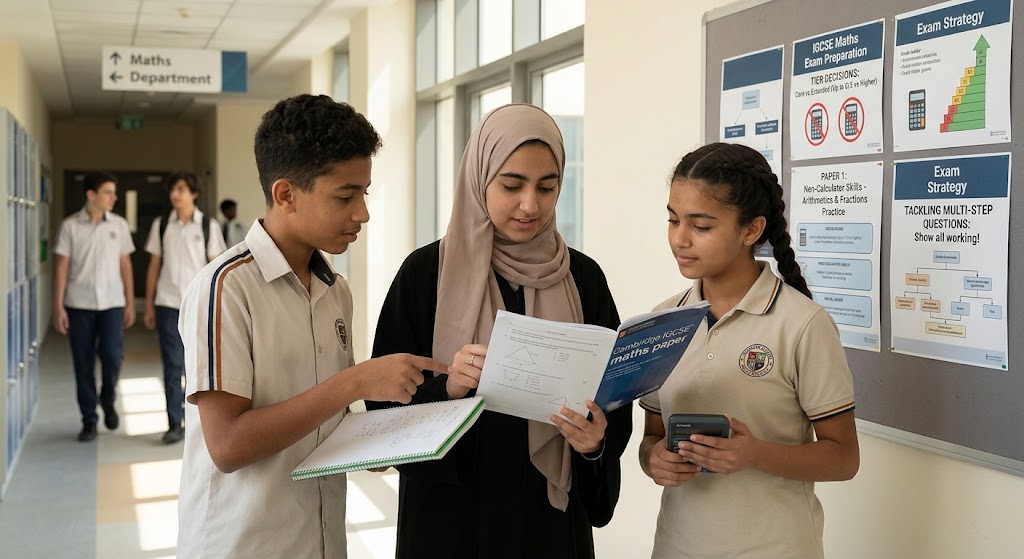
Three specific features of Cambridge and Edexcel IGCSE maths frequently intensify the feeling of threat for UAE students:
Tier decisions
Foundation or Core entry caps the highest grade available (often at Grade 5 or C), whereas Higher or Extended carries much more demanding abstract content. Worry alone should never decide the tier, nor should panic. The decision must rest on objective diagnostic evidence of what your child can do, so discuss it carefully with their subject teacher.
The non-calculator paper
Without the safety blanket of a calculator, small arithmetic slips, negative numbers and fraction operations come to the very front. Practise these core arithmetic skills calmly and separately before they appear in the middle of a past paper.
Multi-step questions
Long, 4- to 6-mark questions place the heaviest load on working memory. Writing every single sub-step down on paper, rather than trying to hold it mentally, significantly protects against overload.
08When it is more than maths anxiety
Most maths anxiety improves steadily with patient, structured support. However, certain signs call for broader professional help:
- •Panic attacks, severe distress, tears before maths lessons, or school avoidance
- •Persistent changes in sleep or appetite, or a sustained low mood
- •Worry that spreads beyond maths into most areas of school life
- •A strong, unshakeable belief that they are fundamentally "stupid"
If these signs persist, speak directly with your school's counsellor or pastoral team, and consult your family doctor.
Maths Anxiety vs Dyscalculia
Maths anxiety is not the same as dyscalculia, a specific learning difference that affects basic number sense, subitising and arithmetic reasoning. The symptoms can overlap, and a student can have both. If your child has struggled with fundamental number concepts since early primary school, regardless of effort or emotional state, ask the school about an assessment by an educational psychologist.
Disclaimer: This article provides educational guidance and does not replace clinical or medical advice.
09Frequently asked questions
10Sources and further reading
• Ashcraft, M. H., & Kirk, E. P. (2001). The relationships among working memory, math anxiety, and performance. Journal of Experimental Psychology: General.
• Maloney, E. A., & Beilock, S. L. (2012). Math anxiety: Who has it, why it develops, and how to guard against it. Trends in Cognitive Sciences.
• Maloney, E. A., Ramirez, G., Gunderson, E. A., Levine, S. C., & Beilock, S. L. (2015). Intergenerational effects of parents' math anxiety on children's math achievement and anxiety. Psychological Science.
• Carey, E., Hill, F., Devine, A., & Szűcs, D. (2016). The chicken or the egg? The direction of the relationship between mathematics anxiety and mathematics performance. Frontiers in Psychology.
• Dowker, A., Sarkar, A., & Looi, C. Y. (2016). Mathematics anxiety: What have we learned in 60 years? Frontiers in Psychology.
• Foley, A. E., Herts, J. B., Borgonovi, F., Guerriero, S., Levine, S. C., & Beilock, S. L. (2017). The math anxiety-performance link: A global phenomenon. Current Directions in Psychological Science.
• Park, D., Ramirez, G., & Beilock, S. L. (2014). The role of expressive writing in math anxiety. Journal of Experimental Psychology: Applied.
• Jamieson, J. P., Mendes, W. B., Blackstock, E., & Schmader, T. (2010). Turning the knots in your stomach into bows: Reappraising arousal improves performance on the GRE. Journal of Experimental Social Psychology.
Related Guides on Psychology of Learning
Writer on learning and the psychology of studying. Nimra writes guides for parents on study technique, memory and exam preparation for British and IB curriculum students across the UAE.
Every guide is checked for accuracy, educational validity and parent clarity before it is published.
Is it maths anxiety, or a gap your child can't see?
An Ustaad maths specialist can run a short online 1-to-1 session with your child, work out which topics are causing the stall, and rebuild from the first shaky step. Sessions are online, for families in every emirate.