

Many UAE parents start noticing this pattern during the secondary school years. School expectations stay steady all year, so the pressure does not suddenly appear before exams. It builds quietly over time.
A child may seem fine for months, and then become emotional or withdrawn as exams come closer. What surprises parents is how sudden this shift looks.
But the stress was rarely sudden. It had been building for weeks, sometimes months, inside the child's routine. That quiet pressure is where the cycle begins, and where most parents miss it.
What Parents Usually Notice First
Most parents do not first recognise this as stress. They notice changes in behaviour.
A child who studied on her own suddenly needs constant reassurance. An organised student starts delaying work or avoiding her books. Some become emotional over small things at home. Others go quiet.
These changes often show up in everyday routines:
- unfinished homework
- disturbed sleep
- arguments about study time or screens
- emotional reactions after school
A Year 10 IGCSE student finishes all her maths homework correctly. The next day, her teacher gives a short timed quiz on the same topic. She freezes. Her marks drop. At home, her parents see this as carelessness, and she may start blaming herself too.
But her understanding was real. It only worked when she did not feel watched, timed, or judged. The gap between "understands at home" and "performs in school" is where the cycle begins, and where the stress slowly starts to show.
This is also where the subject-level pattern starts to show. For a closer look at why hours of revision often do not turn into IGCSE maths marks, see Why IGCSE Maths Students Suffer Low Marks | Ustaad.

What Is Happening Beneath the Panic
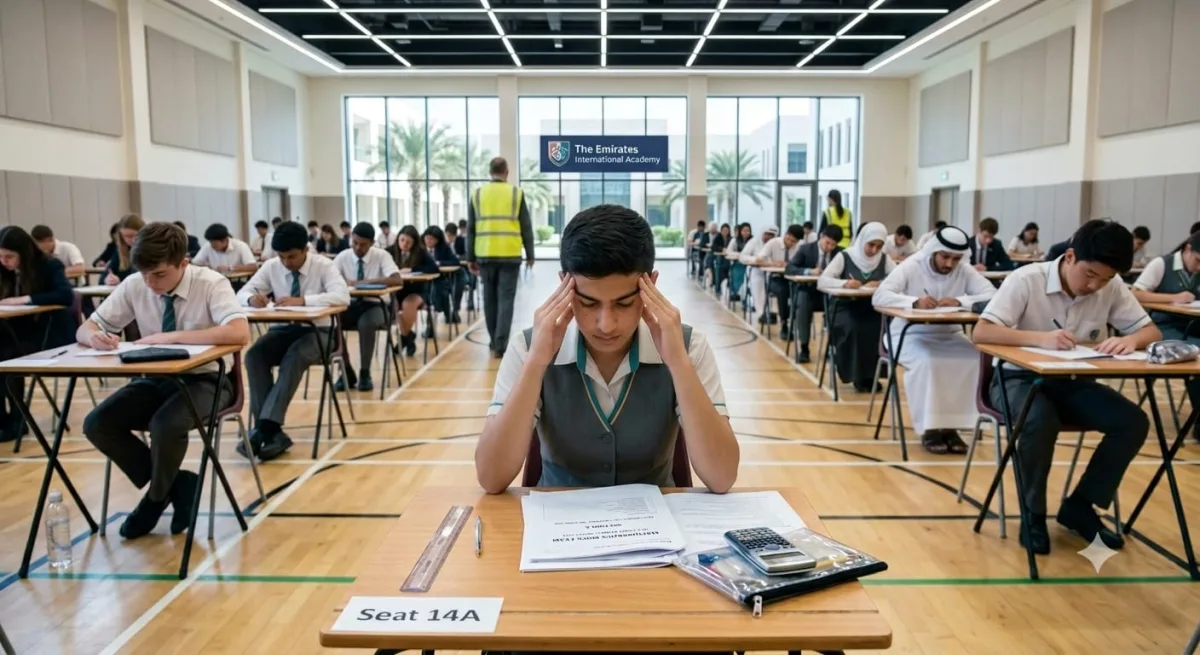
Exam panic looks like a sudden emotional event. It rarely is.
What students feel is the result of weeks of low-grade pressure with no release. They have been holding small worries quietly: questions they did not understand in class, marks that felt unfair, or comparisons they overheard at home or with peers.
By exam time, the stress is not new. It is just finally showing up because the child can no longer hold it in. A sudden outburst, an unusual mistake, or a strange mood during exams often tells us more about your child's mental state than the result itself.
I once worked with a Year 11 IGCSE Chemistry student in the UAE. She was usually confident, but during one mock, she stopped halfway through Paper 2. Her teacher noticed she had answered eight questions correctly, then started erasing and rewriting the same answer over and over.
Afterwards, she said she felt fine until question nine, when she did not recognise the format. From that moment, her brain "stopped trusting itself," and she could not move on.
This is what cognitive load under pressure looks like in a real exam room. It is not a lack of knowledge. It is losing access to it.
Why Stress Often Appears Suddenly Before Exams
After working with many UAE students, I have noticed that children in secondary school become very aware of expectations and comparisons. The pressure rarely arrives in one moment. It builds slowly, and then bursts when the child can no longer hold it in.
Research across Gulf school contexts has also shown that students in high-expectation environments tend to hide their stress, especially when grades and performance are a regular topic at home.
By the time formal exams begin, what looks like sudden panic is usually the point where quiet coping has finally run out.
In a recent case, a Year 12 student preparing for A-Level Physics in Abu Dhabi was scoring 82–85% on past papers at home. In his first school mock, he scored 62%. Same content. Same student.
What changed was the environment. Bright lighting, an invigilator in the room, and knowing the result would reach the head of department shifted his focus from the questions to himself. His preparation was solid; his exam state was not, and his confidence dropped sharply.
Drops like this are rarely about content. They are about how exam conditions meet the pressure that has been building unnoticed. For Abu Dhabi students preparing for physics exams, this kind of exam-state preparation is one of the focus areas at Ustaad's physics tutoring in Abu Dhabi.
Common Misconceptions About Exam Panic
Four common assumptions often get in the way of helping students:
Misconception 1:"If they studied more, they wouldn't panic."
Misconception 2:"They're just being dramatic."
Misconception 3:"They were fine last year, so they'll be fine this year."
Misconception 4:"They avoid studying because they don't care."
What Steadier Students Do Differently
I often tell parents that students who handle exam season more calmly are rarely the most gifted. They share a few habits, built quietly early in the term:
- They treat homework as thinking, not just task completion. When they get something wrong, they review the reasoning, not just the answer.
- They sit timed practice papers earlier in the term. By exam time, the format no longer surprises them, and they stop panicking under timed conditions.
- They talk about difficulty without shame. They tell parents or teachers when something does not make sense.
- They keep study sessions short and consistent rather than long and unfocused.
Two A-Level Maths students started the term with similar grades. One checked only the final answer on his homework. The other reviewed every wrong working step and asked his teacher about it.
By mock season, the second student was scoring fifteen marks higher on average. Not because he was brighter, but because his preparation built a more accurate picture of what he actually knew.
The pattern is consistent: steadier students reduce uncertainty early. Exam panic feeds on uncertainty.
How Parents Can Help, Before and During Exam Season
Helpful parent support is usually quieter than parents expect.
Earlier in the term, what helps most is stability:
- predictable routines
- calm conversations at home
- realistic daily expectations
- short, consistent study habits
- noticing effort, not only outcomes
A mother in Abu Dhabi described her daughter as feeling "completely different during exam months." Her daughter attended a British curriculum school and performed steadily through the year, but every exam period the atmosphere at home shifted. Sleep became irregular. Small questions turned into arguments. Routines felt tense.
At first, the mother thought stricter discipline would help. Later she realised her daughter was not struggling with the schoolwork; she was carrying the weight of constant performance talk at home.
When the family reduced exam talk and built calmer routines earlier, the atmosphere changed. The exams did not become easier. The emotional load became lighter. For Abu Dhabi families where this pressure shows up most clearly around a single subject, especially maths, structured help is available through Ustaad's maths tutoring in Abu Dhabi.
Once a child is already overwhelmed, the approach needs to soften, not intensify. Shorter sessions, less pressure, and rebuilding small routines often help more than long schedules.

When Extra Support May Help
As a counsellor, I often see patterns families struggle to address on their own. When a child avoids studying despite wanting to do well, when gaps stay hidden in homework but appear under timed conditions, or when their emotional regulation drops across the term, these are usually signs the child is carrying more than effort alone can solve.
In many UAE families I work with, this is where I recommend reaching out to Ustaad. Not as added pressure, but as calmer, structured guidance for parents trying to understand what is happening underneath.
If a student continues to struggle despite consistent effort, personalised academic support may help identify the underlying issue and build a more effective path forward.
No commitment. Cancel anytime.
Final Thoughts for Parents
When exam stress becomes visible, I find parents tend to focus only on the exam period itself. In my experience, the more important story is usually what was building before.
Students cope better when support starts earlier in the year. Small routines and calmer communication make a real difference over time. Parents start to notice changes gradually: a child who is more willing to talk, less defensive, and more able to explain their thinking without shutting down.
That shift comes from stability, not intensity.
If your child only seems stressed during exam season, the most useful question is not "how do we get through this week?" but "what was happening in the months before?" From what I have seen, early awareness usually prevents the same cycle from repeating each term.
Frequently Asked Questions
Related Articles for UAE Parents
Exams Are Back in the UAE. What Changes for Your Child
After portfolio grading, what changes for students who have never sat a real paper, and how parents can help.
Psychology of LearningYour Child Understands Physics. So Why Are the Marks Still Low?
The gap between understanding and exam performance: retrieval, working memory, and nerves.
Parent GuidanceGCSE & IGCSE Revision Tips for UAE Parents
Study skills that raise grades, and how to support your child without taking over.
Nimra Shahzada | Education Counsellor & Student Support Specialist
Nimra Shahzada holds a Bachelor's degree in Psychology and works as an Education Counsellor with children across different school settings and age groups. Her work focuses on student wellbeing, academic confidence, and emotional support during high-pressure learning periods. She helps families build calmer, more consistent routines before pressure starts affecting their child's performance and wellbeing.
Nida Iqbal | MPhil in Education Leadership and Management
Nida Iqbal holds an MPhil in Education Leadership and Management. She reviewed this article for educational accuracy and parent relevance, ensuring the guidance reflects sound practice for UAE families navigating exam-related stress.
Ustaad supports students and families across the UAE through structured academic mentorship, exam preparation guidance, and personalised learning support.
No commitment. Cancel anytime.
 Ask on WhatsApp