

In my counselling work with UAE families, the chemistry conversation almost always begins after the report card. A parent shows me a drop from an A to a B, and asks what happened. The report offers a polite guess. The child in the next room knows the real story but cannot describe it.
The drop is almost never the first sign. It is the last one. In chemistry, the earlier signs appear at home, in the notebook, and in one honest conversation. Parents just have to know where to look.
Why Chemistry Behaves Differently From Other Subjects
Chemistry hides its problems in a way other subjects do not. In maths, a weak topic shows up in the next test within a week. In chemistry, students can copy definitions and pass a short quiz without understanding the topic underneath. The mark stays fine. The gap keeps growing.
This is because chemistry topics sit on each other. If a Year 9 student never fully grasps ionic bonding, the mole feels harder in Year 10. If the mole is unclear, stoichiometry breaks. By Year 12, organic mechanisms feel unreachable, and the student cannot explain why.
The good news: fixing a bonding gap in Year 9 takes two sessions. Fixing the same gap in Year 12, once it has spread through five other topics, takes half a term. That is why chemistry rewards early attention more than almost any other subject at IGCSE and A-Level.
For the student-side view of how chemistry knowledge fades from memory once it has been learned, see Why Chemistry Fades From Memory. That article covers what happens inside a student’s head. This one covers what parents can see from the outside.
The Signs That Appear Long Before the Grade Drops
Six specific patterns show up in students who are about to struggle. None of them involve a low mark. All of them are visible at home, in the notebook, or in one honest conversation.
They Stopped Explaining What They Studied
At the start of the year, most students will tell you what they did in class if you ask. When chemistry becomes uncomfortable, that stops. They say “we did chapter 4” without any content. If your child used to describe experiments or draw diagrams at the dining table and no longer does, the subject has quietly become something they want to avoid discussing.
The Notebook Is Neat but Thin
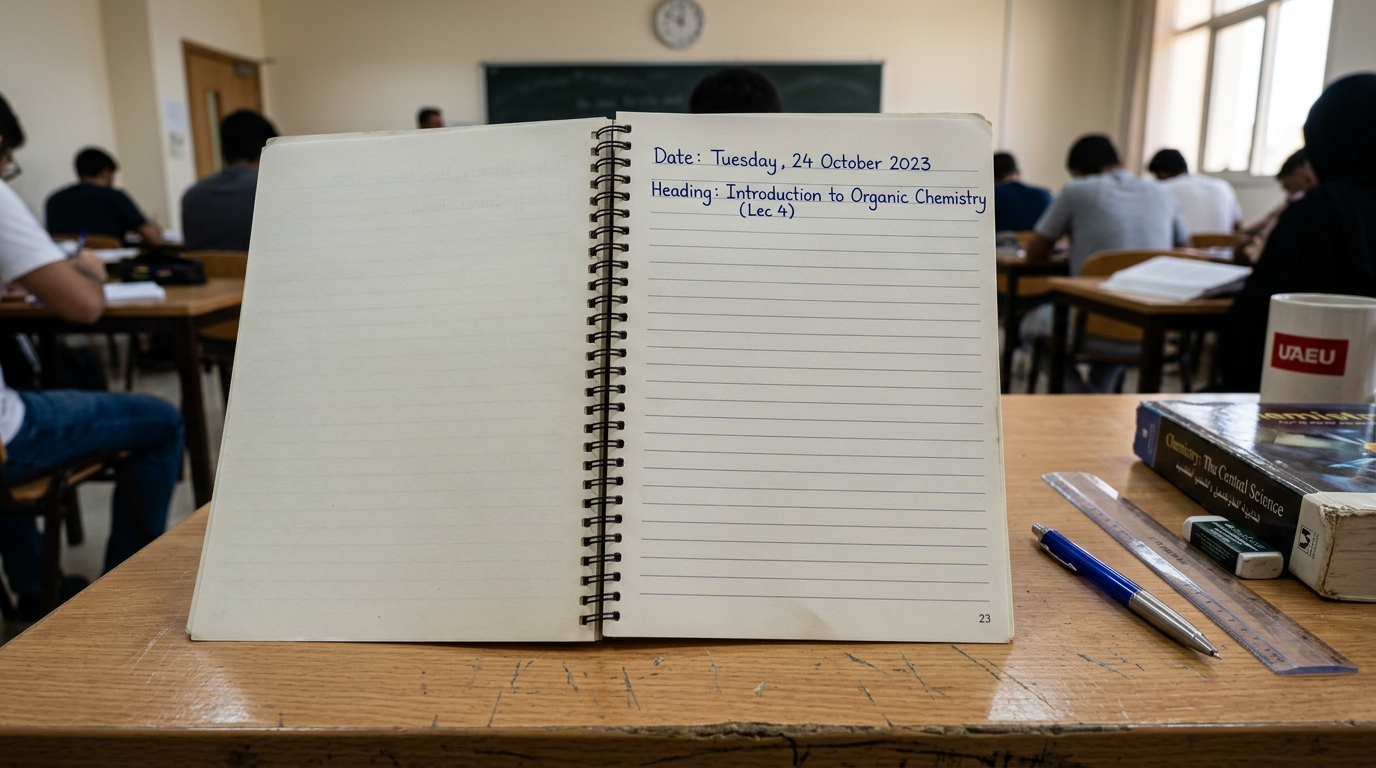
Chemistry notebooks fill up quickly during a healthy term. Equations. Diagrams. Practical observations. Mark scheme phrasing copied from the board. When a student is falling behind, the notebook stays clean but stops growing. Pages have headings and dates but only two or three lines underneath. The neatness is the tell. It looks like the notebook of a student trying to appear on top of the subject rather than one actually working through it.
They Avoid Practical Write-Ups More Than Tests
I once spent an afternoon with a Year 11 chemistry teacher in Abu Dhabi, going through her students’ notebooks with her. She showed me the pattern she watches for. The students most at risk of a mock-exam drop were not the ones who missed homework. They were the ones who left practical write-ups until the last night. When a student understands a topic, the write-up is easy: describe what they did, what they observed, what it means. When they do not understand it, the write-up exposes it directly, because there is no formula to hide behind. If your child is finishing tests on time but delaying practical reports, that is the earlier signal.
Textbook Terminology Sounds Foreign at Home
Chemistry has words that should feel familiar by the middle of Year 10. Ask your child what a mole is, without letting them open a book. If they explain it in their own words, the foundation is holding. If they answer with a copied definition, or say “it’s just a number teachers use”, the gap has already started. This check takes two minutes and works in any language.
They Confuse Equations That Look Similar
There is a specific pattern where students mix up equations that share symbols. Rate equals concentration over time gets confused with concentration equals moles over volume. Ionic equations get written the same way as full equations because the student cannot see why anything should be cancelled. This is not carelessness. It is a sign that the underlying concept was never fully separated from the surface arithmetic. Teachers see this daily, and it is one of the strongest predictors of a mid-term drop.
Homework Takes Longer Without Getting Better
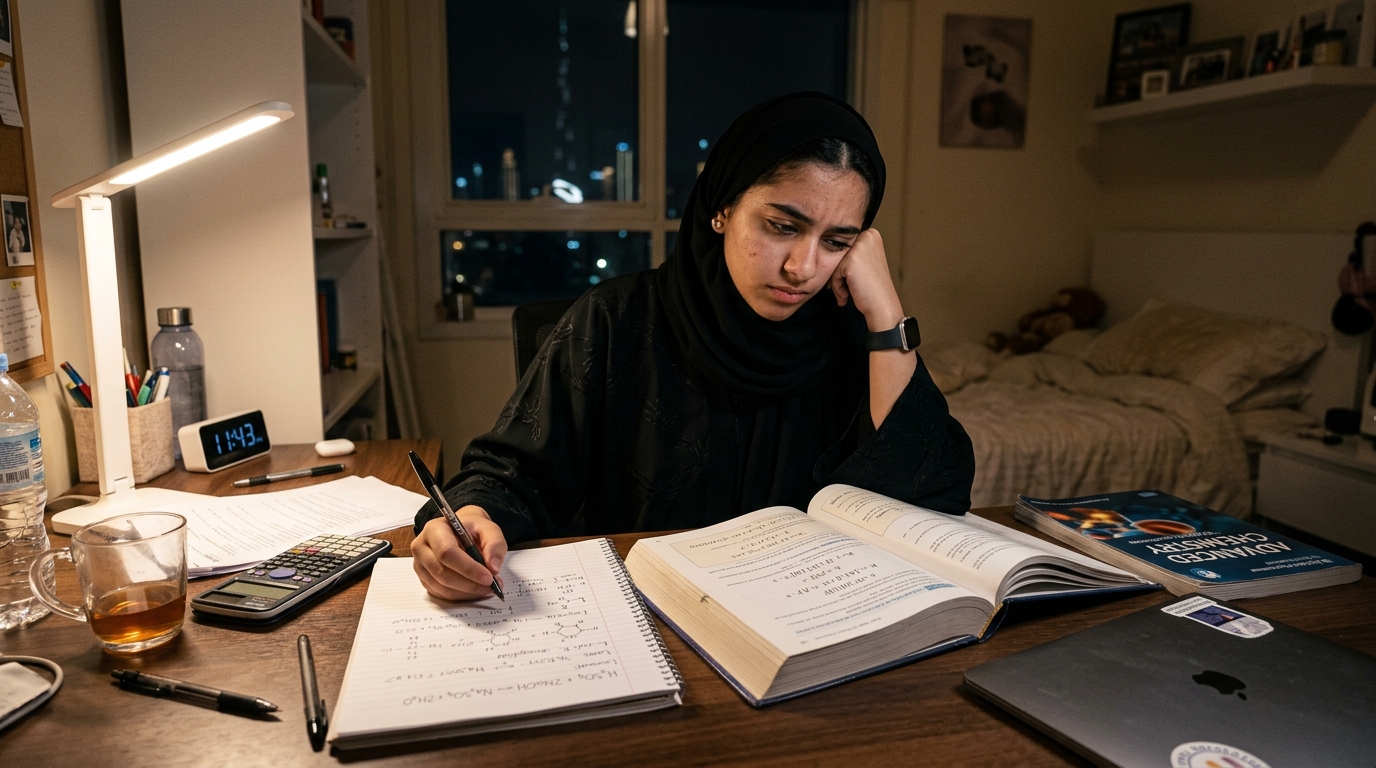
A Year 10 student sat opposite me last term. His parents had told me he was studying chemistry for over an hour every evening but his marks had dropped from a B to a D. I asked him what he actually did in that hour. He told me: reread the chapter, look at the equations, ask a friend, redo one question, close the book. That was the whole hour. If chemistry homework used to take forty minutes and now takes ninety, but marks are the same or slightly worse, the extra time is being spent on guesswork. This is often the sign parents notice first, because it is measurable at the kitchen table.
What Parents Often Miss About Chemistry Transitions
Three moments in a UAE student’s school path are riskier than the rest, and most families do not see them as transitions until after they have caused a problem.
The first is the shift from Year 9 to Year 10. In Year 9, chemistry is more descriptive and forgiving. In Year 10, Cambridge IGCSE 0620 and Edexcel IGCSE 4CH1 introduce calculation-heavy topics quickly. A student who was comfortable last year can look confused within six weeks without any warning from the school.
The second is the middle of Year 11, when past paper practice replaces new content. Weaknesses that were carried quietly through the syllabus become visible under exam-style questions. Parents interpret the sudden struggle as exam pressure. It is usually the accumulation of small gaps that were never addressed. For the emotional side of this pattern, our earlier piece What UAE Parents Miss About Exam Panic explains how mock-season stress often traces back to earlier terms.
The third is IGCSE to A-Level. A-Level chemistry expects fluent handling of concepts that were only introduced at IGCSE. Students who scraped a grade 7 or an A at IGCSE by memorising can find A-Level unreachable within the first term. Many families realise this only after the first internal exam, when the fix is far more expensive in time.
What Happens When Parents Wait for the Report Card
By the time a report shows a drop, roughly four to eight weeks of teaching have already moved on from the topic that caused it. The student is now trying to learn new material on top of the gap. Every fresh topic makes the gap harder to isolate.
I have sat with families whose child was fine at Year 10 mocks and struggling by Year 11 mocks. In almost every case, the parents had noticed one of the six signs around week five or six of the previous term and waited to see if it resolved. It rarely does in chemistry.
This is not about panicking at the first missed homework. It is about noticing when two or three signs appear together and taking a short, low-effort action while the gap is still small.

What Parents Can Do This Week
The most useful checks take under fifteen minutes and give parents a clearer picture than any report card.
- Ask a specific question, not a general one. “How is chemistry going?” almost always returns “fine”. “Can you explain what the mole is, without opening the book?” returns real information within thirty seconds.
- Look at the last practical write-up rather than the last test. The write-up shows whether they understood what they were doing. The test shows only whether they could recall the answer.
- Give them one past paper question from the current topic and watch how they start. Confident students read the question once and begin. Struggling students reread, flip through notes, or ask which formula to use. The first thirty seconds tell you almost everything.
- Check the notebook every three or four weeks. Not to inspect, but to see whether it is filling in. A thinning notebook in the middle of a term is almost always a signal of a topic that has become uncomfortable.
None of this requires a chemistry background. It requires paying attention to the shape of your child’s work, not only the numbers on the report.
When to Bring in Support
If two or more of the six signs are present for longer than three weeks, and your child is heading into IGCSE 0620, A-Level, IB Chemistry, or AP Chemistry, that is the point where a diagnostic conversation is useful. Not a full course. A single session with someone who can identify whether the gap is in bonding, calculations, or exam technique.
Early support works because the fix is usually small at that stage. Waiting turns a small fix into a term-long rebuild.
At Ustaad, families in Abu Dhabi and Dubai often reach out at this stage precisely because their child has not dropped yet. That is the right window. A free trial session lets a specialist tutor identify the gap in one sitting and tell the parent honestly whether ongoing support is needed. Explore chemistry tutoring at Ustaad or, if you are in Abu Dhabi, chemistry tutor Abu Dhabi for the local option.
A Note From an Education Counsellor
I meet many parents who feel guilty for not noticing sooner. There is no reason to. Chemistry is hard to read from the outside, and schools rarely flag a student until the grade actually falls. The most useful thing a parent can do is stop waiting for the report card and read the smaller signals.
None of this requires being a chemistry expert. It requires knowing where to look, and acting when two signals appear together. That is what keeps an early two-session fix small, rather than letting it grow into a term-long rescue project by Year 12.
Frequently Asked Questions
Nimra Shahzada | Education Counsellor & Student Support Specialist | Ustaad UAE
Nimra Shahzada holds a Bachelor’s degree in Psychology and works as an Education Counsellor with children across different school settings and age groups. Her work focuses on student wellbeing, academic confidence, and early-stage learning support. She helps families notice the small routine shifts that appear before performance drops.
Nida Iqbal | MPhil in Education Leadership and Management
Nida Iqbal holds an MPhil in Education Leadership and Management. She reviewed this article for educational accuracy and parent relevance, ensuring the guidance reflects sound classroom practice for UAE families navigating early academic warning signs.
Noticing signs but not sure what they mean?
Sometimes the challenge is not the subject, it is knowing what a small pattern change actually means. A single diagnostic session with a specialist chemistry tutor can identify whether the gap is worth acting on now, or whether it will resolve on its own.
No commitment. Cancel anytime.
 Ask on WhatsApp