
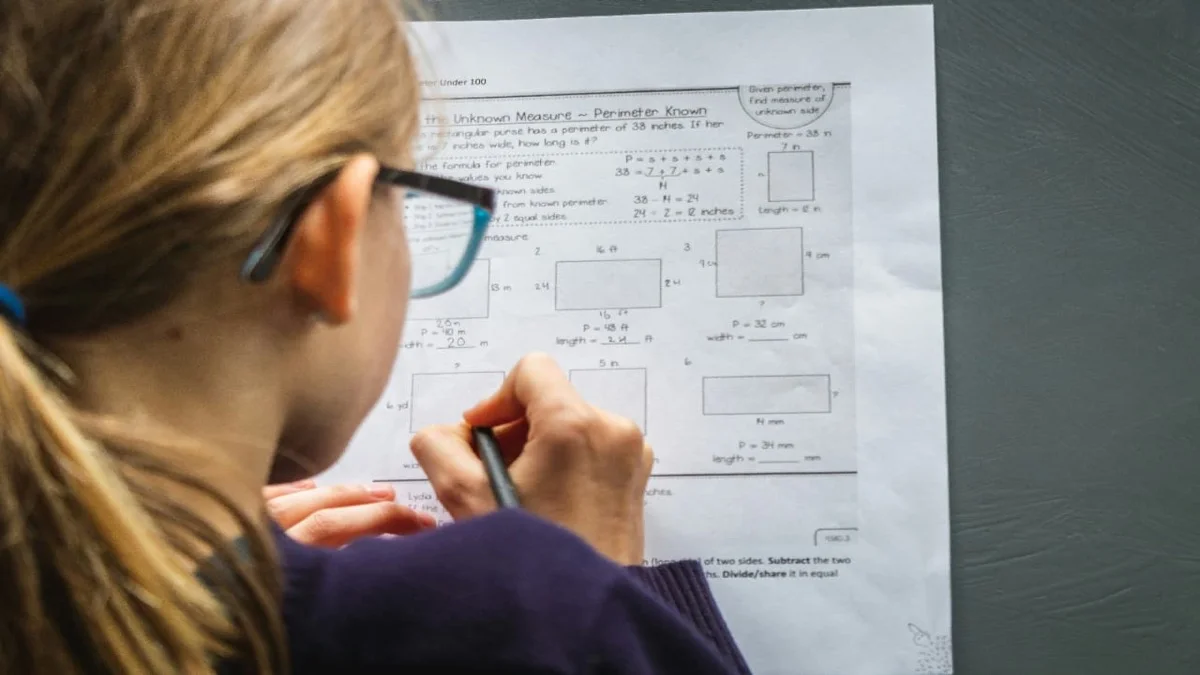
There is a pattern many parents across the UAE begin noticing around exam season. Their child spends weeks revising, completes worksheets regularly, attends classes consistently, and walks into the IGCSE maths exam looking fully prepared. But after the paper, the response is often uncertain:
"I don't know how it went."
Then the results arrive, and the marks are far lower than expected.
For many families, the confusing part is that the effort was genuinely there. The student studied consistently, revised carefully, and appeared disciplined at home. Yet somehow, the final performance still failed to reflect the preparation.
This is one of the most common concerns parents raise during Year 10 and Year 11, especially in competitive British curriculum schools across Dubai and Abu Dhabi where academic pressure quietly increases as board exams approach.
In many cases, the issue is not laziness, distraction, or lack of revision time.
The real difficulty begins when students are expected to apply what they know independently under timed exam conditions.
And by the time parents notice the problem clearly, the gap has often been developing for much longer beneath the surface.
What Actually Happens Inside the Exam Hall
The early signs are usually subtle.
A student may revise confidently the night before the exam, solve familiar textbook questions comfortably, and even explain a topic correctly at home.
Then the paper presents the same concept in a slightly different form.
Suddenly, the method that felt obvious during revision no longer feels obvious anymore.
This is where many IGCSE maths students begin losing marks.
Not because they never studied the topic, but because their understanding was built around familiar question patterns instead of the mathematical idea underneath them.
Cambridge IGCSE 0580 and Edexcel IGCSE 4MA1 papers are designed specifically to test application, flexibility, and reasoning. Examiners regularly change wording, restructure question layouts, and combine concepts together inside one problem.
Students who rely mainly on repetition often struggle when the presentation changes.
Students who understand the logic behind the method usually adapt more calmly.
Over time, repeated moments like this do more than affect grades. They slowly change how students feel before exams and often become part of a much larger emotional pattern that many UAE families notice during assessment season, especially when stress is only addressed at the last minute. That experience is explored further in maths exam anxiety, what UAE parents often notice too late.
A Simple Equation That Explains the Entire Problem
Here is a real classroom observation that explains the issue very clearly.
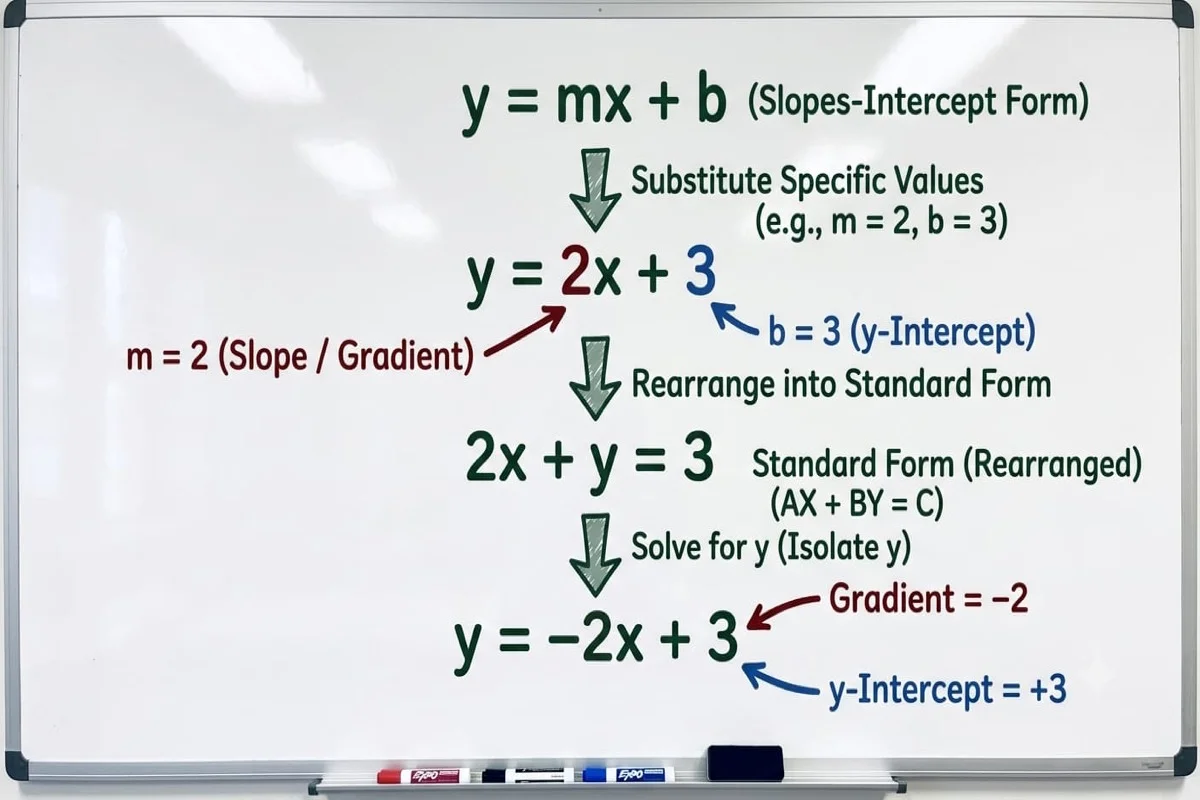
A student is shown the equation:
They answer confidently.
- m is the gradient
- b is the y-intercept
When the equation appears as:
the student immediately identifies:
- gradient = 2
- intercept = 3
That part feels easy.
Then the same concept appears differently:
And suddenly confusion begins.
Many students glance at this and immediately assume the gradient is 2 because their mind connects the term "2x" to familiar practice questions.
But the equation first needs rearranging:
Now the gradient becomes −2.
The mathematics never changed. Only the presentation changed.
And that small shift is often enough to expose weak conceptual understanding.
What many students are actually missing is not algebra itself, but the ability to recognise what the equation represents beyond its layout on the page.
Once students begin connecting ideas across different chapters instead of memorising isolated patterns, unfamiliar questions stop feeling completely new.
That is exactly what many IGCSE maths exams are testing.
Where Revision Starts Breaking Down
One of the biggest misunderstandings parents hear is:
"Just practise more questions."
Practice matters.
But in maths, repetition without understanding can quietly create another problem.
A student may solve twenty similar questions correctly during revision and still freeze during the exam when the structure changes slightly.
Why?
Because the brain memorised a pattern, not the reasoning behind it.
This becomes especially common in students balancing school, tuition, homework, and revision schedules across busy academic environments in the UAE. Many become extremely familiar with predictable question styles but struggle when independent thinking is suddenly required under pressure.
That is why two students can spend the same number of hours studying and still achieve very different outcomes.
One student understands:
- why the method works
- when it applies
- how to adapt it
The other mainly remembers steps attached to a familiar layout.
The difference becomes visible only when the exam changes the structure.
The Emotional Shift Parents Often Notice Too Late
This is usually the stage where maths stops feeling like "just another subject."
At first, students assume they simply made careless mistakes.
Then the same thing happens again in another test.
Slowly, a more damaging thought begins forming:
"Maybe I'm just not good at maths."
That belief changes behaviour very quickly.
Students begin:
- hesitating during questions
- avoiding difficult topics
- relying heavily on memorised methods
- panicking faster in exams
- losing confidence before even attempting unfamiliar problems
The issue is no longer purely academic. It becomes emotional.
For many families in the UAE, this emotional shift develops gradually through repeated moments where effort does not seem to match results.
The encouraging part is that confidence usually returns once understanding becomes clearer.
Not through pressure. Not through longer study hours. But through repeated experiences where the student finally understands why something works.

What Real Understanding Actually Looks Like
Fractions provide a very simple example.
Take this:
Some students memorise separate rules for:
- addition
- subtraction
- multiplication
- division
That approach may work for routine exercises.
But once questions become mixed, layered, or unfamiliar, confusion starts appearing because the student is remembering procedures without understanding the relationship underneath them.
Now compare that with a student who genuinely understands fractions.
They understand that fractions represent parts of a whole.
So when solving:
they understand why equal parts are needed before addition becomes possible.
Similarly:
feels logical because multiplication scales one quantity by another.
And division becomes easier to interpret when students understand why:
instead of treating it like a rule that simply needs memorising.
Once understanding becomes deeper, students stop depending entirely on fixed patterns. They become more flexible when questions appear in unfamiliar forms.
That flexibility is what IGCSE maths papers reward most.
How IGCSE Maths Revision Should Actually Work
As an IGCSE maths teacher, this is something I often explain very honestly to parents:
The issue is usually not how many hours a student studies. It is how those hours are being used.
Here are a few approaches that genuinely improve performance over time.
Focus on understanding before speed
Practise the same concept in different forms
Use past papers diagnostically
Past papers should not become memorisation exercises. The important questions are:
- Where did the student hesitate?
- Which step caused confusion?
- At what point did reasoning break down?
That is where meaningful improvement begins.
Show full working clearly
Strengthen algebra continuously
What Kind of Support Actually Helps Students Improve
One thing many parents eventually realise is that more tuition does not automatically solve the problem.
Sometimes students already spend hours attending classes, revising notes, and completing worksheets.
What they actually need is more personalised academic observation.
The most effective support usually begins by identifying:
- the exact step where confusion begins
- the point where reasoning stops
- where the student starts guessing instead of thinking clearly
That is very different from simply re-teaching an entire chapter again.
This is also why many families eventually move away from repetitive tuition models and begin looking for more personalised academic guidance that focuses on how the student thinks, not just what they memorise.
Platforms like Ustaad are becoming increasingly relevant for UAE families because the approach focuses more on diagnostic learning, behavioural understanding, and concept clarity instead of simply increasing worksheet volume.
For Abu Dhabi families looking for this kind of focused, concept-led support, Ustaad's maths tutoring in Abu Dhabi is built around exactly these principles.
And in many cases, that shift changes far more than marks alone. It changes how students experience the subject emotionally.
Final Thoughts for Parents
If your child has been studying consistently but the marks still do not reflect the effort, the worst conclusion to draw is that they are incapable.
Most of the time, the problem is not intelligence.
It is a preparation style that does not fully match what modern IGCSE maths exams are actually testing.
This is one of the most fixable academic problems students face.
But solving it usually requires a different kind of revision:
- less dependence on memorised patterns
- more focus on reasoning
- stronger conceptual connections
- more independent thinking
- calmer learning environments
Once that shift begins, improvement often follows surprisingly quickly. Then confidence slowly returns after it. And the subject that once felt overwhelming starts becoming manageable again, with the right kind of support.
Which, in the long run, is the kind of progress that actually lasts.
If a student continues to struggle despite consistent effort, personalised academic support may help identify the underlying issue and build a more effective path forward.
Frequently Asked Questions
IGCSE Maths Specialist | Ustaad UAE (name withheld on request)
This article was written by a senior IGCSE Mathematics specialist at Ustaad UAE with classroom experience across Cambridge IGCSE (0580) and Edexcel IGCSE (4MA1). The author works closely with Year 10 and Year 11 students in Dubai and Abu Dhabi, with a focus on diagnostic teaching, conceptual fluency, and exam technique. The author's name has been withheld on request.
Nida Iqbal | MPhil in Education Leadership and Management
Nida Iqbal holds an MPhil in Education Leadership and Management. She reviewed this article for educational accuracy and parent relevance, ensuring the guidance reflects sound IGCSE classroom practice for UAE families.
Ustaad supports IGCSE maths students across the UAE through diagnostic, concept-led learning aligned to Cambridge IGCSE Mathematics (0580) and Edexcel IGCSE Mathematics (4MA1).
No commitment. Cancel anytime.
 Ask on WhatsApp