

Your child knows the biology. They can define osmosis. They can list the stages of mitosis. They revise for hours. Yet the mock report keeps showing the same pattern: full marks on the short questions, and only two or three out of six on the long ones.
Sound familiar? For most UAE families sitting Cambridge IGCSE 0610 or Pearson Edexcel International GCSE 4BI1, this shortfall between effort and outcome is what pushes them to seek support. Once a student sees what each board actually rewards on a 6-mark question, the fix becomes clearer.
The content on the syllabus does not need to change for a student to score better on long questions. What often needs to change is how the student meets the question. Individual results vary, and any student who is behind on the underlying content will need to close that gap alongside technique work.
What Happens on the 6-Mark Question
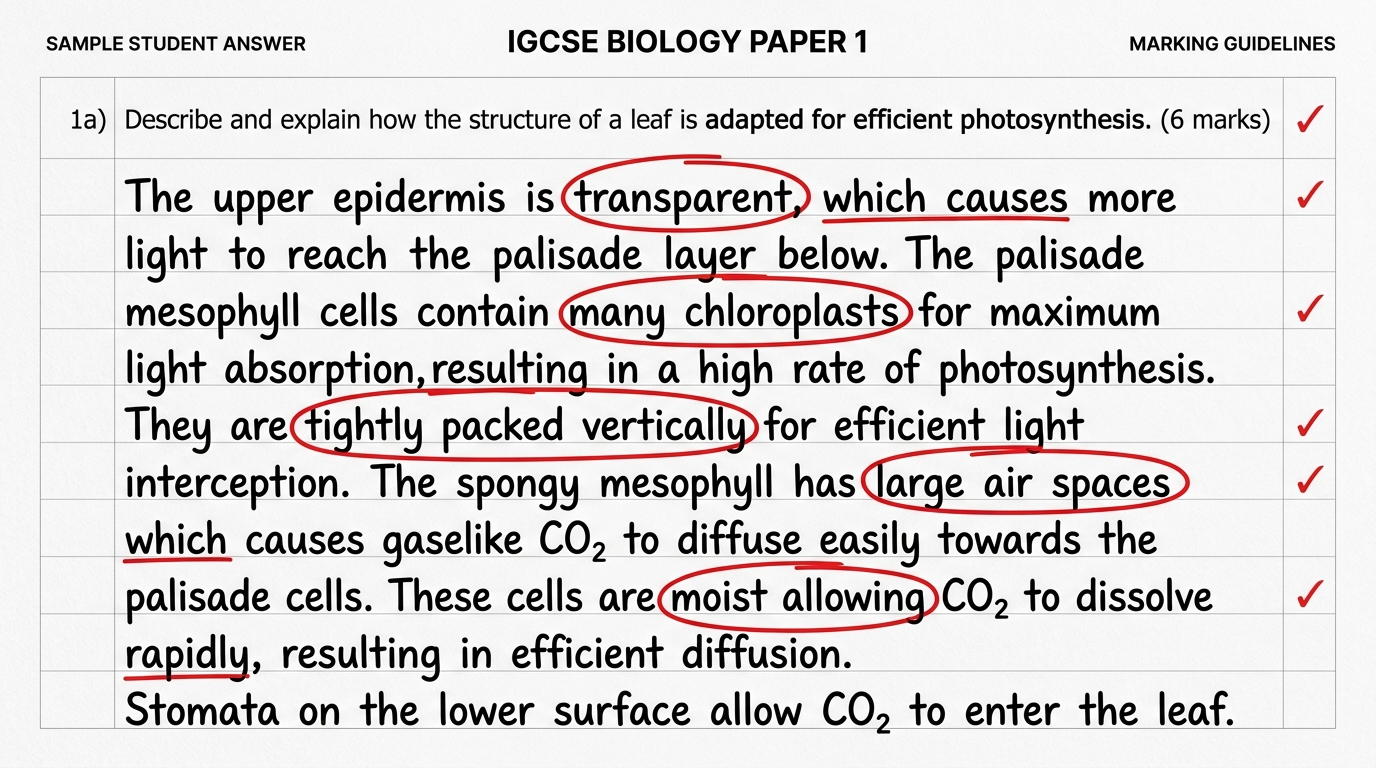
The 6-mark question is not asking your child to write everything they know. It asks them to link biological ideas in a structured chain: cause to mechanism to effect, or structure to function to outcome. Whether the topic is diffusion, respiration or gas exchange, that structured chain is what mark schemes reward.
The two boards approach this differently, and the difference matters when you are helping your child prepare.
Cambridge IGCSE 0610
Pearson Edexcel International GCSE 4BI1
In both boards, every tick on the script comes from a defined mark scheme. Content that is factually correct but does not match the mark scheme earns nothing. That is why two students writing on the same topic can score very differently on the same question.
For families exploring one-to-one support, our Biology tutoring in Abu Dhabi page explains how a diagnostic session identifies where the mark-scheme gap sits.

Why Students Lose Marks, and How to Resolve It
Below are the six patterns examiners flag most often on IGCSE Biology 6-mark answers. Each pattern is written as the question a parent or student would ask, with the fix directly underneath.
Why does my child write full pages and still score 2/6?
Fix: treat the mark value as a guide to how much developed credit is required. Before writing, plan enough distinct, relevant ideas to reach the available marks, and follow the command word rather than forcing every answer into six separate sentences.
Why do answers keep missing the "why" when the question says "explain"?
Fix: underline the command word in the question stem before writing a single sentence.
Why does factually correct Biology sometimes earn no credit?
Fix: re-read the question stem after every two lines. Check the answer is still on the named organ, process or organism.
Why do labelled diagrams keep losing marks?
Fix: land each label line exactly on the structure, and use clear, unambiguous biological terminology. Some abbreviations are accepted in particular mark schemes, but full terms are safer when the student is unsure.
Why do students contradict themselves in one answer?
Fix: finish the plan first, then write one line at a time, checking direction each time.
Why does the same student score full marks on short questions but not long ones?
Fix: learn a small set of linking phrases and use them deliberately. See Section 06 for the specific phrases and how to slot them in.
Why Writing More Backfires
Many students believe longer answers score higher. In IGCSE Biology, they usually do not, and over-writing carries real costs.
First, over-writing wastes exam time. If one 6-mark answer takes fourteen minutes instead of six, the last few questions on the paper get rushed and lose marks that were fully available. Time control is part of technique.
Second, over-writing invites contradictions. A student writes "oxygen enters the alveoli" in one line, then "oxygen leaves the alveoli" three lines later. Cambridge mark schemes state that credit should not be awarded for a correct statement that is contradicted within the same question part. Pearson marking depends on the wording and guidance for the individual question, so contradictions are risky under either board.
Third, extra text tends to drag in irrelevant material. Examiners award marks for valid content that answers the question asked, but off-topic writing uses up the space and time that could have gone into developing the required points properly.
The goal is not to write the fewest words possible. It is to stay in control of the answer. Match the depth of the response to the mark value. Some 6-mark questions reward six independent facts. Others reward three developed explanations linked by cause and effect. The command word and the question structure decide which.
Command Words Students Misread
Describe asks what happens. Explain asks why it happens. Suggest asks for a reasoned inference from the data or diagram in front of the student. Compare asks for similarities and differences in the same sentence structure. Discuss, where it appears, asks the student to address a topic in depth in a structured way.
Students who treat these command words as interchangeable lose marks predictably. Writing a full explanation for a question that only asks for a description does not earn extra credit, and it uses time the student needs elsewhere.
If your child finishes a Biology paper with time to spare and still scores below expectation, the command word check is worth investigating first. A calm re-read of the command word before writing keeps the answer aligned with what the question actually asks.
Diagrams and Labelling, the Silent Mark-Losers
Diagrams and data representations appear regularly across IGCSE Biology papers on both Cambridge and Edexcel. Students are asked to interpret them, label them, or complete them. Labelling errors are among the more common reasons students lose marks on diagram questions.
Diagrams appear across the specification: the heart, the kidney nephron, the leaf cross-section (including stomata and photosynthesis pathways), the digestive tract, and plant transport tissues (xylem and phloem). Students who revise the content without practising the drawings often freeze when a labelled diagram appears in the exam. Regular drawing practice as part of revision turns passive recognition into an exam-ready skill.
When calculating magnification, convert the image size and actual size into compatible units before dividing. Follow the answer format, significant-figure instructions and mark scheme for the specific question.

How UAE Students Turn 3-Mark Answers into 6-Mark Ones
For students who are already secure on the content, adopting a short planning habit before writing is often what shifts long-question performance. Three steps make up the plan.
Step 1: Count
Step 2: Chain
Step 3: Cross-check
Focused technique work can lift long-question performance when the underlying content is already secure. Where content itself is the gap, technique alone will not close it. Individual outcomes vary between students, and the honest starting point is a short diagnostic that separates content gaps from technique gaps.
Case study. Example diagnostic.
A Year 10 Cambridge IGCSE 0610 student in Al Barsha, Dubai was scoring inconsistently on 6-mark questions across mocks. A diagnostic session showed that most lost marks came from writing full-page answers without matching them to the mark-scheme structure. Focused technique work then centred on mark-scheme matching and structured planning.
Case study. Example diagnostic.
A Year 11 Pearson Edexcel 4BI1 student in Khalifa City, Abu Dhabi had a mock diagnostic that showed lost marks on 6-mark questions clustered around diagram labelling and command-word errors. Sessions focused on those two areas over the following weeks, using past-paper questions from the relevant paper variants. Our Biology tutoring in Abu Dhabi page explains how these diagnostics are structured.
What Parents Can Do at Home
Ask your child to show you the last 6-mark question they answered and the mark scheme next to it. Do not review the biology. You do not need to. Ask them to circle every mark-scheme point their answer earned, and every point the mark scheme awards that their answer missed.
This simple side-by-side reveals what part of the answer is not landing. Sometimes it is content the student never fully learned. Sometimes it is command-word confusion. Sometimes it is answer structure. Different causes need different fixes.
The second habit to protect is timing. On weekend revision days, set a phone timer for the recommended time per question and hand the student one past-paper 6-marker. When the timer ends, they stop. This trains the pacing needed in the real exam hall.
Frequently Asked Questions
Related reading from the Ustaad blog
- IGCSE MathsWhy IGCSE students forget maths in exams
- Exam StrategyWhat UAE parents miss about exam panic
- ChemistryWhy chemistry fades from memory (and what helps)
- ChemistryEarly signs your child needs help in chemistry
- Parent GuidanceHow to read a UAE school report card like an education counsellor
- BiologyExplore Biology tutoring in Abu Dhabi
Sources and Transparency
The examination-board information in this article was checked against the official sources listed below. Requirements can vary by paper and examination series, so students should also consult the mark scheme for the exact question they are practising.
- Cambridge IGCSE Biology (0610) syllabus, 2026 to 2028, Cambridge Assessment International Education.
- Pearson Edexcel International GCSE Biology (4BI1) specification, Issue 3, September 2024, Pearson Education.
- Cambridge IGCSE Biology (0610) Paper 4 mark scheme, sample series.
- Pearson Edexcel International GCSE Biology (4BI1) Paper 1B and Paper 2B mark schemes, sample series.
- Cambridge command-word definitions, Cambridge International glossary of command words.
Student-side patterns are drawn from Ustaad UAE tutor observations across parent-facing counselling and revision sessions. Case study framings are illustrative and not attached to any single named student. If a specific claim in this article does not match your current syllabus, examiner report or mark scheme, please tell us and we will correct it in the next editorial pass.
Ustaad UAE Editorial Team | Biology Editorial Desk
This article was prepared by the Ustaad UAE Editorial Team, drawing on published Cambridge Assessment International Education (0610) and Pearson Edexcel (4BI1) syllabus documents, publicly available examiner reports, and mark scheme samples. Visit our editorial page to see the profiles of the people behind each piece.
Nida Iqbal | MPhil in Education Leadership and Management
Nida Iqbal holds an MPhil in Education Leadership and Management. She reviewed this article for educational accessibility, tone and parent relevance. Subject-specific mark-scheme review by a current Cambridge 0610 or Pearson 4BI1 specialist is pending.
Ready for a personalised session?
A diagnostic session can help identify whether the main difficulty is subject knowledge, command-word interpretation, answer structure or exam timing.
No commitment. Cancel anytime.
 Ask on WhatsApp