Why you can trust this guide
It is written by a UAE educationist who works with students day to day, and the exam-board facts (series dates, grading and tiering) are checked against official Cambridge, Pearson Edexcel and Ofqual guidance. Ustaad has supported more than 2,500 UAE students since 2015. We help parents choose the right curriculum for their child with clear, practical advice, not sales pressure.
On paper, IGCSE and GCSE look almost identical. In practice, a few real differences can shape your child's two years. A UAE educationist explains them in plain words, so you can pick the right fit.
IGCSE or GCSE? For parents choosing a school in the UAE, it is one of the most common questions, and a fair one. The two names look almost the same. The single letter "I" is the only visible clue. No one really stops to explain what sits behind it.
So let us keep it simple. IGCSE and GCSE are close relatives. They lead to the same place. But they are not identical twins, and the small gaps between them can matter for your child. Here is what you actually need to know.
What Are GCSE and IGCSE?
GCSE stands for General Certificate of Secondary Education. It is the exam most students in the UK take at around age 16. It was built for schools inside the UK.
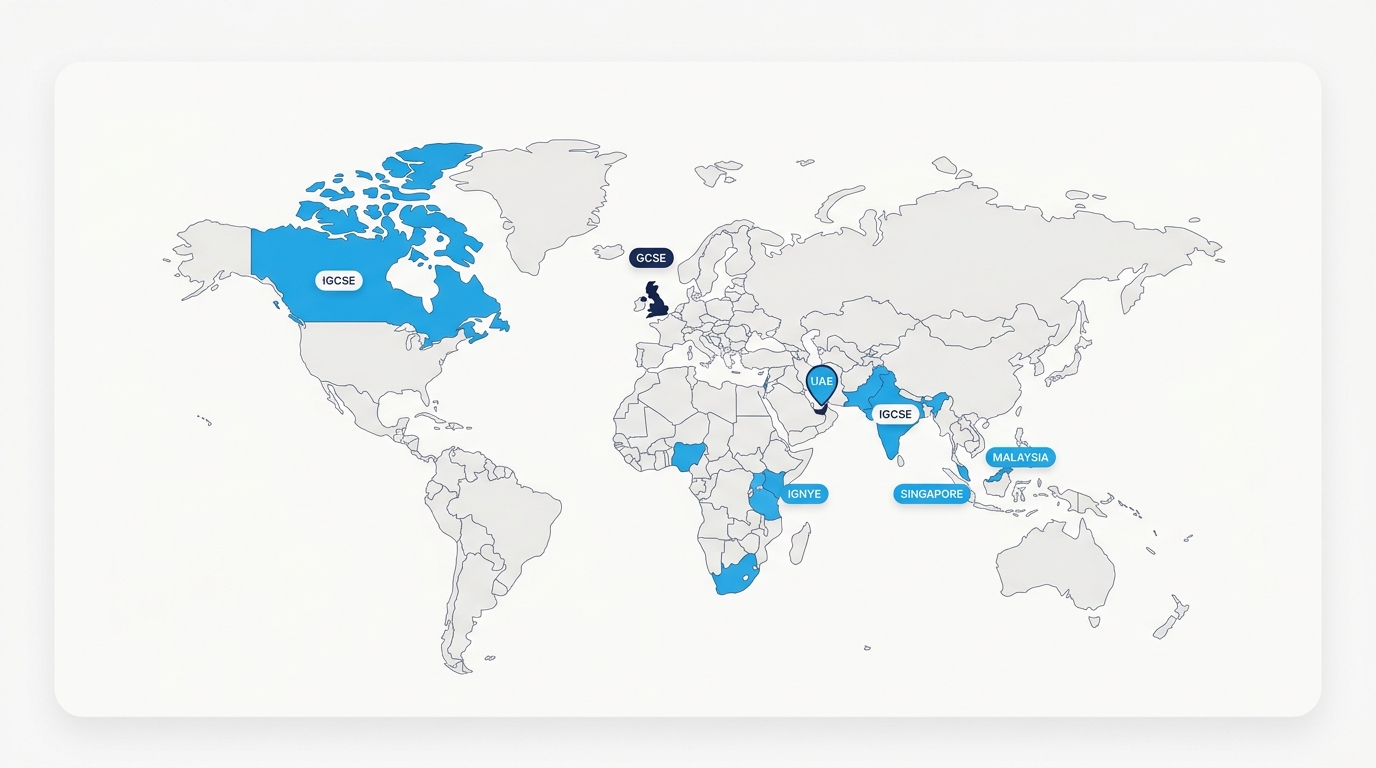
IGCSE stands for International General Certificate of Secondary Education. It is the worldwide version of the same exam. It is run mainly by Cambridge and Pearson Edexcel, and it is taught in more than 150 countries. This is why you see IGCSE in so many UAE schools. It was made for classrooms full of children from many different countries.
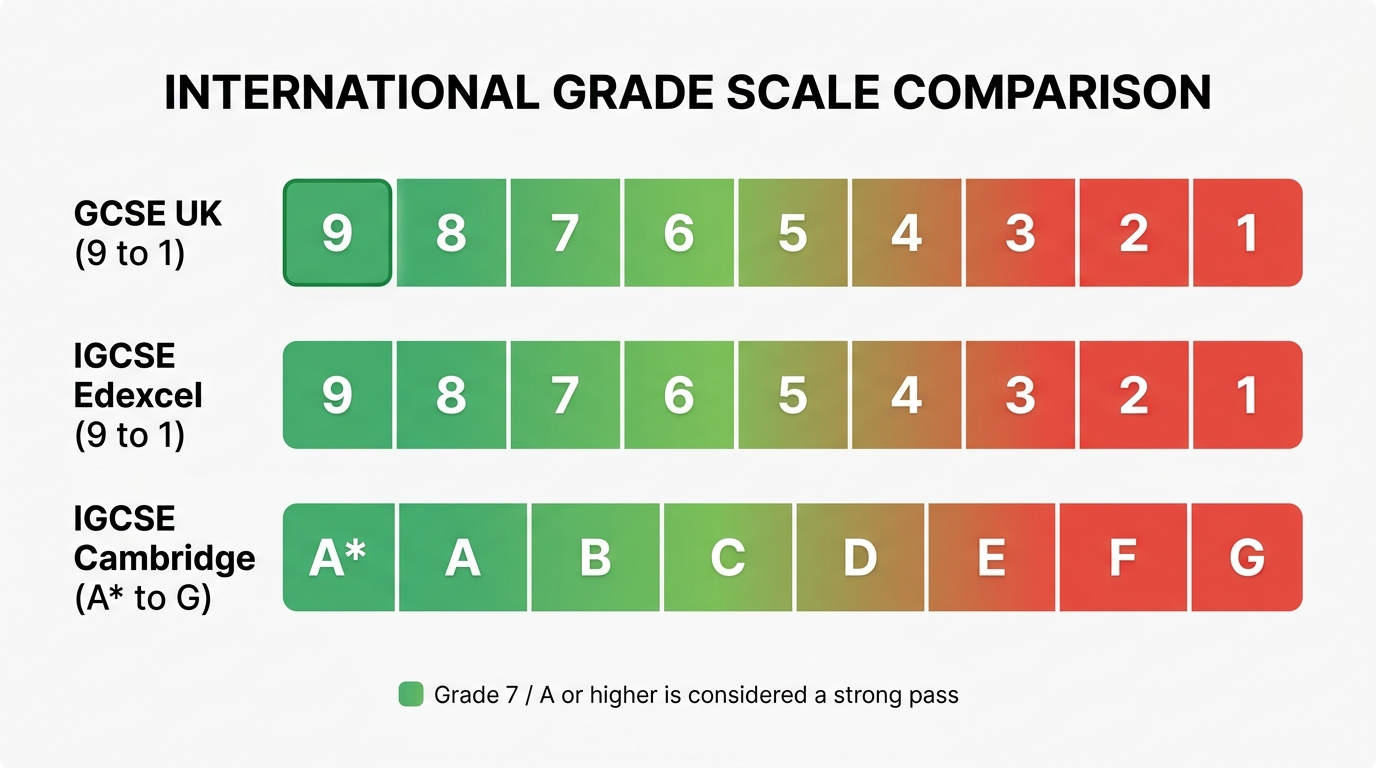
Both are two-year courses. Children usually study them in Years 10 and 11. Grading depends on the board: GCSE in England and Pearson Edexcel International GCSE both use 9 to 1, while Cambridge IGCSE commonly uses A* to G. Either way, schools and universities treat the two qualifications as broadly comparable. The real gap is in how each one is built and tested.
IGCSE vs GCSE at a Glance
Here is the full picture in one table. Keep it next to any school brochure you are reading.
| Feature | GCSE | IGCSE |
|---|---|---|
| Made for | Children in UK schools | Children from many countries |
| Main exam boards | AQA, OCR, Pearson Edexcel, WJEC | Cambridge and Pearson Edexcel |
| Where you find it | Mostly the UK | Worldwide; offered by many British curriculum schools in the UAE |
| Grades | 9 to 1 in England (9 is highest) | Depends on the board: Edexcel uses 9 to 1; Cambridge commonly uses A* to G |
| Content | Uses UK examples and set books | Uses examples from around the world |
| Subjects and levels | Foundation and Higher tiers in some subjects | Tiering varies by board (Cambridge Core/Extended, Edexcel Foundation/Higher, some untiered) |
| Exam dates | Mainly summer; November series for English and Maths | Depends on board and subject; commonly May/June and November |
The Curriculum Differences That Matter Most
The easiest way to see the difference is to ask one question: who was each course made for?
GCSE is built around the UK. In English Literature, for example, students must study Shakespeare. History and Geography often use British and European examples. This is not a fault. It is simply who the course was made for.
IGCSE is built for children around the world. It uses examples from many countries. Its English set texts vary by board and syllabus, and may not centre on Shakespeare the way GCSE does. Subjects like Geography and Business often use cases a child in Dubai, London or Nairobi can all follow.
This shows up in the classroom. A child who has never lived in the UK can feel lost when a lesson assumes they grew up there. International content can make that gap smaller, which for expat families can make a real difference to how settled a child feels.
IGCSE can also be flexible on level. Some subjects are split into tiers, so a school can enter your child at the level that fits instead of pushing everyone down one path. The names differ by board: Cambridge uses Core and Extended, Edexcel uses Foundation and Higher, and some subjects have no tiers at all.
ONE THING TO KEEP IN MIND: None of this changes how hard the work is. A strong IGCSE and a strong GCSE ask for the same effort and depth over two years. The style is different. The hard work is not.
How the Two Are Tested
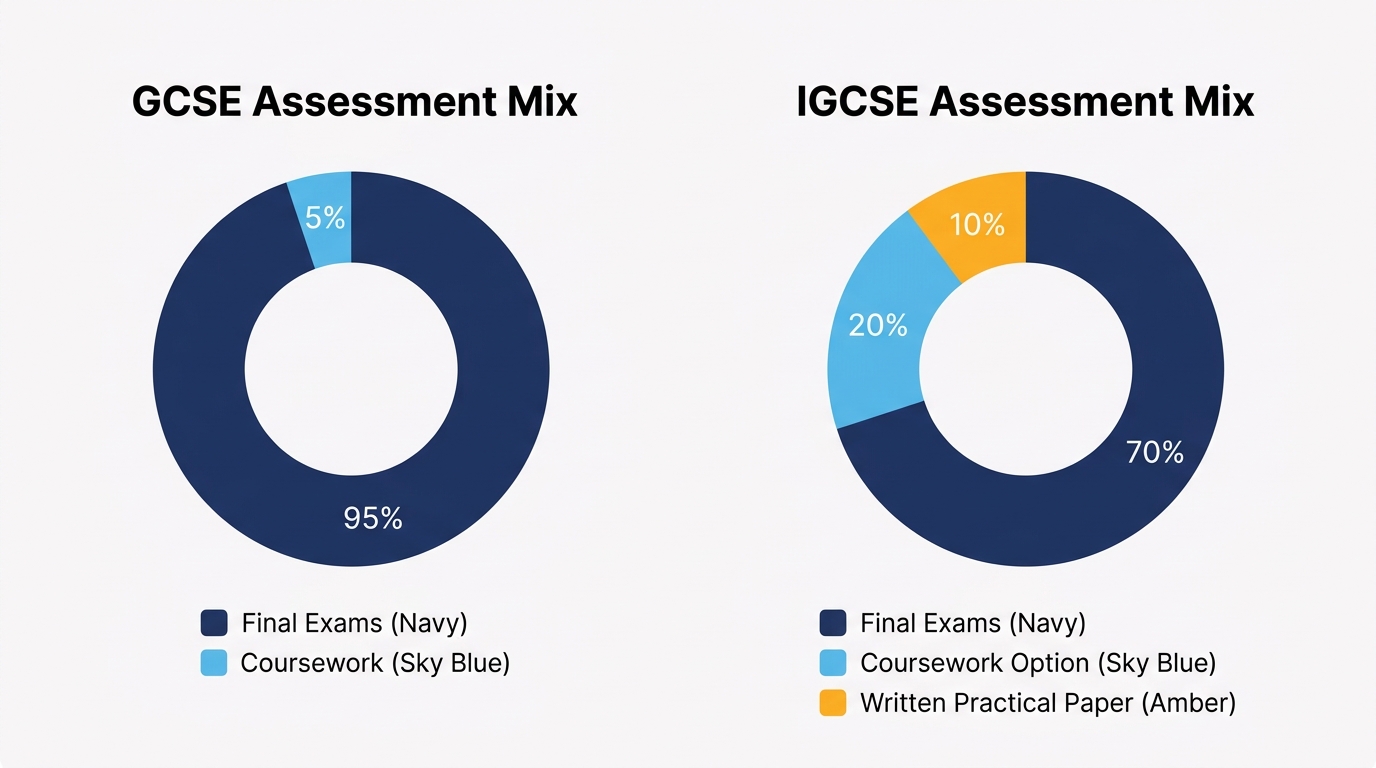
For years, the big split was coursework. GCSE had more of it. IGCSE leaned on final exams. That gap has now mostly closed. Here is where things stand today.
| How it is tested | GCSE | IGCSE |
|---|---|---|
| Coursework | Removed from most subjects after the 2017 UK changes (kept in Art and a few others) | Still an option in many subjects; the school picks coursework or exam only |
| Main focus | Almost all final exams at the end of Year 11 | Final exams, with more choice of route |
| Science practicals | Tested through exam questions on the required experiments | Often a written practical paper instead of lab marks |
| Exam dates | Mainly summer; November series mainly for English and Maths (age 16+) | Depends on board and subject; commonly May/June and November |
Exam dates depend on the board and the subject, so it is worth being precise. Cambridge IGCSE and Pearson Edexcel International GCSE commonly run May/June and November series, though not every subject sits in every series. (Pearson's old January series ended after January 2023.)
GCSE exams are mainly taken in summer, and a November series is normally open only for English Language and Maths, usually to students aged 16 or over. If resits or entry timing matter to you, ask the school exactly which series your child's subjects are offered in.
One word of care. Two schools may both say they teach "IGCSE Chemistry." But one may use Cambridge and the other Edexcel, with different papers, tiers and grading. Always ask the school which exam board and which level they use.
Once you know the board, targeted practice on those exact papers is what lifts a grade. That focus sits at the heart of our IGCSE tutoring.
Which One Suits UAE Students Better?
There is no single winner. Any honest teacher will tell you the same. The real question is which one fits your child and your family's plans.
IGCSE often fits when…
- •Your family may move country again.
- •Your child has studied in more than one school system.
- •You want the international version, built for a global student body.
- •A tiered subject (Core/Extended or Foundation/Higher) would suit your child.
- •It is simply the option your chosen school offers.
GCSE often fits when…
- •Your family is closely tied to the UK.
- •You may move back for sixth form or university.
- •Your child is happy with UK-based content.
- •You want the same set-up they will meet later in the UK.
- •It is the route your preferred school runs.
In real life, the school counts for more than the name. A well-taught GCSE will help a child more than a poorly taught IGCSE. The other way round is just as true. Strong students can drift in a weak class, and average students can bloom in a good one. The people around the course count for the most.
If your child is struggling in a subject under either course, one-to-one support can find the gap early, before it starts to pull their grades down. For students on the UK track, the same close attention shapes our GCSE tutoring.
Do Universities Treat Them the Same?
This is the part most parents really want to hear, so let me be clear.
THE SHORT ANSWER: Both GCSE and International GCSE are widely recognised by schools and universities around the world, and are generally treated as comparable. But exact entry requirements vary by university, course and subject.
What matters most is not which version your child sat, but the grades, the subjects chosen, and whether those subjects fit the next step, such as A-Level or IB. Requirements do vary, especially for English Language, Maths and competitive courses, so it is always worth checking what a specific university and programme ask for. A child aiming at medicine, for example, needs strong science grades either way.
So put the name lower on your list. Put subject choice, likely grades and good teaching at the top. These are the things that carry a child into sixth form and beyond.
Final Advice for Parents
If you remember one thing, remember this. IGCSE and GCSE are close cousins, not rivals. The gaps are small. Both work well when the grades are strong.
Start with your child, not the label. A child who does well in final exams, and who may head to a UK sixth form, can do very well with GCSE. A child who has moved between systems, or whose school teaches it, may be better suited to International GCSE. Many British-curriculum schools in the UAE offer International GCSE, so often the school you choose will settle the question.
Then look at the school itself. The teachers. The support on offer. Pick the place where your child will feel known and pushed in the right way. Get that right, and either course will take them where they need to go.

Frequently Asked Questions
How Ustaad helps you choose
Choosing between IGCSE, GCSE, A-Level, IB and the American curriculum is one of the biggest early decisions a UAE family makes. We help parents think it through, matching the pathway to the child's strengths, their school, and where the family is heading next. Since 2015 we have supported more than 2,500 students across every emirate, on both Cambridge and Edexcel routes.
In the capital, families can also work with our dedicated IGCSE tutors in Abu Dhabi and GCSE tutors in Abu Dhabi.
No commitment. Cancel anytime.
About the Author
Written by a UAE educationist at Ustaad
This guide was written by a UAE-based educationist who works closely with students across Dubai and Abu Dhabi. Their focus is curriculum guidance: helping families see how British-curriculum pathways fit each child, and turning exam-board detail into plain advice parents can act on.
Verified By
Reviewed by a curriculum expert
A curriculum expert with direct knowledge of Cambridge IGCSE, Pearson Edexcel International GCSE and GCSE in England checked this article for factual accuracy, including exam-board series, grading scales, tiering and assessment. The guidance is reviewed and updated as exam-board rules change.
Sources
- • Pearson Edexcel: International GCSE November series from 2023
- • GOV.UK: November GCSE English Language and Mathematics exam entries
- • Ofqual: GCSE English Language and Maths results from the November series
Related reading from the Ustaad blog
Why IGCSE Maths Students Suffer Low Marks After Revision
Hours of revision do not always translate to high marks. Discover the root cause and how to fix it before exams.
IGCSE PhysicsWhy IGCSE Physics Formulas Stop Working in Exams
Students memorise equations but struggle when question formats change. Here is how to build true analytical reasoning.
Parent GuidanceWhat UAE Parents Miss About Exam Panic Right Before Exams
A closer look at why exam anxiety peaks in the final days before an IGCSE paper, and how parents can help.
IGCSE ChemistryWhy Chemistry Fades From Memory (and What Helps)
Understanding why chemical concepts evaporate quickly without active retrieval and spaced practice.
Need help translating a report card into a study plan?
Our UAE education counsellors and subject specialist tutors can help decode subject reports, identify core learning gaps, and build a targeted revision roadmap.
No commitment. Cancel anytime.
 Ask on WhatsApp