
How to Help Your Child Choose IGCSE Subjects: A UAE Parent Guide to Year 9 Options
Year 9 options forms arrive in most UAE British-curriculum schools in the second term. Here is how to help your child choose IGCSE subjects they will enjoy, do well in, and that keep the right doors open for A-Level and university.

The options form comes home in a plain envelope in January. Twelve subjects, four boxes to tick, a deadline in three weeks. A Year 9 student in Abu Dhabi wants to drop Physics because her best friend is dropping it. Her father wants her to keep everything, because she once said she might like medicine.
Both are deciding the next two years on a guess. The choice feels huge, and in one way it is: the subjects picked now shape which A-Levels are open in Year 12. In another way it is smaller than it looks, because most of the timetable is already fixed, and only a handful of choices really carry weight.
This guide separates the decisions that matter from the ones that do not, and gives you a simple test to use on every option your child is considering.
Keep English, Maths and Science strong, because every route needs them. Choose the science route and Maths tier that keep likely A-Levels open. Then pick the options your child enjoys and has real evidence of doing well in. Eight to ten good IGCSEs beat eleven stretched ones.
When UAE schools ask you to choose
In most British-curriculum schools in Dubai, Abu Dhabi and Sharjah, Year 9 students choose their IGCSE or GCSE options during the second term. A typical calendar looks like this, though every school sets its own dates:
| When | What happens | What to do |
|---|---|---|
| January to February, Year 9 | Options evening, subject talks and the options booklet | Attend together and note each subject’s assessment style and entry advice |
| February to March, Year 9 | Options form deadline | Use the three-filter test in section 06 before you submit |
| Term 3, Year 9 | School confirms subjects and option blocks | Check the confirmed list matches what you chose |
| August to September, Year 10 | Two-year IGCSE courses begin | Ask how long changes are allowed after the start |
| May to June, Year 11 | Final IGCSE exams | Coursework and practicals are often finished earlier |
Schools following Pearson Edexcel International GCSE or the UK GCSE use the same rhythm. If you are unsure which qualification your school offers, our guide to IGCSE vs GCSE in the UAE explains the difference.
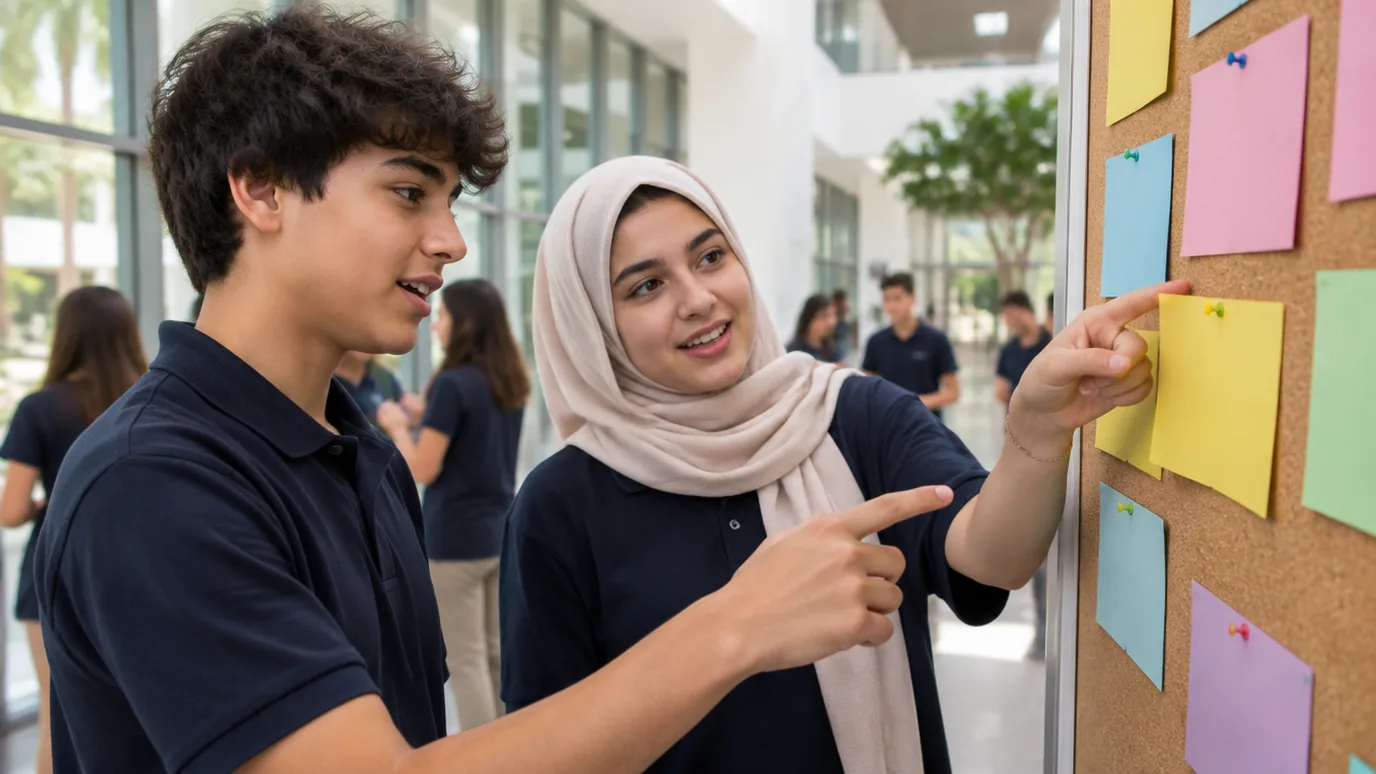
What is already decided for you
Before your child picks anything, a large part of the Year 10 timetable is fixed. It usually includes:
- English: English Language, and in many schools English Literature as well.
- Mathematics: the tier (Core or Extended) is decided with the school, covered in section 05.
- Science: every student studies science, but the route can be a choice, covered in section 04.
- UAE requirements: Arabic is taught to all students in UAE private schools, at a level that depends on whether Arabic is their first language, and Islamic Education is taught to Muslim students. Some schools also continue UAE Social Studies or Moral Education into Year 10.
That often leaves three or four genuine choices, such as Business, Economics, Computer Science, Geography, History, Art, a modern language or Additional Maths. Those are the decisions worth your time.
How many IGCSEs is enough?
Most students in UAE British-curriculum schools finish with 8 to 10 IGCSEs, counting the core subjects. Some take 11 or 12. More is not automatically better.
Sixth forms and universities look first at the grades in the subjects that matter for the course: Maths and English almost always, plus the subjects linked to the A-Levels your child will take. A set of 8 IGCSEs at grades 7 to 9 opens more doors than 11 IGCSEs at grades 4 to 6.
If your child may apply to a UAE university, the Ministry of Education equivalency process asks for a minimum number of IGCSE or GCSE passes alongside AS or A-Level results. Arabic and Islamic Education are studied, but they do not count among those subjects. The exact rules change from time to time, so check the current Ministry guidance and the university's own entry criteria in Year 9, not Year 13.
Science: triple, co-ordinated or combined?
This is the choice parents ask about most, because it decides how many science IGCSEs your child earns and how much depth they reach. Cambridge and Pearson Edexcel offer three routes:
| Route | IGCSEs earned | Depth | Best suited to |
|---|---|---|---|
| Separate (triple) science: Biology, Chemistry, Physics | 3 | Most content | Students who enjoy science and are likely to take science A-Levels, medicine or engineering |
| Co-ordinated Sciences (Cambridge) or Science Double Award (Edexcel) | 2 | Solid core of all three | Students who may take a science A-Level and want time for other options |
| Combined Science (Cambridge) | 1 | Least content | Students unlikely to study science after Year 11 |
Many sixth forms accept either separate science or Co-ordinated Sciences for A-Level Biology, Chemistry or Physics, as long as the grade is strong, often a 6 or 7. Combined Science can make a science A-Level harder to start. Before choosing, read the sixth-form entry requirements of your school, or the school your child may move to, and check which route its students usually take.

Maths: tiers and Additional Maths
IGCSE Maths is set at two levels. In Cambridge IGCSE Maths they are called Core and Extended. In Pearson Edexcel they are Foundation and Higher. The lower tier caps the top grade, at grade C on the Cambridge A* to G scale.
That cap matters. A-Level Maths, Physics, Economics and Chemistry usually expect a strong grade from the higher tier. If your child is near the boundary in Year 9, a few months of focused work can decide which tier they sit, so it is worth asking the Maths teacher directly where they stand.
Confident mathematicians can also take Additional Maths (Cambridge) or Further Pure Maths (Edexcel). It is a strong preparation for A-Level Maths and Further Maths, but it adds workload, so it suits students who already find Extended Maths comfortable.
The three-filter test for every option
For each option your child is considering, run it through three filters. A strong choice passes at least two. A choice that passes none, such as “my friend is taking it”, deserves a second look.
Will they still want to open this book in May of Year 11?
Look for: Topics they read about without being asked, lessons they talk about at dinner.
Do Year 8 and Year 9 results back this choice up?
Look for: Report card attainment, test scores and teacher comments, not one good mark.
Does this subject protect an A-Level or university route they might want?
Look for: Sixth-form entry requirements and the pathways table in this guide.
The second filter is where report cards help. Look at attainment and teacher comments across Year 8 and Year 9, not a single test. Our guide on how to read a UAE school report card shows what to look for.
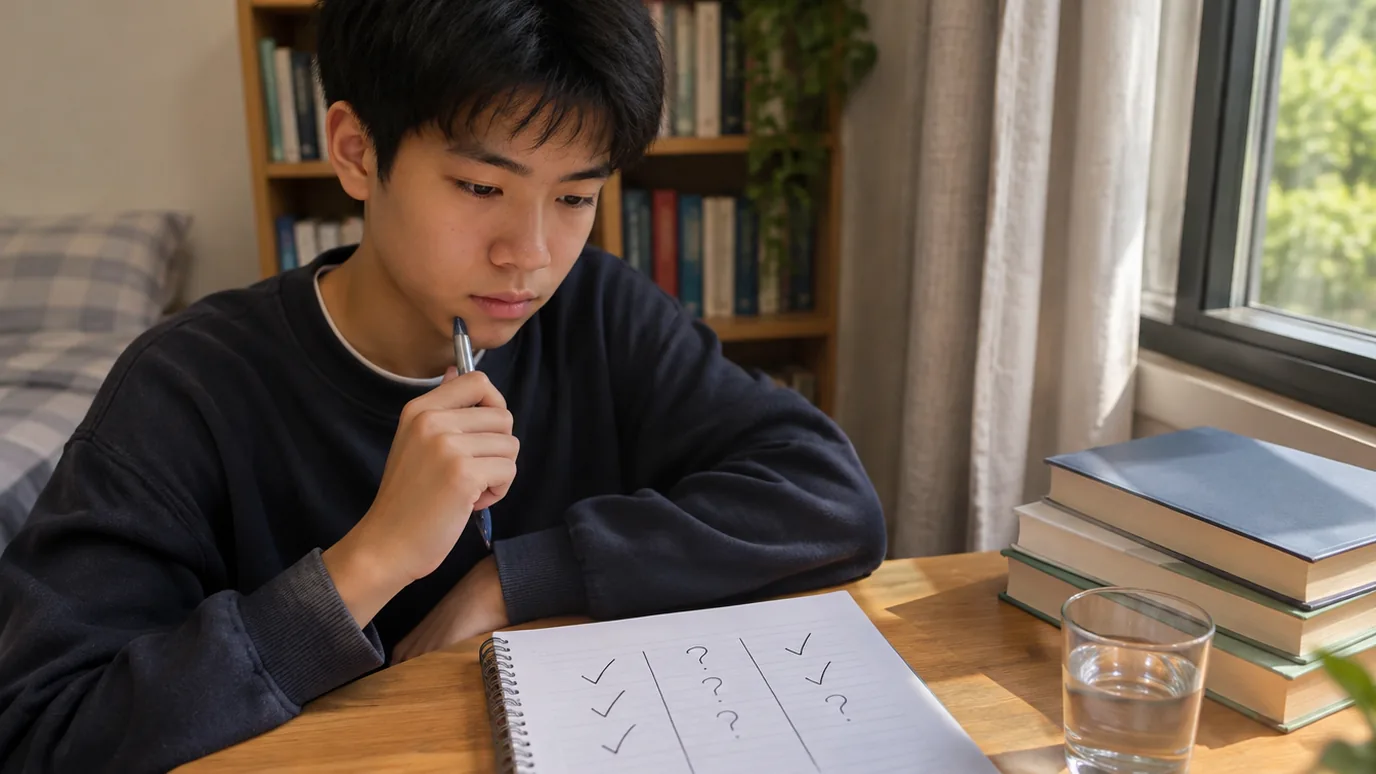
Matching subjects to future pathways
Your child does not need a career plan at 14. But if a route is already on the table, these IGCSEs keep it open. Treat this as a starting point and confirm with the school and the universities you have in mind.
| If your child might study | IGCSEs worth keeping strong | Why |
|---|---|---|
| Medicine, dentistry or pharmacy | Biology, Chemistry, Physics or Co-ordinated Sciences, Extended Maths, English | These courses usually require A-Level Chemistry and often Biology, and look closely at science and Maths grades |
| Engineering or physics | Physics or a double science route, Extended Maths, Additional Maths if confident | A-Level Maths and Physics are standard entry subjects |
| Computer science | Extended Maths, Computer Science, a science | A-Level Maths matters more than an IGCSE in Computer Science |
| Business, economics or finance | Extended Maths, Economics or Business, English | Strong Maths keeps A-Level Economics and Maths open |
| Law, humanities or media | English Language and Literature, History or Geography, a language | Essay writing and analysis are the skills to build |
| Undecided | A balanced spread: a science route that allows A-Level science, Extended Maths, one humanity, one creative or language subject | Keeps the most doors open until Year 11 |
For how A-Level study differs from IGCSE, and why independent study habits matter so much in Year 12, see A-Level tutoring in the UAE and independent thinking.
Five common mistakes families make
- Choosing for friends or a favourite teacher. Classes and teachers change in Year 10. The subject stays for two years.
- Picking an “easy” subject. No IGCSE is easy without interest. A subject your child dislikes is hard to revise in Year 11.
- Taking too many IGCSEs. An extra subject takes revision time from Maths, English and the sciences.
- Dropping a science too early. Moving to Combined Science can make science A-Levels harder to start.
- Leaving the Maths tier to chance. Ask in Year 9 where your child stands, while there is time to move up.
The conversation at home
The best decisions come from your child, with your questions shaping them. Instead of telling them what to choose, try these:
- “Which lessons do you look forward to, and why?”
- “Which subject would you be happy to revise on a Saturday in Year 11?”
- “What did your teachers say about you in this subject?”
- “Is there a course or job you are curious about, even a little?”
- “If you drop this subject, is there anything you might regret in two years?”
Then take two or three questions to the options evening or a meeting with the subject teacher. Our list of questions to ask at UAE parent-teacher meetings works well here too.
When to get extra support
Some signs in Year 9 are worth acting on before options are confirmed:
- Your child is near the boundary between the lower and higher Maths tier
- They want a separate science but their Year 9 science grades are inconsistent
- They are moving schools or switching from another curriculum into IGCSE
- They have no clear strength yet and the choice is causing stress at home
A few targeted lessons in Year 9 can change which tier or science route your child starts Year 10 in. Ustaad works with students online and one-to-one across the UAE, with IGCSE tutors in Dubai, IGCSE tutors in Abu Dhabi and IGCSE tutors in Al Ain. You can also read more about IGCSE tutoring, or our private tutoring guide for UAE parents if you are deciding whether a tutor is the right step.
Frequently asked questions
Sources and further reading
Cambridge International: What is the difference between the IGCSEs in Combined Science and Coordinated Science? (Combined Science is a single award; Co-ordinated Sciences is a double award, equivalent to two IGCSEs).
Cambridge International: Cambridge IGCSE subjects and syllabuses.
Pearson Edexcel: Edexcel International GCSE qualifications.
UAE Ministry of Higher Education and Scientific Research: Entry criteria for Foundation and Bachelor level (university entry rules for school-leaver certificates).
KHDA (Dubai) and ADEK (Abu Dhabi) publish the curriculum requirements for private schools in each emirate. Your school's options booklet is the final word on what it offers.
Unsure about a Maths tier or science route?
Every first 1-hour lesson includes a free 15-minute orientation, so your child and their tutor can agree where to focus first. Sessions are online and 1-to-1, for families in every emirate. No commitment. Cancel anytime.
Nimra Shahzada writes about the study problems UAE parents see at home: children who revise for hours but still lose marks, homework that never gets finished, and exam stress that builds before mocks.
Ustaad Editorial Team. Every guide is checked for accuracy and parent clarity before it is published.