What Is IGCSE? Full Form, Meaning, Subjects and Grades Explained for UAE Parents
IGCSE is the qualification most students in UAE British-curriculum schools sit at the end of Year 11. Here is what the letters stand for, how the exams work, how they are graded, and what comes next, in plain language.
A family moves to Dubai, enrols their son in Year 10, and the welcome pack says he will spend the next two years working towards his IGCSEs. The letters appear on every timetable, report and parents' evening invitation, but nobody stops to explain them.
This guide does. It covers what IGCSE stands for, who sets the exams, which subjects students take, how the two tiers and two grade scales work, when results arrive, and what the qualification leads to. If you want the side-by-side comparison with the UK GCSE, read our IGCSE vs GCSE guide after this one.
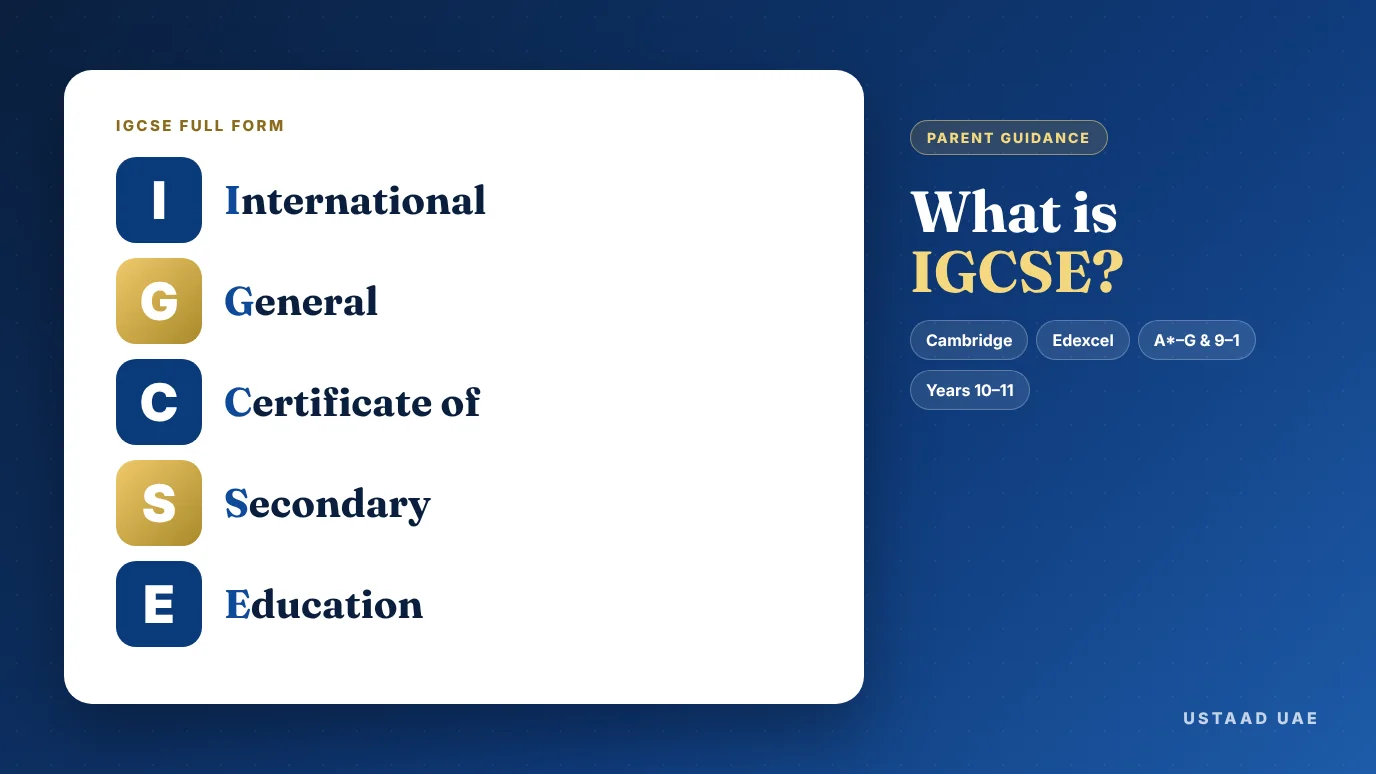
IGCSE stands for International General Certificate of Secondary Education. It is a two-year qualification, usually taken in Years 10 and 11 (ages 14 to 16), set mainly by Cambridge International or Pearson Edexcel. Students take one exam per subject, often 7 to 10 subjects, graded A* to G or 9 to 1. It leads on to A-Levels, the IB Diploma or other post-16 courses.
IGCSE full form and meaning
IGCSE stands for International General Certificate of Secondary Education. Each word tells you something:
- International: written for schools outside the UK, with content and examples that suit students in many countries, including the UAE.
- General: it covers broad subjects, not a narrow vocational specialism.
- Certificate: each subject is graded and certified separately, so a student finishes with a set of IGCSEs, not one overall score.
- Secondary Education: it marks the end of the middle stage of secondary school, before post-16 study.
Cambridge introduced the IGCSE in 1988 as an international alternative to the UK GCSE. Today it is one of the most widely taken qualifications for 16-year-olds in international schools, and the default end-of-Year-11 exam in most UAE British-curriculum schools.
Who sets IGCSE exams
“IGCSE” is used loosely for two qualifications from different exam boards. Your child's school chooses the board subject by subject, and some schools mix them.
| Board | Name of the qualification | Grades | Example code (Maths) |
|---|---|---|---|
| Cambridge International (CAIE) | Cambridge IGCSE | A* to G, or 9 to 1 for some syllabuses | 0580 |
| Pearson Edexcel | Edexcel International GCSE | 9 to 1 | 4MA1 |
| OxfordAQA | OxfordAQA International GCSE | 9 to 1 | Offered in fewer UAE schools |
The quickest way to tell which one your child sits is the syllabus code on the exam entry or subject handbook. A four-digit Cambridge code such as 0580 or 0610 means Cambridge IGCSE; a code such as 4MA1 means Edexcel International GCSE. The board matters, because each one has its own papers, mark schemes and past papers to practise with.
Who takes IGCSE in the UAE
IGCSE is taught in British-curriculum and many international schools across Dubai, Abu Dhabi, Al Ain, Sharjah and the Northern Emirates. These private schools are regulated by KHDA in Dubai and ADEK in Abu Dhabi.
Most students start their IGCSE courses in Year 10, at around 14, and sit the final exams in May or June of Year 11. Some schools begin parts of the content in Year 9 or let strong students sit a subject early, such as a second language or Maths. Students joining from the American, Indian or IB systems usually join at the start of Year 10, and the first term is where gaps in prior knowledge show up most.
IGCSE subjects: how many and which
Cambridge alone offers more than 70 IGCSE subjects, but each school offers a smaller menu. In UAE schools most students take between 7 and 10 IGCSEs, made up of:
- Core subjects nearly everyone takes: English (First Language or as a Second Language), Mathematics and at least one science route.
- Options chosen in Year 9: for example Business, Economics, Computer Science, Geography, History, Art or a modern language.
- UAE requirements: Arabic, Islamic Education (for Muslim students) and UAE Social Studies are taught alongside, following Ministry rules, even when they are not sat as IGCSEs.
Science can be taken as three separate sciences, as Co-ordinated Sciences (a double award) or as Combined Science (a single award). Our guide on how to choose IGCSE subjects explains which route keeps which A-Level doors open.
Core and Extended: the two tiers
In subjects such as Maths and the sciences, students are entered for one of two tiers. The tier decides which papers they sit and which grades they can reach.
| Tier | Board name | Grades available | Best for |
|---|---|---|---|
| Lower tier | Core (Cambridge), Foundation (Edexcel) | Up to C (Cambridge) or 5 (Edexcel) | Students securing a solid pass |
| Higher tier | Extended (Cambridge), Higher (Edexcel) | A* to E (Cambridge) or 9 to 4 (Edexcel) | Students aiming for top grades or that subject at A-Level |
How IGCSE is graded
IGCSE uses two grade scales. Cambridge IGCSE is mostly graded A* to G, with some syllabuses graded 9 to 1. Edexcel International GCSE uses 9 to 1, where 9 is the highest. A result below the lowest grade is shown as U (ungraded).
- Grade 7 lines up with the bottom of grade A
- Grade 4 lines up with the bottom of grade C
- Grade 1 lines up with the bottom of grade G
On the 9 to 1 scale, grade 4 is a standard pass and grade 5 a strong pass. Sixth forms in the UAE often ask for a 6 or 7 (a B or an A) in the subjects a student wants to take at A-Level, and some ask for more in Maths and the sciences.
How IGCSE is assessed
Most of the grade comes from written exams sat at the end of the course. Depending on the subject, assessment can also include:
- Practical work in the sciences, either as a practical test or a written paper about experiments, such as the Cambridge Alternative to Practical paper.
- Coursework in some subjects, such as Art and Design, and in optional coursework routes some schools choose.
- Speaking and listening components in languages and some English syllabuses.
Because the final papers carry most of the marks, how a student answers matters as much as what they know. Learning the exam's command words and practising with real past papers is where many marks are won.
IGCSE exam dates and results
IGCSE exams run in fixed exam series each year. UAE schools mostly use the summer series:
| Exam series | Board | Results usually released |
|---|---|---|
| May/June | Cambridge and Edexcel | August |
| October/November | Cambridge | January |
| January | Edexcel, for many subjects | March |
The November and January series are mostly used for resits or for students who need a result before the summer. Exact timetables and results dates are published by the boards each year, and your school's exams officer confirms them.
What comes after IGCSE
IGCSE is a stepping stone, not the end of school. In Year 12 most UAE students move on to one of these routes:
- A-Levels (AS in Year 12, A2 in Year 13), usually three or four subjects. See our A-Level tutoring page.
- The IB Diploma, six subjects plus the core, for students who want breadth.
- BTEC and other applied courses, offered by some schools for career-focused routes.
Sixth forms set entry grades for each subject, so IGCSE results decide which post-16 courses are open. For UAE university entry, the Ministry sets equivalency rules for the British system, covering the number of IGCSE and A-Level passes. Check the current rules with your school, as they can change.
How parents can help
- Find out the board and syllabus code for every subject, and keep the list somewhere you can see it.
- Ask which tier your child is entered for in Maths and the sciences, and what it would take to move up.
- Note the mock exam dates in Year 11; mocks are the best early signal of the final grade.
- Look at the subject reports for trends across terms, not one test score. Our guide to reading a UAE school report card helps.
- Keep sleep, routine and a weekly revision rhythm steady in Year 11, rather than relying on last-minute cramming.
If a subject is slipping, or your child has joined from another curriculum, a few months of targeted support in Year 10 is worth more than a rush before the exams. Ustaad teaches online and one-to-one, matched to the exact board and syllabus, with IGCSE tutors in Dubai, IGCSE tutors in Abu Dhabi and IGCSE tutors in Al Ain. You can also read about our IGCSE tutoring across the UAE.
Frequently asked questions
Sources and further reading
Cambridge International: Cambridge IGCSE: subjects, syllabuses and grading.
Pearson Edexcel: Edexcel International GCSE qualifications.
OxfordAQA: OxfordAQA International GCSEs.
KHDA (Dubai) and ADEK (Abu Dhabi) regulate private schools in each emirate; your school's exams officer confirms entries, tiers and exam dates.
Starting IGCSE, or worried about a subject?
Every first 1-hour lesson includes a free 15-minute orientation, so your child and their tutor can agree where to focus first. Lessons are online and 1-to-1, matched to the exact IGCSE board and syllabus.
Nimra Shahzada writes about the study problems UAE parents see at home: children who revise for hours but still lose marks, homework that never gets finished, and exam stress that builds before mocks.
Ustaad Editorial Team. Every guide is checked for accuracy and parent clarity before it is published.