
Switching From an American to a British School in the UAE: Year Groups, Gaps and How to Catch Up
Families in Dubai, Abu Dhabi and Sharjah change curriculum all the time, after a move, a new job or a new school place. Here is how an American grade maps to a British year group, which timing works, and how to close the gaps before they show up in exams.
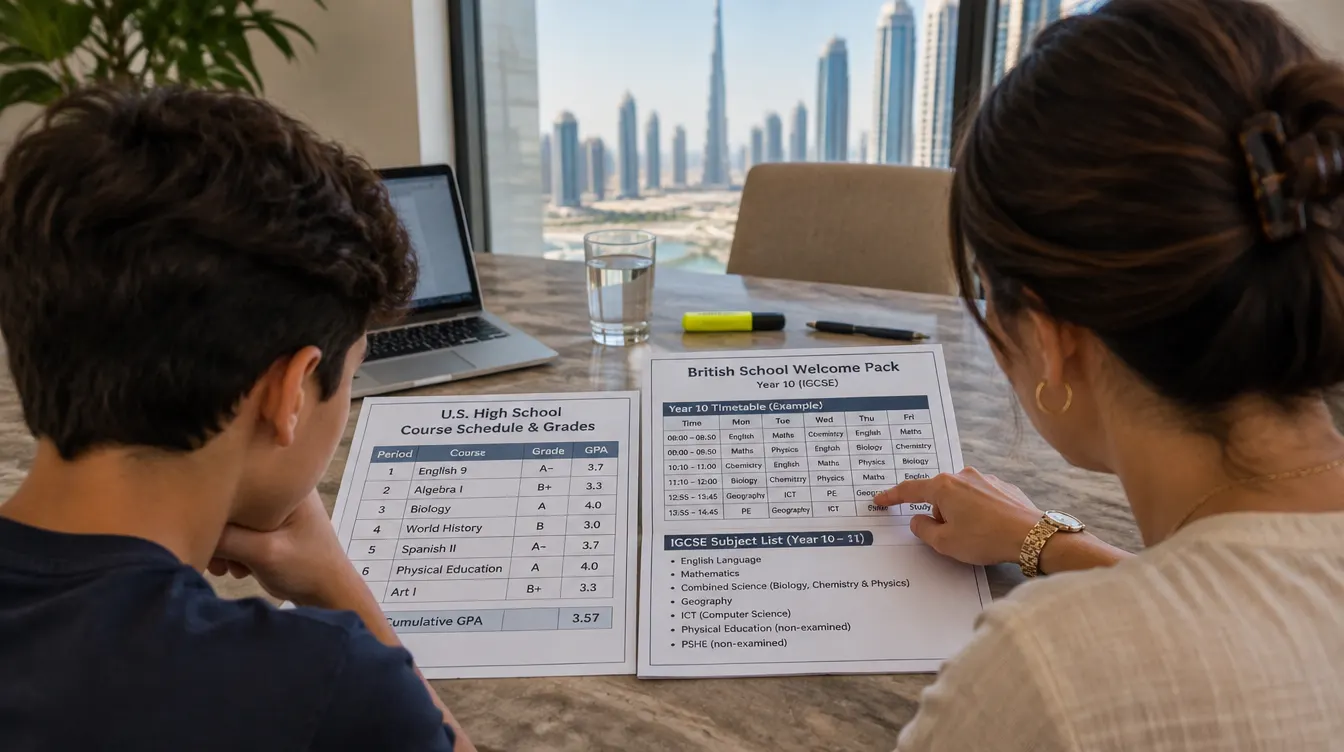
In the UAE, changing curriculum is ordinary. A family moves from Abu Dhabi to Dubai, a sibling gets a place at a different school, or parents decide they want IGCSEs and A-Levels rather than a high school diploma. For many children that means switching from an American to a British school, and the first questions are always the same: which year will my child join, will they fall behind, and what do we need to fix first?
The good news is that most students settle within a term. The switch goes wrong mainly when the timing is poor or when nobody spots the gaps until the first set of exams. This guide covers both.
A British year group is numbered one higher than the American grade for the same age, so Grade 9 usually becomes Year 10. The easiest time to switch is before Year 10, when the two-year IGCSE course starts. The usual gaps are maths topics taught in a different order, three sciences studied together, and timed exam writing. The receiving school decides placement, so get its decision in writing.
How American grades map to British year groups
Both systems place children mainly by age, but they number the years differently. British schools start counting a year earlier, so the British year group is one number higher than the American grade for a child of the same age.
| American grade | British year group | What happens that year |
|---|---|---|
| Grade 6 to 8 | Year 7 to 9 | Key Stage 3: broad subjects, the base for IGCSE |
| Grade 9 | Year 10 | First year of the two-year IGCSE course |
| Grade 10 | Year 11 | IGCSE exams in May and June |
| Grade 11 | Year 12 | First year of A-Levels (AS in many UAE schools) |
| Grade 12 | Year 13 | Final A-Level exams and university applications |
The table is the usual pattern, not a guarantee. The receiving school decides where your child goes, using age, the transfer certificate and transcripts from the previous school, and sometimes its own assessment. In Dubai, placement follows KHDA rules; in Abu Dhabi, ADEK rules; and in the other emirates, the Ministry of Education. Age cut-off dates can differ between regulators, so a child born in the summer may be placed differently from the table above. Ask for the placement in writing before you accept a seat.
When to switch, and when it is risky
Timing matters more than anything else. IGCSE is a two-year course across Years 10 and 11, so a student who arrives halfway through has to learn a year of content they missed while also preparing for exams. The earlier the switch, the more time there is to close gaps calmly.
General guidance. The receiving school decides placement for each child.
If your child joins at the start of Year 10
This works well for most students. Your child joins the IGCSE course with everyone else, but they will need to choose subjects quickly. Our guide to choosing IGCSE subjects walks through the options form, and what IGCSE means explains the grades and exam boards.
If your child joins in Year 12
Sixth forms usually set entry grades for each A-Level, normally based on IGCSE results. A student coming from Grade 10 in an American school has no IGCSEs, so many schools use an entrance test or interview instead. Expect questions on algebra for A-Level Maths and Physics, and on extended writing for essay subjects.
The gaps that usually show up
American and British courses cover much of the same knowledge, but in a different order and assessed in different ways. These are the gaps tutors see most often in students who switch.
| Subject | Typical American background | What the British course expects |
|---|---|---|
| Maths | Algebra I and Geometry taught as separate year-long courses | Algebra, geometry, vectors, statistics and probability taught together every year, plus non-calculator papers in some boards |
| Science | One science per year, such as Biology in Grade 9 | Biology, Chemistry and Physics studied side by side, with set practicals |
| English | Essays and projects written over days | Timed responses to unseen texts in the exam hall |
| Assessment | Grades built from homework, quizzes and projects | Grades decided mainly by final exams, with precise command words |
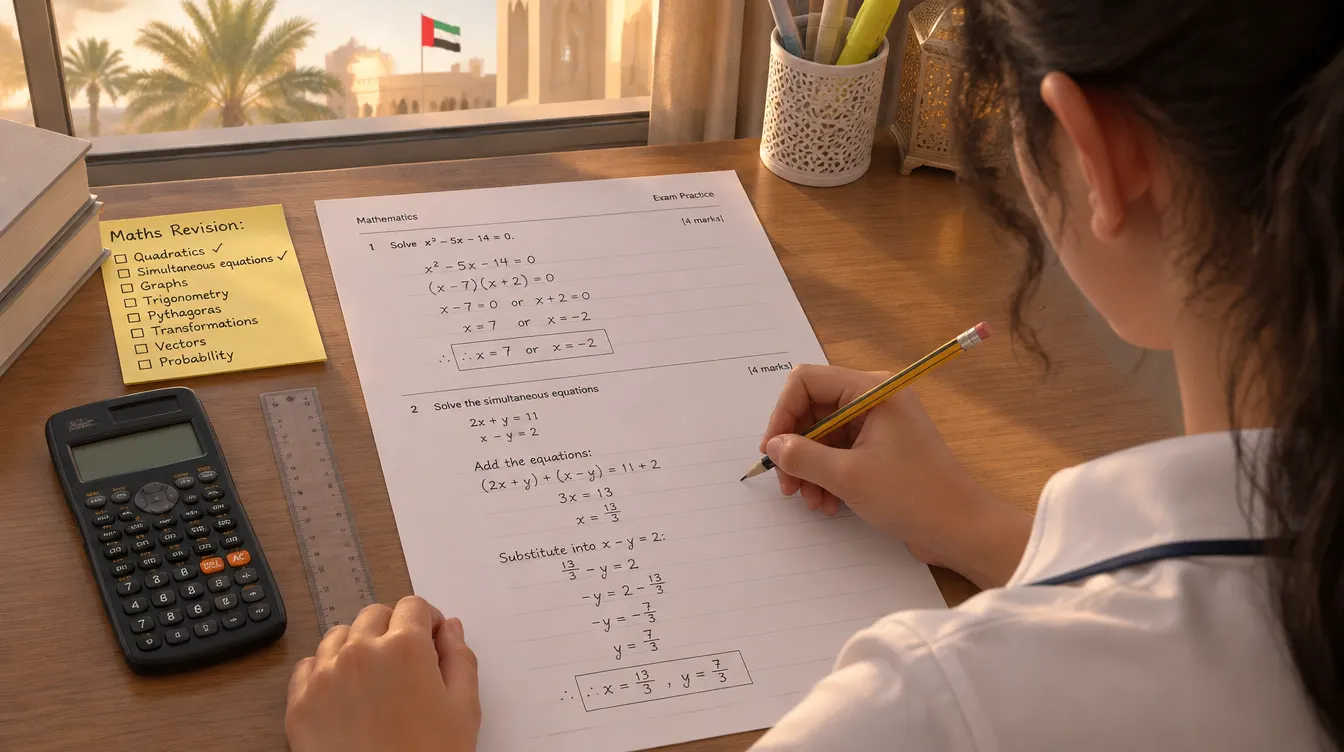
The biggest change is often not the content but the exam style. Students used to continuous assessment can know the material and still lose marks because they misread what a question asks. Our guide to command words in IGCSE and A-Level exams is a good first read for any student making the switch.
What American-curriculum students bring
It is not all catching up. Students from American schools are often confident speakers, used to class discussion and presentations, and comfortable with research projects. Those strengths help in English, the humanities and later in A-Level coursework. The aim of the first term is to keep that confidence while adding exam technique, not to make your child feel they are starting again.
A 6-week catch-up plan
Start in the first week at the new school, before the first tests. Short, regular work beats a weekend cram.
- Week 1: Find the gaps. Ask each teacher for the scheme of work and compare it with what your child has covered. Mark topics as done, partly done or new.
- Weeks 2 and 3: Maths first. Close the algebra and geometry gaps, because later topics build on them. Practise without a calculator if your child will sit a non-calculator paper.
- Weeks 3 and 4: Sciences. Cover the basics of the science your child has not studied recently, and learn the required practicals by name.
- Week 5: Exam writing. Answer short past-paper questions to time, then check them against the mark scheme.
- Week 6: Review. Sit one short paper per core subject and update the gap list before the first school assessment.
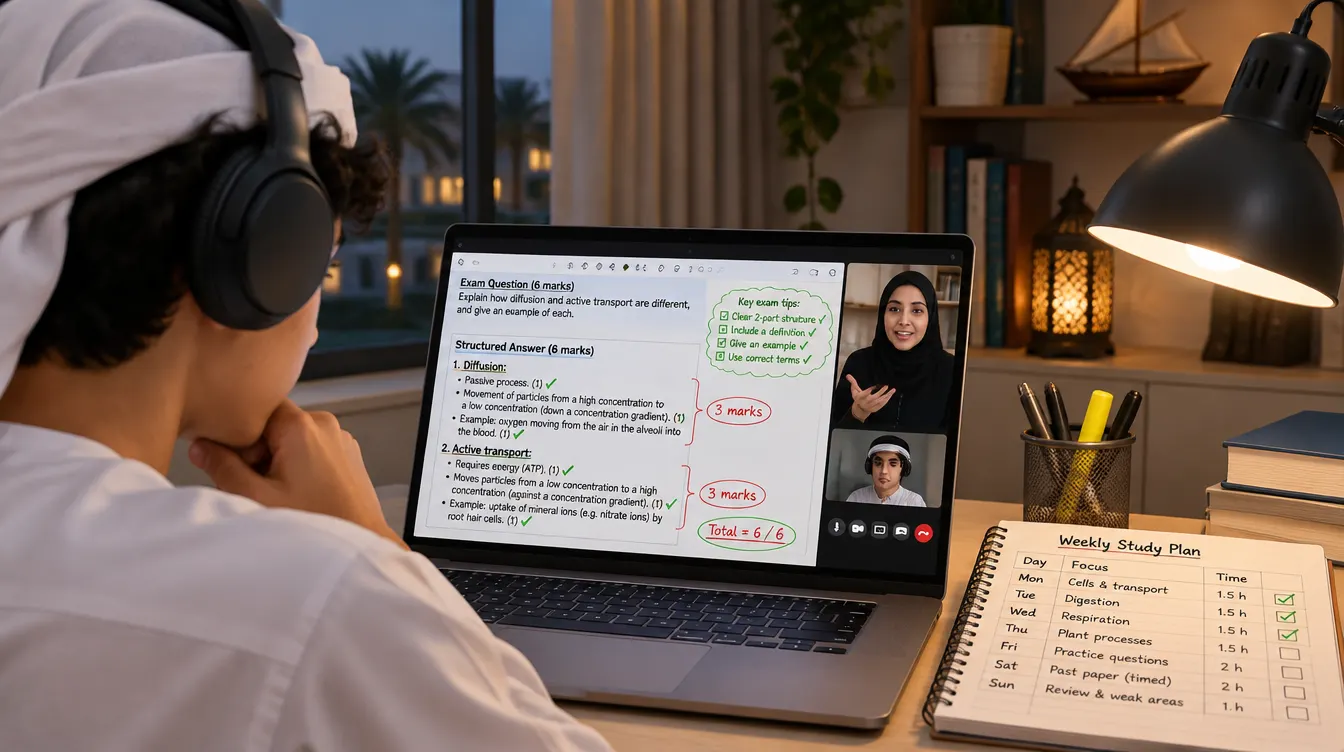
A specialist tutor can speed this up, because they know both systems and can spot a gap from one worked answer. Ustaad runs online, 1-to-1 IGCSE tutoring and maths tutoring for students across the UAE, and our tutors also teach the American curriculum, so they can see exactly what your child already knows.
Questions to ask the new school
Before you accept a place, ask:
- Which year group will my child join, and can we have that in writing?
- Which exam boards does the school use for each IGCSE or A-Level subject, Cambridge or Pearson Edexcel?
- Which topics has the class already covered this year, and is there a catch-up plan for new students?
- Will my child be placed in a maths or science set, and when is that reviewed?
- Are there subjects my child cannot start mid-course, such as a language?
Once your child has started, the first report will show how the switch is going. Our guide to reading a UAE school report card explains what to look for.
Frequently asked questions
Sources and further reading
KHDA (Dubai): Student placement guidelines for Dubai private schools.
ADEK (Abu Dhabi): British curriculum in Abu Dhabi private schools.
UAE Ministry of Education: Guide to academic certificate equivalency for private schools.
The receiving school’s admissions team confirms the year group, exam boards and catch-up support that apply to your child.
Switching to a British school this year?
A tutor who teaches both curricula can check what your child already knows, build the gap list with you and close it before the first assessments, from IGCSE Maths and the sciences to exam writing. Lessons are online and 1-to-1, and every first 1-hour lesson includes a free 15-minute orientation.
IGCSE support by city: IGCSE tutors in Dubai · IGCSE tutors in Abu Dhabi · IGCSE tutors in Al Ain
Nimra writes Ustaad's guides for UAE families on school choices, exams and study habits, turning school rules and requirements into clear next steps.
Ustaad Editorial Team. Every guide is checked for accuracy and parent clarity before it is published.