
How to Read an Examiner's Report: The Secret Document That Turns B Grades into A*s
Mark schemes tell you what the answer is. Examiner reports tell you why thousands of students lost marks on it. Here is how Cambridge, Edexcel, and IB students in the UAE can use them to stop bleeding marks.


01The document top students read (and 96% ignore)
Every August, after more than 300,000 Cambridge (CAIE) and Pearson Edexcel papers have been marked and grade boundaries set, each Principal Examiner writes an unsparing, question-by-question post-mortem. It is formally titled the Examiner Report (or Report on the Examination).
In top British and IB curriculum international schools across Dubai and Abu Dhabi, from Dubai College and JESS to Cranleigh and BSAK, academic heads of department spend whole inset days dissecting these reports line-by-line. They look for the exact trends where their cohorts slipped.
Yet among candidates themselves, fewer than four in a hundred ever download one.
Most students treat past papers like vending machines: complete questions, count up marks against the mark scheme, assume a 64% simply means "I need to revise more definitions," and immediately print another paper. As highlighted in our guide on why past papers are the final step, that repetition feels industrious, but it repeats identical cognitive mistakes across eight papers in a row.
A mark scheme only tells you what the correct answer was. The Examiner Report tells you why thousands of capable students wrote an answer they thought was right, and were awarded zero.
Senior examiners do not grade papers to catch students out, but they are legally constrained by board standardisation. When 60% of candidates write the word "equal" instead of "constant" in chemistry equilibrium, examiners cannot award discretion marks. That nuance lives exclusively in the Examiner Report.
02Mark scheme vs examiner report: the critical distinction
To understand why relying solely on mark schemes stalls grades at a B (Grade 6), compare what each document reveals about the exact same examination question:
| Feature | The Mark Scheme (MS) | The Examiner Report (ER) |
|---|---|---|
| What it shows | Accepted keywords & alternative paths. | Why candidates lost marks & common misconceptions. |
| Misconceptions | Notes "Reject [word]" without reasons. | Explains the false logic behind writing that rejected word. |
| Student Timing | Zero commentary on timing or reading habits. | Highlights which parts were skipped under time pressure. |
| Grade Jump | Helps reach Grade 5 or 6 (foundation baseline). | Bridges the gap between Grade 7 and Grade 9 (or B to A*). |
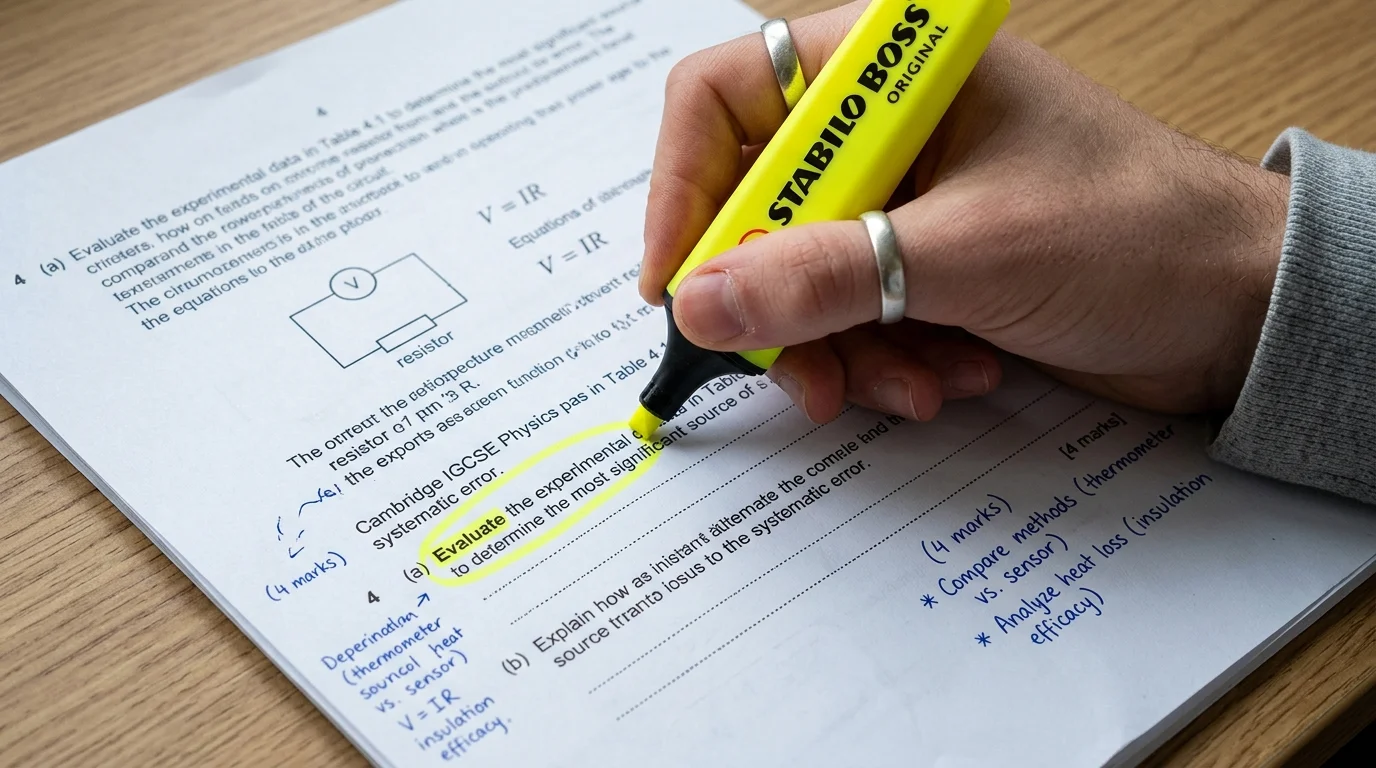
03Where to find official reports (Cambridge, Edexcel, IB)
Unlike past papers which are hosted everywhere online, Examiner Reports are occasionally harder to find because exam boards categorise them as teacher resources. Here is the exact path for each major UAE curriculum:
Cambridge Assessment International Education (CAIE for IGCSE & A-Level)
Look under Past Papers & Resources on past paper repositories (PapaCambridge, BestExamHelp, or GCE Guide). Look for files ending in _er.pdf (e.g. 0580_s24_er.pdf for Summer 2024 IGCSE Maths). CAIE produces one consolidated PDF containing reports for every paper variant (P11, P12, P21, P22, etc.).
Pearson Edexcel (IGCSE & International A-Level)
Search the Pearson qualifications portal under your subject's Specification and sample assessments, then Exam materials, and open Examiner Reports. Edexcel provides detailed question-by-question statistical graphs showing the mean score achieved on every individual question.
International Baccalaureate (IB DP & MYP)
The IB publishes official Subject Reports for May and November examination sessions. These are distributed to DP Coordinators via My IB and shared internally via ManageBac or school portals. Ask your subject teacher directly for the May 2024 and May 2025 Subject Reports.
04The 4 recurring traps Chief Examiners report every summer
Across twenty years of Examiner Reports in sciences, mathematics, humanities, and languages, four behavioural errors account for more than 60% of lost marks among otherwise well-prepared students:
The "Textbook Brain Dump"
When a question starts with "Using the data in Table 1..." or "Referring to Figure 3...", candidates write pristine textbook explanations without citing a single figure, coordinate, or trend from the provided stimulus.
Examiner verdict: "Candidates showed strong factual knowledge but failed to access Level 2 application marks."
The Casual "Explain"
Treating "Describe" and "Explain" as identical. Students accurately state what happened (e.g. "the rate decreases"), but leave out the biological or physical mechanism (e.g. "fewer successful collisions per second"). Master these distinctions in our guide to exam command words.
Examiner verdict: "Candidates described the graph shape but offered zero scientific reasons for the change."
Premature Rounding & Precision
Rounding intermediate working steps to 2 decimal places in multi-step physics and maths problems. By the final line, compounding rounding errors push the answer just outside the mark scheme's tolerance range.
Examiner verdict: "Premature rounding on line 3 cost candidates the final accuracy mark despite correct methods."
Negative Qualifier Blindness
Under exam adrenaline, the eyes glide right past negative modifiers: "Which of the following is NOT a feature..." or "Explain why this reaction does NOT proceed...". This cognitive phenomenon is part of the scaffolding trap that makes students freeze on exams.
Examiner verdict: "A significant number answered the affirmative question rather than the negative prompt."
05The 3-Pass Past Paper Protocol (Black, Green, Purple pen)
To stop burning through past papers with minimal retention, high-achieving candidates follow the 3-Pass Protocol. It transforms passive testing into deliberate diagnostic repair:
Pass 1: Timed Execution (Black Pen)
Sit the paper in exam conditions without books, phone, or music. When time expires, immediately lay down the black pen.
Pass 2: Mark Scheme Audit (Green Pen)
Mark ruthlessly. If your answer does not have the exact underlined mark-scheme keyword or allowed synonym, award zero. Calculate your baseline raw percentage.
Pass 3: Examiner Report Audit (Purple Pen)
Open the Examiner Report for that exact session. Scroll only to the questions you marked zero or partial credit in Pass 2. Read the Chief Examiner's commentary. Note down whether your mistake was a rare slip or one of the cohort's recurring traps.

06Attachment 01: Past Paper Error-Log & Audit Sheet (PDF)
Use the official Ustaad Past Paper Error-Log & Examiner Audit Sheet after every timed past paper to classify lost marks into the four examiner audit categories, identify your cognitive error patterns, and formulate one strict rule for your next paper.
Past Paper Error-Log & Examiner Audit Sheet
1-Page Printable A4 Vector PDF · Cambridge, Pearson Edexcel & IB
07Turning examiner critiques into high-yield flashcards
Once you identify a recurring misconception from the Examiner Report, do not leave it on the paper. The fastest way to lock in the correction is to write a Two-Sided Examiner Flashcard (in Anki, Quizlet, or on index cards):
Front: What do candidates regularly confuse about longitudinal sound waves?
Front: What is the single word missing that stops evaluation marks in an 8-mark question?
08How 1-to-1 mentorship fixes script habits before exam day
Auditing an examiner report on your own requires high metacognition. Teenagers revising alone often justify their mistakes: "I knew what I meant," or "The examiner was being too harsh."
That rationalisation is dangerous because the real examiner in June will be just as unforgiving.
This is where experienced private mentorship creates disproportionate gains. When an Ustaad tutor sits with an IGCSE or A-Level student in Dubai or Abu Dhabi, they don't simply reteach a syllabus chapter from scratch. They review the student's actual handwritten past papers, annotate the script with board-specific criteria, and run targeted 5-minute drills until full credit is earned on demand. Explore our dedicated exam preparation tutoring to target script gaps early.

Is your child losing marks to content gaps, or examiner traps?
In the first lesson, an Ustaad curriculum specialist audits your child's recent exam scripts, identifies which of the 4 examiner traps are draining grades, and builds an exact board-matched recovery plan. Every first lesson includes a free 15-minute orientation.
09Frequently asked questions

Written by Nimra Shahzada
Nimra writes about the study problems UAE parents and students experience at home: children who revise diligently for hours but still lose marks, exam timing panic, and bridging the gap between textbook understanding and exam-board mark schemes.