


A student has the equation y = 2x + 12 in front of them. I ask what c is. "Twelve," they say, straight away, no hesitation.
"Twelve what?"
Nobody answers.
This happens in almost every class I teach, at every level. Students learn to find the intercept long before they learn to say what it means, and the two skills get marked very differently. One earns a method mark. The other earns an interpretation mark, and that is the one most students give away for free.
This article covers what the intercept means, how to write that meaning so it earns the mark, and, just as important, when it does not mean anything at all.
The intercept is the starting value
The y-intercept is the value of y when x is 0. It is whatever you have before anything changes: before any time passes, before any distance is travelled, before any input is added.
In y = 2x + 12, the intercept is 12. That is the point (0, 12), where the line crosses the y-axis.
The other number in the equation, the gradient, tells you how fast that starting value changes. If you want a fuller explanation of what the gradient means, I have written about that separately, so I will not repeat it here.
Figure 1: The line crosses the y-axis exactly at (0, 12). The intercept is 12 (the value of y before x begins to increase).
A UAE example: the taxi meter
Say a taxi charges AED 12 just to start the meter, then AED 2 for every kilometre after that. (These are illustrative figures for this example, not a quote from any real fare table; actual rates change and usually include a minimum fare, so do not use these numbers to estimate a real trip.)
The equation for the fare looks like this:
fare = 2 × distance + 12
The intercept, 12, is what you pay before the car has moved a single metre. The gradient, 2, is the price of each extra kilometre.
Try it for a 10 km trip: 2 × 10 + 12 = AED 32.
That is the whole idea. The intercept is the fixed part. The gradient is the part that grows.
UAE Taxi Meter Equation Simulator
fare = 2 × distance + 12Drag the slider to 0 km. Notice that even before the taxi moves, the meter already displays AED 12. That is the y-intercept.

How to write it for the marks
Exam questions often ask what the intercept represents, and this is where students lose marks even when they have found the right number.
"The intercept is 12."
Correct number, but zero context or units. Loses the interpretation mark.
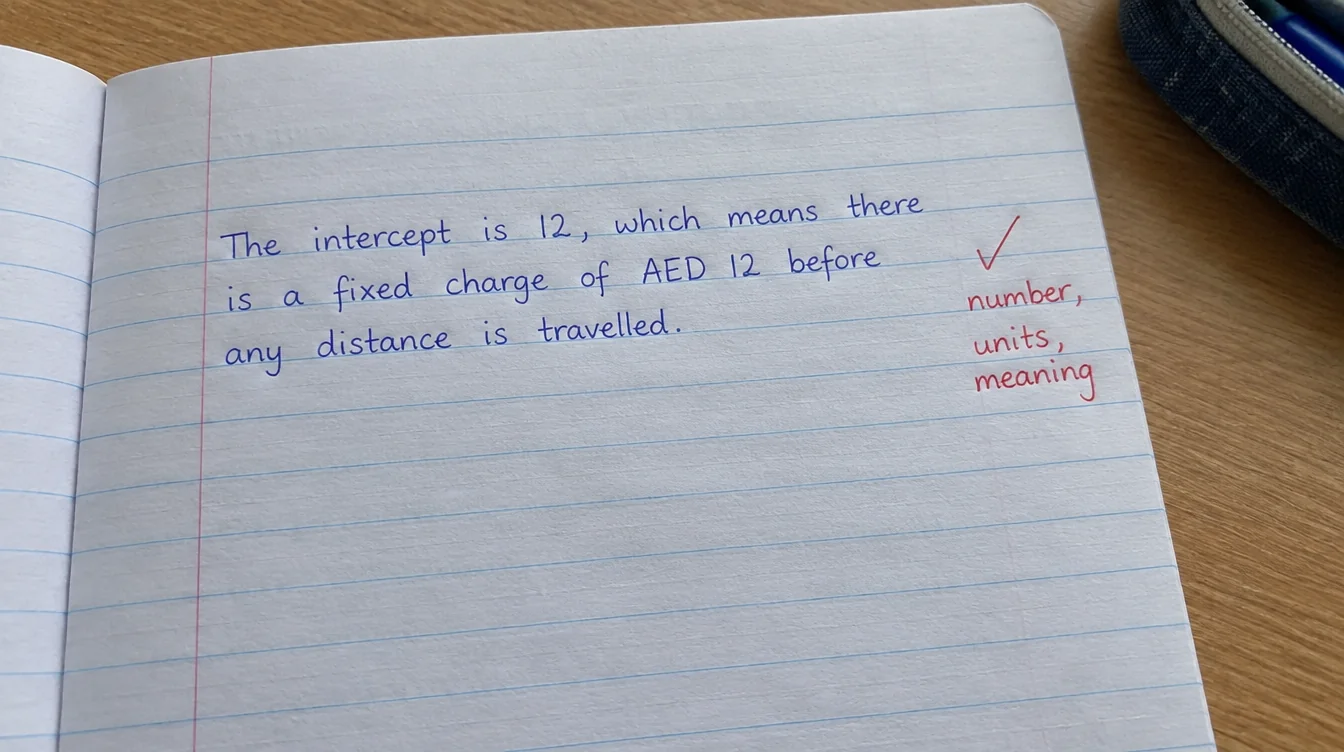
"The intercept is 12, which means there is a fixed charge of AED 12 before any distance is travelled."
Includes the numerical value, the real-world units, and context at x = 0.
The weak answer is correct and worth almost nothing. The full answer earns the mark because it has three things in it:
Train yourself to hit all three every time you are asked to interpret an intercept. It is the same habit I describe for reading exam questions properly in my colleague's piece on command words, where the question is telling you exactly what kind of answer it wants, and "interpret" or "what does this represent" wants all three parts, not just the number.
For students preparing for Cambridge or Edexcel papers, Ustaad's 1-to-1 maths tutoring specifically drills these precision interpretation marks across algebra, coordinate geometry, and statistics.
When the intercept means something
Take this example: test score = 8 × hours of revision + 35.
The intercept, 35, is the score a student would be expected to get with zero hours of revision.
This one makes sense, because zero hours of revision is a real, possible situation. A student could genuinely do no revision at all. The intercept sits inside a situation that could actually happen, so it is worth interpreting.
The test to apply here: is x = 0 a real situation, and is it inside the range the data actually covers? If yes, the intercept means something and you should say what.
When the intercept means nothing
This is the part most revision skips, and it is usually where the better marks are hiding.
Example A: height and age.
Say a line of best fit, built from students aged 11 to 16, gives:
height = 5 × age + 90 (height in cm)At age 0, this line says a baby is 90 cm tall. A newborn is about 50 cm. The line is simply wrong there, because it was never built from babies. It was built from 11 to 16 year olds, and it only describes that range safely.

Example B: ice cream sales and temperature.
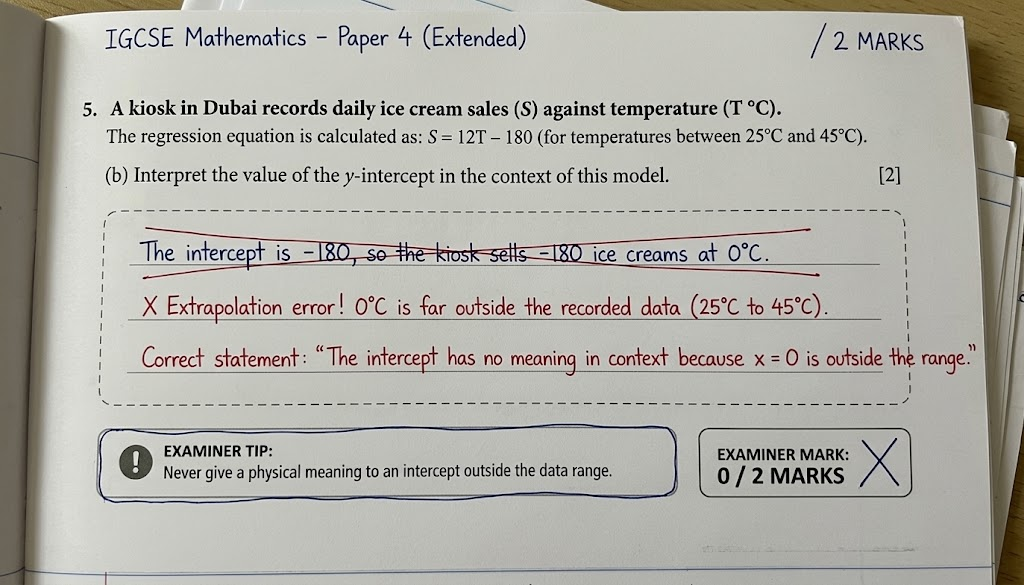
For days between 25°C and 45°C, suppose: sales = 12 × temperature − 180.
At 0°C, the line says sales = −180 ice creams. You cannot sell a negative number of ice creams. The model breaks down completely outside the temperatures it was built from.

Figure 2: The line predicts a 90 cm newborn because it is extrapolated back to x = 0. The intercept has no physical meaning because x = 0 is far outside the measured dataset.
There is a name for this. Reading a line within the range of the data you have is called interpolation. Reading it beyond that range, the way we just did at age 0 and at 0°C, is called extrapolation, and it is exactly where these intercepts fall apart.
"The intercept has no meaning here because x = 0 is outside the range of the data."
That is it. You do not need to explain why the number is wrong in detail. You need to say clearly that it falls outside the data the line was built from.
What changes at A-Level
In statistics, a regression line's intercept often exists only to make the line fit the data correctly; it is not meant to represent anything real on its own. At A-Level, you are expected to say explicitly whether interpreting the intercept is sensible in context, and to avoid extrapolating beyond the range of the data used to calculate the line.
Spot the error
Here is a student's answer to the ice cream question from section 05:
"The intercept is −180, so the shop sells −180 ice creams at 0°C."
Before clicking below, think: what crucial error did this student make in their interpretation?
One habit before the exam
Before you write anything about c, ask yourself one question:
"Is x = 0 inside my data, and is it a real situation?"
State the number, the units, and what it means in context at starting conditions.
Say it is outside the range of the data (extrapolation), and leave it there.
Practise this habit on real past papers before sitting your final exams. If you are building a structured revision timetable, see our guide on IGCSE preparation and why past papers are the final step to make sure foundational concepts are solidified first.
Can your child explain every number on the graph?
In a free 30-minute trial, Fahad Khan works through a real-life graph question with your child and shows where the interpretation marks are being missed. Lessons are online and 1-to-1, for families in every emirate.
Frequently Asked Questions
Maths Tutor, IGCSE, GCSE & A-Level
10+ years of teaching experience, BS Mathematics & B.Ed, specialising in Cambridge and Edexcel Maths from IGCSE through A-Level. Focuses on mark-scheme accuracy, algebra confidence, and calm exam technique for UAE students.
Educational Validity & Curriculum Accuracy
Every guide is checked for accuracy, educational validity and parent clarity before it is published. Verified against current Cambridge 0580 and Edexcel 4MA1 coordinate geometry syllabuses.
Meet the writers and reviewers behind Ustaad UAE on our editorial page.