
The One Word in Every Exam Question That Decides Your Marks
Your child knows the content but loses marks anyway. The reason is usually command words. Here is how to read them and answer exactly what the examiner wants.



Here is something that happens in exam halls across the UAE every single session. A student reads a question, recognises the topic, feels a wave of relief, and writes down everything they know about it. Three neat paragraphs. Then the paper comes back and the six-mark question scored two.
The student is upset, and understandably so. They knew the material. They wrote a lot. So where did the marks go?
Almost always, the answer is a single word near the start of the question that the student read straight past. Describe. Explain. Compare. Evaluate. State. These are called command words, and they are the exam telling you, in plain language, exactly what kind of answer will earn the marks. Miss the command word and you can write a page of correct facts and still lose most of the marks, because you answered a question the examiner did not ask.
As examiners, this is the single most common way we see capable students throw marks away. The good news is that it is also one of the fastest things to fix. You do not need to learn more content. You need to learn to read six or seven words properly.
Quick answers before you read
The verb in a question that tells you what to do: describe, explain, compare, evaluate, and so on.
The mark scheme rewards a specific type of answer for each command word. The wrong type scores low even when the facts are right.
Confusing 'describe' with 'explain' is the classic. One wants what happens, the other wants why.
Train your child to circle the command word before writing anything, and to know what each one demands.
Yes. It is content they already have, unlocked by better reading. Marks can move within weeks.
What a command word actually is
Every exam question is really two parts joined together. There is the topic, which is what the question is about, and there is the command word, which is what the question wants you to do with that topic.
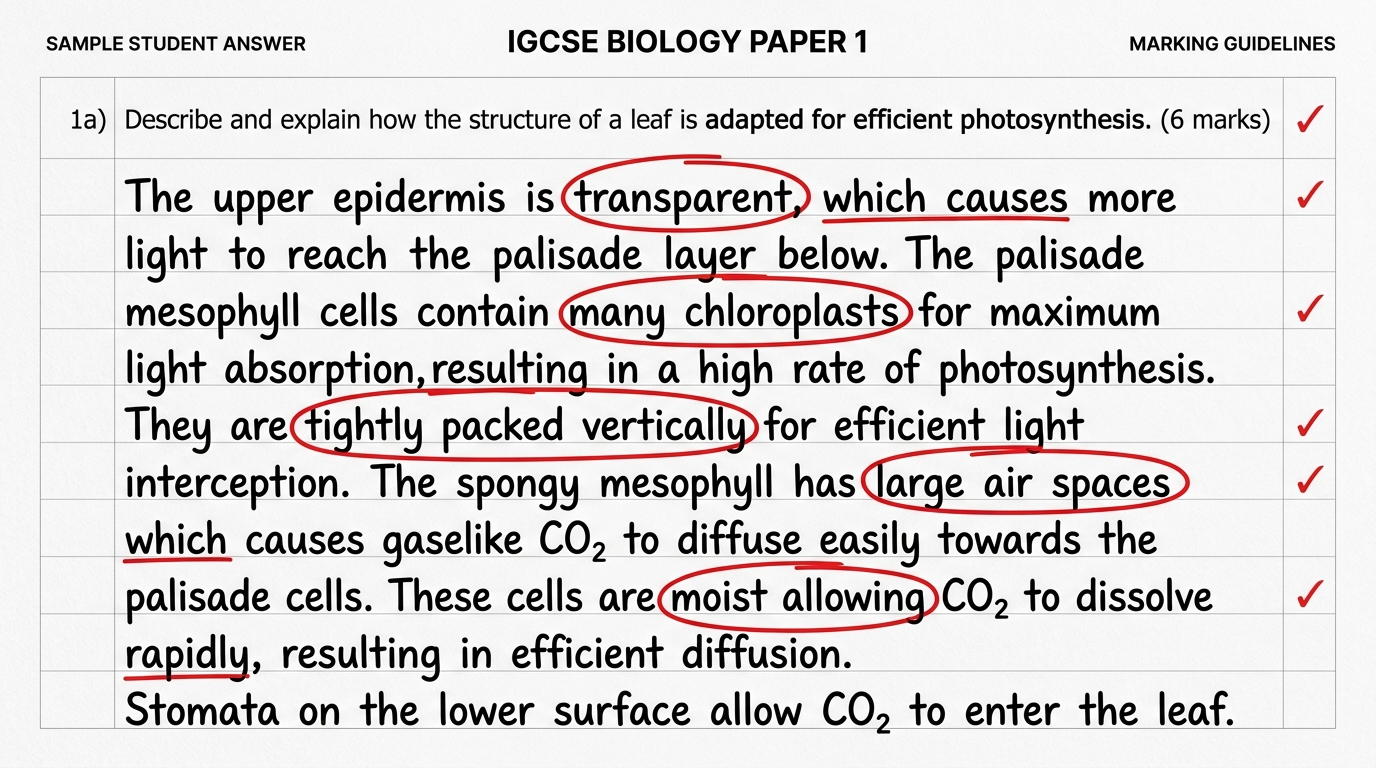
Take a question like: "Explain why a plant wilts when it is not watered." The topic is plant water loss. The command word is explain. A student who knows about osmosis and turgor pressure has the topic covered. But if they only describe what happens, the leaves droop, the stem bends, they have not explained why, and the marks for reasoning are gone.
The mark scheme is built around the command word, not around how much you know. For an explain question, the marks are sitting behind the words because and therefore and this causes. For a describe question, they are sitting behind what you observe. Same topic, completely different answer, and the command word is the only thing telling you which one to give.
A question is a topic plus a command word. Most students read the topic and skip the command word. The marks live in the command word.
The command words that cost the most marks
Some command words are close cousins, and the small difference between them is exactly where students slip. These are the ones we see cost the most marks, session after session.
Describe versus explain
This is the big one, and it appears in almost every subject. Describe asks for what happens. Explain asks for why it happens. They look similar and they are not.
| "Describe" wants | "Explain" wants |
|---|---|
| What you see or what occurs | The reason it occurs |
| The graph rises then levels off | The rate slows because the substrate runs out |
| Facts, observations, steps | Causes, mechanisms, because and therefore |
| No reasoning needed | Reasoning is the whole point |
A quick test your child can use in the hall: if they can answer without ever writing the word because, the question was probably describe. If the answer only makes sense with a because in it, the question was explain and every sentence should be building toward that reason.
State and give versus explain
State and give are asking for a short, direct answer. A fact, a name, a number. No sentence needed, no reasoning, no padding. Students often over-write these, spending three minutes and a paragraph on a question that wanted four words. That wastes time they will need later in the paper. If the command word is state, one line is the correct length.
Compare, Evaluate and Discuss
Compare is a trap for a specific reason. It asks for similarities and differences between two things, in the same sentence. A student who writes a paragraph about the first thing, then a separate paragraph about the second, has not compared them, they have described two things side by side. The mark scheme wants linked statements: "A is faster than B, whereas B is more accurate." The words whereas, both, and in contrast are what earn the marks here.
Evaluate and discuss appear more at A-Level and carry the most marks per question. They ask for a two-sided answer and a judgement. Arguments for, arguments against, then a conclusion that actually decides something. A student who argues only one side, however well, has answered half the question. The marks at the top of the scheme are reserved for the student who weighs both sides and then commits to a view.
Describe wants what, explain wants why, compare wants linked differences, evaluate wants both sides plus a verdict. Knowing which is which is worth more than knowing extra content.
How the mark scheme really reads a command word
Parents rarely see a mark scheme, so this part is worth understanding. When we mark, we are not rewarding effort or the amount written. We are matching what the student wrote against a list of specific points the command word requires.
On an explain question worth four marks, the scheme usually lists four reasoning points. A student earns a mark each time they hit one, and writing three descriptive sentences that never reach a reason earns nothing, no matter how neat or long they are. This is why a student can fill the space, feel they did well, and still score low. They wrote plenty. They just did not write the type of thing the command word was pointing at.
It also explains a comment parents hear a lot: "my child understands it, they just do not show it in exams." Often the understanding is genuinely there. What is missing is the habit of aiming the answer at the command word so the understanding actually lands on the mark scheme. We wrote about that gap more fully in Your Child Understands Physics. So Why Are the Marks Still Low?, and command words are one of the biggest reasons it happens.
The five-second habit that fixes it
The fix is almost embarrassingly simple, which is why it works. Before writing a single word of an answer, your child does three things.
Circle the command word.
Physically circle it on the paper. This one action stops the brain from racing straight into brain-dumping everything it knows.
Say what it wants.
In their head: this says explain, so I need reasons, not just what happens.
Check the marks.
A four-mark question wants roughly four points. That number tells them how much to write, so they do not under-answer or waste time over-answering.
Three seconds each, before every question. It feels almost too small to matter, and it routinely moves a grade, because the content was never the problem. The aim was.

How parents can practise this at home
You do not need to know the subject to help with this. Command words are the same across biology, history and economics, so you can drill them without understanding the topic at all.
- Take any past paper: Go through it together and just circle the command word in every question. Do not answer them. The circling is the skill.
- Ask what each command word wants: Ask your child what each command word wants before they attempt the answer. If they can say "describe wants what happens," they are already ahead of most of the hall.
- Verify against the mark scheme: When they mark their own work against the mark scheme, ask one question: did the answer match the command word? Lost marks are very often a command-word mismatch, not a knowledge gap.
If you have not started working with past papers yet, our guide to why past papers are the final step, not the first, explains how to sequence them so command-word practice fits in at the right stage.
A quick reference for the common command words
Keep this near your child's desk. It covers the command words that appear most often across IGCSE and A-Level papers.
| Command word | What it wants | The mark is in |
|---|---|---|
| State / Give | A short, direct fact | One correct line, nothing more |
| Describe | What happens or what you observe | Accurate observations and steps |
| Explain | Why it happens | Reasons: because, therefore, this causes |
| Compare | Similarities and differences, linked | whereas, both, in contrast |
| Calculate | A numerical answer with working | Correct method shown, then the value |
| Suggest | A sensible idea for an unfamiliar case | Applying what you know to a new situation |
| Evaluate / Discuss | Both sides, then a judgement | For, against, and a clear conclusion |
Bringing it together
Command words are the quietest reason capable students underperform, and one of the easiest to fix. There is no new content to learn. There is just a word in every question that has been telling the student what to do all along, and a habit of reading it before the pen moves.
A student who circles the command word, knows what it demands, and aims every sentence at it, will pull marks out of knowledge they already had. That is the fastest kind of improvement there is, and it starts with a past paper and a pen this evening, not with more revision.
If your child is writing plenty and scoring less than they should, do not add more content. Watch how they read the question first. The marks are usually hiding in that one word they keep reading past.
Find out where your child's marks are really going
A short diagnostic session with an Ustaad tutor puts your child through a timed question, then marks it against the real mark scheme and shows you exactly where the marks were lost. Very often it is command-word mismatches, not gaps in knowledge, which means the fix is quick. No teaching on the first day, just a clear picture of where the marks are leaking.
We match students across the UAE with tutors who are active examiners and know their exact board and tier, in Dubai, Abu Dhabi, Sharjah and every emirate, in person or online. If you have never worked with a tutor before, our guide to ten honest questions to ask first will help you judge the fit.
Frequently asked questions
About the writers
This guide comes from the people who teach and mark for Ustaad families every week, not an anonymous marketing desk. Nimra Shahzada writes our parent-facing guides on learning and the psychology of studying, and Nida Iqbal, who holds an MPhil in Education Leadership and Management, reviews them for accuracy. You can see who reviews Ustaad's academic content and how we keep it trustworthy.

Author of Ustaad guides on study habits, cognition, and student exam performance across UAE schools.
Reviews curriculum accuracy and pedagogical standards across Ustaad's academic publication board.
Your Child Understands Physics. So Why Are the Marks Still Low?
The gap between understanding and exam marks: mark scheme alignment, working memory overload, and calculation precision.
Academic & Exam SkillsIGCSE Preparation: Why Past Papers Are the Final Step, Not the First
How to sequence topic learning and command word mastery before taking on full timed past papers.
Parent Guidance10 Honest Questions to Ask Before You Hire a Private Tutor in Abu Dhabi
How to evaluate whether a tutor actively teaches command-word strategy and examiner techniques.